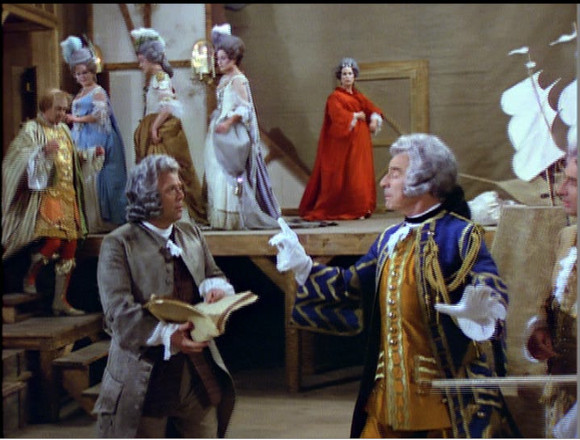
The Play of Daniel (Danielis ludus) is a 12th or 13th century Latin liturgical play from Beauvais in nothern France. It appears in the liturgy for January 1st, The Feast of the Circumcision, and appears to have been an attempt to channel the traditional post Christmas disorder into more acceptable channels. It was probably performed by the sub deacons of the Cathedral; young men in minor orders. Alex and David Fallis have run with this setting and tried to create a piece that would evoke the same sort of reactions from a 21st century audience as the original did for those who saw it in Beauvais. That’s a huge ask but, to my mind, they succeeded admirably.
Tag Archives: strauss
Ariadne goes to war
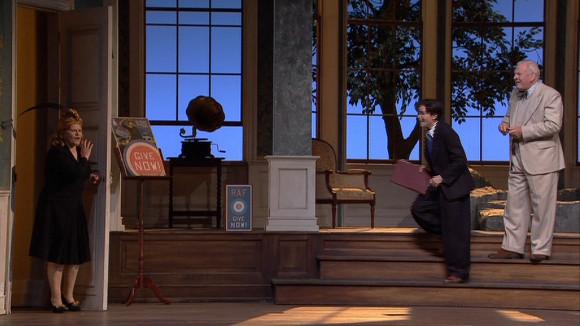
Katherina Thoma not unreasonably chooses to set her 2013 Glyndebourne production of Ariadne auf Naxos in a country house in the south of England (though I suppose equating the Christies with a rather boorish Viennese bourgeois might be thought a touch unkind). She also chooses to set it in 1940 which sets us up for an almost Marxian dialectic not just between high art and low art but between art and life; especially where life and death are concerned.
Mild und Leise… occasionally
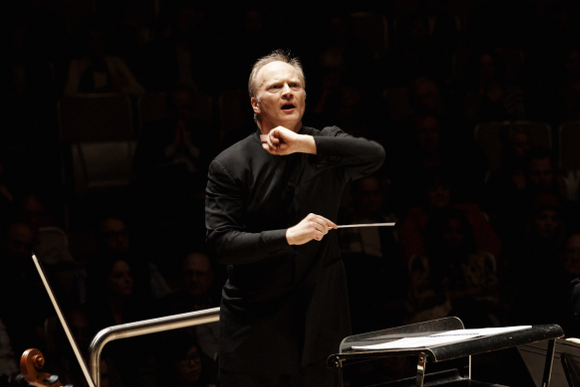
The TSO’s program last night was too tempting to miss; Adrianne Pieczonka singing Strauss and Wagner and a Beethoven 7th plus Gianandrea Noseda conducting. So I went.
Things started off with Casella’s Italia. This is a sort of mash up of Pucciniesque bombast and Neapolitan popular tunes. I’m surprised it never featured in a Warner Bros cartoon. Perhaps it did. In any event Nosada is probably the ideal conductor for it; infusing it with a kind of manic energy. Next up were the Strauss Vier letzte lieder. Here manic energy is exactly what’s not needed and Nosada seemed to have some difficulty adjusting. Too often Adrianne Pieczonka’s beautiful singing was covered by an over loud orchestra. Roy Thomson Hall is tricky but George Benjamin showed exactly how to manage the acoustic last weekend. Nosada wasn’t so successful.
Intermezzo
It has been said that the best music in Richard Strauss’ Intermezzo is in the orchestral interludes that link the various scenes. It’s probably true and certainly the singers don’t get much interesting to sing with the best music given to the orchestra even during the scenes. That said, all of the music is vastly better than the truly cringe-worthy libretto, also by Strauss. It’s in prose, much of it is spoken and there are odd interjections of more vernacular German for the servants, rather in the manner of the random cockney in ancient Ealing films. The plot is based on an, aaparently real life, episode in the married life of the Strausses, here thinly disguised as the Storches, in which Frau Storch gets the wrong end of the stick about suspected infidelity by her husband and threatens divorce. If Frau Strauss ever saw the piece, which is apparently unlikely, she might reasonably have seen the portrayal of herself by her husband as much sounder grounds for dumping him. Christine Storch is the sort of woman one wants to tie up in a sack and drown!
So wondrous sweet and fair!
On a bright, sunny winter’s day there are few more inviting places to be than the Richard Bradshaw Amphitheatre positively glowing in the sunlight. When one’s reason for being there is a recital by Jane Archibald with the redoubtable Liz Upchurch at the piano one feels doubly blessed. It was one of the best performances of the many I have attended in that space.
Continue reading
Gruberova’s Zerbinetta
A chance to see the young Edita Gruberova’s near legendary portrayal of Zerbinetta would be reason enough to watch the 1978 Vienna recording of Ariadne auf Naxos but, as it happens, there’s much more. For a start the cast includes Gundula Janowitz, Walter Berry, René Kollo and Trudeliese Schmidt plus Karl Böhm, a man who worked closely with Strauss, is conducting.
Dense and dramatic Ariadne
Claus Guth’s 2006 production of Ariadne auf Naxos recorded at the Opernhaus Zürich in 2006 is a compelling piece of theatre. It’s one of those Regietheater pieces that combines a workable concept with compelling Personenregie to create a whole that’s extremely illuminating. The entire Vorspiel is played out, in modern dress, in front of a grey curtain. We get an immediate idea of how Guth is going to explore/exploit metatheatricality as soon as the Haushofmeister appears. He’s played by none other than Zürich Intendant Alexander Pereira. Who is calling the shots? This is reinforced when he drops the bombshell that the opera seria must be combined with Zerbinetta’s farce. This speech is delivered by Pereira from among his guests in the Intendant’s box. It’s very clever. But there’s so much more going on during the Vorspiel. The Komponist is getting seriously deranged; perhaps even more so after he begins his infatuation with Zerbinetta. There’s a moment when it looks like a love triangle is being set up. The diva just gives one look that suggests that she’s got her eyes on the Komponist. It’s a typical moment. A look, a gesture, seems to convey so much. It all concludes with the deranged Komponist shooting himself.
Roots
I was talking to Leslie Barcza of barczablog at a concert yesterday. He asked me what I was most looking forward to in the upcoming season and I was a bit stumped for an answer because there’s lots of good stuff in Toronto this season but nothing that really sets my pulse racing. Finally I answered with the TSO’s Dream of Gerontius, which, it turns out, is not exactly high on Lesley’s bucket list. This led to a brief discussion about how origins affect our reactions; that is until the actual concert interrupted our talk.
Historic Ariadne
Opera videos of performances before 1980 are quite rare and are mostly films. Recordings of live performances are extremely uncommon and often quite interesting. A couple have just been rereleased on DVD. The one reviewed here is an Ariadne auf Naxos from the 1965 Salzburg Festival (the other is a recording, in German, of Don Giovanni with Fischer-Dieskau – watch this space). It’s an old ORF TV broadcast with a grainy 4:3 black and white picture and less than stellar mono sound but it does provide an idea of what audiences saw and heard fifty years ago.
Natalie Dessay showcase
Le miracle d’une voix is a compilation of scenes from various recordings in which Natalie Dessay featured made between 1993 and 2003. It’s especially interesting in that a couple of pieces feature more than once. There are three Les oiseaux dans les charmilles; Olymia’s aria from Les contes d’Hoffmann and two Grossmächtigen Prinzessin from Ariadne auf Naxos. Thrse demonstarte what I have always believed to be Dessay’s greatest strength; her ability to recreate a character to fit in a particular production. The two Zerbunetta arias illustrate this perfectly. In the first, a Salzburg production from 2001, Zerbinetta is a depressed, heavy drinking, prostitute who celebrates a kind of deeply sad sisterhood with Ariadne before being dragged off by a very sleazy Russell Braun. In the second, from the Palais Garnier in 2003, she’s a bubble headed tourist in bikini and wrap who pesters poor Ariadne all around what looks like a Mediterranean building site. They are completely different characterisations but both highly effective. The same is true of the three Olympias who range from very conventional doll to inmate in some sort of asylum or home.