An anti-Valentine

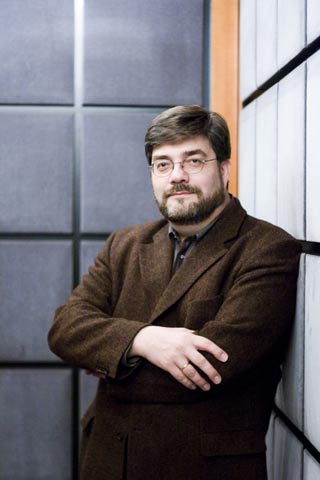
selig_franz_josefToday’s lunchtime recital in the Richard Bradshaw Amphitheatre was a recital of Schubert and Strauss songs on the theme “Love’s Dark Shore”.  The performers were German bass Franz-Josef Selig, in town singing King Marke in Tristan und Isolde, and the COC’s own Rachel Andrist at the piano.  There wasn’t much about “Love” in the pieces chosen but there was plenty of death, depression and despair.  One might think it would be a complete downer but nobody could possibly be depressed witnessing the artistry of Selig.

Those who have heard Selig in Tristan know that he has a massive voice.  It was fascinating to hear him turn it to lieder.  He is a very German lieder singer in the best possible way.  He enunciates with great clarity and gets full value out of the meaning of every phrase.  He clearly loves the texts.  He also manages his huge voice wonderfully.  Mostly he sang quite quietly with beautiful legato and perfect control but when he wanted volume it was there in abundance and without strain.  He also has a real range of tone colour and sheer beauty of tone.  Often he sounded more like a baritone than a bass but he could get almost tectonically low when he needed to.  It was very impressive.  Rachel’s accompaniment was perfectly fine too though I think most of the audience was focussed on the voice.

I did hear a few grumbles about the unrelieved darkness of the material but I felt the works suited the singer and it was, as these things are, a fairly short programme so the lack of variety didn’t really bother me.  All in all, a very worthwhile way to spend one’s lunch break.

Sister swap

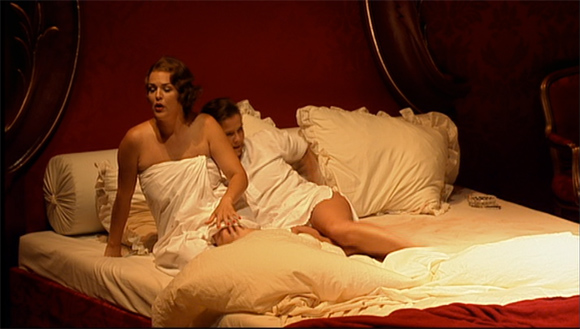
Richard Strauss’ Arabella is a bit of a peculiarity.  The music is top notch Strauss and the libretto is by von Hofmannsthal so it ought to be quite superb.  It doesn’t quite get there though.  It’s hard not to think that if von Hofmannsthal had lived a little longer he would have tightened up the libretto.  Act 1 works fine but Acts 2 and 3 seem rather contrived and could definitely use a few cuts.  I’m not sure that the whole Fiakermilli thing works either.  It’s almost as if Prince Orlofsky’s party mislaid Johann and found Richard by accident.  That said there is some very beautiful music.  Aber der Richtige, wenn’s einem gibt is going straight onto my list of top soprano duets.

1.zdenka_matteo Continue reading

Full of sound and Furies

When I first encountered Richard Strauss’ Elektra as a teenager I found the music almost unbearably harsh.  The more I listen to it the more erroneous that judgement seems.  It has its “tough” moments to be sure.  How could an opera about Elektra not?  But it is also full of lush romanticism and there are some really quite lovely passages.  In the 2010 Salzburg Festival recording Daniele Gatti explores both sides of the music in a rather thrilling reading of the score aided and abetted by the Wiener Philharmoniker and a pretty much ideal cast.

set Continue reading

We’ll meet again in a better world

Richard Strauss’ last opera Die Liebe der Danae has a pretty chequered production history.  It was scheduled to premiere at the 1944 Salzburg Festival but that was scuppered when all theatres were closed following the July bomb plot.  A special exception was made for Die Liebe der Danae in that a single, public dress rehearsal was allowed at the conclusion of which Strauss is said to have bid farewell to the Wiener Philharmoniker with the words quoted in the title.  It then remained unperformed until the 1952 festival where it got its true premier followed by productions over the next two years in most major European houses.  After that it pretty much dropped out of the repertoire with occasional performances in Germany but apparently the production recorded at the Deutsche Oper Berlin in 2011 is only the sixteenth production all told.  It’s a bit hard to see why it has been so neglected.  The music is perfectly good Strauss though maybe it lacks a headline aria of the “Es gibt ein Reich” variety.  Maybe the subject matter was just too frivolous for the immediately post-war world; it’s described as “A Joyful Mythology in Three Acts”.  In any event, I was happy to discover it.

Continue reading

Time is a funny thing

A series of blog posts discussing time, perceptions of time and historically informed performance (HIP) plus seeing Opera Atelier’s Der Freischütz got me thinking along some curiously convergent lines and arriving at the conclusion that HIP isn’t and can’t be what it is often purported to be; a fairly faithful attempt to reproduce a work as it would have been seen by its first viewers or “as the composer intended” or something like that.  Not, of course, that even if it was, we would see and hear it as the original audience did but that perhaps is a topic for another day.

Continue reading

Rosenkavalier on the brink

Robert Carsen’s 2004 production of Der Rosenkavalier at the Salzburg Festival was apparently enormously controversial at the time.  In many ways that says more about the iconic status of the piece in Salzburg tradition than about Carsen’s production.  There are a few controversial elements.  He has updated the period to 1914 and the third act is set in a brothel with a fair amount of nudity.  Beyond that, the production is pretty faithful to the libretto and has, I think characteristic Carsen touches like long lines of tables and chairs and a certain geometric elegance.  He seems to be using the sides of the stage to comment on the action which tends to be fixed centre stage.  I say seems because the video direction (by Brian Large) is utterly perverse and makes it extraordinarily difficult to see what Carsen is doing, let alone decode it.  We see the whole stage, maybe, for three seconds in the whole piece.  Otherwise 99% of what we get is either close up and even closer up or apparently shot from the restricted view seats high up and close to the side of the stage.  The other 1% is just plain nuts and includes a section of the Sophie/Octavian duet in Act 2 where, on stage, Octavian is maybe twenty feet to Sophie’s right but on camera he’s standing right up close on her left hand side.  I could go on but I won’t.  Suffice it to say the video direction comes close to wrecking an otherwise excellent DVD.

Continue reading

Kušej’s Elektra

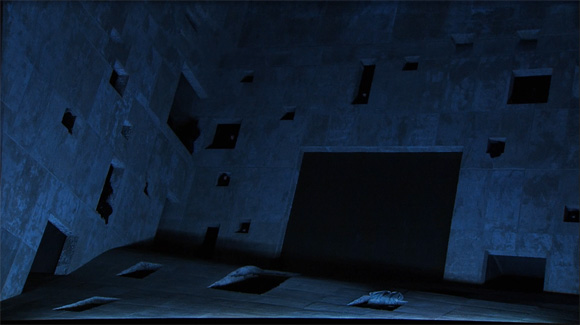
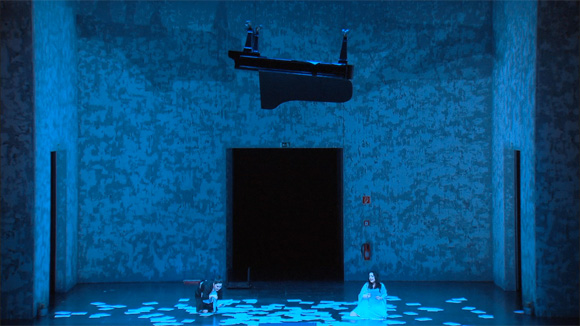
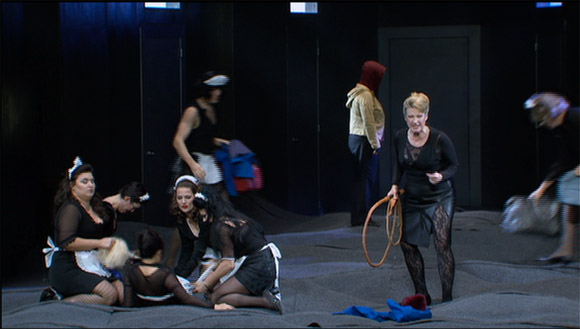
I don’t think Richard Strauss’ Elektra is an easy opera to stage.  The story is straightforward and really well known and the opera is constructed largely as a series of dialogues so designing visual and dramatic elements that enhance the drama is a real challenge.  In his 2005 production for the Opernhaus Zürich Martin Kušej tries hard to do so but rather comes up short.  Fortunately his detailed direction of the singers is effective and pretty much makes up for the “Kušej bingo card” elements of the production.

Continue reading

Birgit Nilsson’s Elektra

I grew up with the Solti Ring and Nilsson’s Immolation Scene still makes the hair on my neck bristle.  The 1980 video recording of her performance in the title role of Strauss’ Elektra at the Metropolitan Opera really doesn’t have the same effect.  The voice is accurate enough, there’s still a lot of power and the vocal acting is good but somehow the voice seems to have hollowed out and to lack resonance.  Admittedly she’s not helped by the recording which seems to favour the orchestra over the voices fairly consistently.  The other sopranos suffer from the acoustic/recording too but come off better and if Leonie Rysanek really had a high fever it’s not obvious.  Mignon Dunn’s Clytemnestra is also well sung.  The orchestra plays wonderfully for James Levine and gets much better treatment from the sound engineers. Continue reading

Kathleen Battle steals the show again

In this next episode of our wallow in Met nostalgia we  are looking at the 1988 production of Richard Strauss’ Ariadne auf Naxos.  It’s a starry affair with James Levine conducting, Jessye Norman in the title role, James King as Bacchus, Kathleen Battle as Zerbinetta and Tatiana Troyanos as the Komponist.  There’s even a bit of luxury casting in the minor roles with Barbara Bonney and Dawn Upshaw among the nymphs.  It’s also as old fashioned as one could possibly imagine, being a revival of a production that premiered in 1962. Continue reading

Farewell Ileana

Ileana at the Stella Maris competition

It’s that time of year again. With a few months left in the opera season in Toronto today saw the first “farewell” concert by a departing member of the COC Ensemble Studio. It was a solo recital by dramatic soprano Ileana Montalbetti, quite possibly the best sounding thing ever to come out of Saskatoon. Ileana is the only full on dramatic soprano I’ve seen in the few years I’ve been following the Ensemble Studio and, as ES boss Liz Upchurch pointed out, they are rare so it’s always interesting to see another one come along. Fair to say too, I think, that it’s not the voice type that is treated most kindly by a piano recital in a fairly intimate space. That said, it was a very enjoyable performance.

Ileana kicked off with O Sachs! Mein Freund! from Die Meistersinger. Any reservations I have about dramatic sopranos and piano recitals come redoubled in spades where “big” opera arias are concerned. The kind of volume and tone needed to sing against a large orchestra in a big theatre tends not to sound too lovely when throttled back with only a piano for support and, honestly, I don’t think this piece was a great idea.

Things improved enormously in the next section though. This was the song cycle Ekho Poeta; Pushkin texts set by Benjamin Britten and written for the Rostropoviches. It’s a rarity; a Britten song cycle I don’t recall hearing before, and it’s very good. It was a much better vehicle for Ileana who displayed plenty of power, well controlled vibrato and pleasing and varied tone colours especially in the middle register. Her high end was much sweeter here than in the Wagner too. Where she needed a lot of attack, as in the rather spiteful Epigramma she could certainly produce it. Being Britten, the piano part in these pieces was really quite demanding too so kudos to pianist Rachel Andrist for excellent and sympathetic musicianship.

The second half of the programme was all Strauss. It started with Arabella’s final aria, which I enjoyed more than the Wagner but about which I have similar reservations as a recital piece.  Then we got a selection of songs from Op. 37, Op. 48 and Op. 32 before finishing up with Zueignung from Op. 10. This was all good stuff with more excellent control and very good German diction. The final number was particularly lovely. For an encore we got a spirited rendering of Sweet Polly Oliver in the Britten setting.

I think Ileana is a very considerable talent and I’m sure she’ll do well in the wider operatic world.  Liz Upchurch and the COC certainly seem to think so.  Liz  “leaked” that Ileana will be back in an as yet unannounced major role. Putting two and two together and making something like e^iπ and adding in a dose of wishful thinking I’m wondering if there is any connection between Ileana’s first piece today and the long rumoured Toronto debut of a certain ex-pat Canadian baritone.

Also, à propos not much, it was nice to see a certain world famous dramatic soprano in sneakers and sans make up watching from the standing room section.