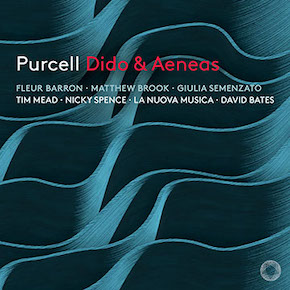
 This new CD recording of Purcell’s Dido and Aeneas sets out to produce a version that might have been heard at court in the early 1680s. This is, of course, one of several theories about the work’s genesis and it’s the one I find most credible. Taking this as a starting point allows music director David Bates a framework in which to consider issues of style and casting.
He posits significant French influence, which I would take as pretty much a given, but also some Italian flavour, which is a new idea to me and I think, too, that it’s clear that the Anglican choral tradition influences the choruses. So what does he do with these premises? First, and perhaps most importantly, he casts a rather dramatic mezzo, Fleur Barron, as Dido and encourages/allows her to present the role as if it were perhaps la grande tragédienne from one of Lully’s tragédies lyriques. Paired with the light, lyric soprano Giulia Semenzato as Belinda it produces an effect that strongly reminded me of Meghan Lindsay and Mireille Asselin in the recent Opera Atelier production though Semenzato ornaments more than most Belindas (and does it very well).
Continue reading →


 operaramblings