
 Purcell’s Dido and Aeneas has a long and dense history in the recording studio. The first recording dates back to 1935 and the vast stream of recordings since serve as a kind of barometer of the changes in style in performing 17th century music. I haven’t listened to every recording but I can look at four key moments in the discography and compare them. I’ve also listened or watched a fair number of fairly recent productions. The video review page has six entries for this work; all 1995 or later. There are also five reviews of live productions and reviews of several related shows. But for the purposes of this mini-project I’m going to look at four recordings that take us from the early 1950s to the mid 1990s. The four recordings are:
- The 1951 (or 1952 depending on source) EMI recording with Kirsten Flagstad and Elisabeth Schwarzkopf.
- The 1961 recording with Janet Baker
- Andrew Parrott’s seminal 1981 recording with Emma Kirkby
- Tafelmusik’s 1995 recording
This post will deal with the first with subsequent posts on the others. Continue reading
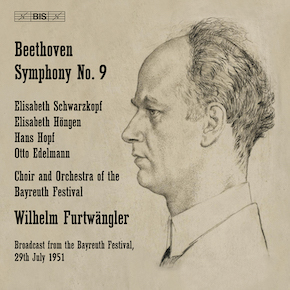 It’s July 29th 1951; the opening night of the first Bayreuth Festival since the end of the war. Noted anti-Nazi Wilhelm Furtwängler will conduct the Festival Orchestra in Beethoven’s Ninth Symphony from the Festspielhaus. It will be broadcast live by Süddeutsche Rundfunk(*) and will be relayed by stations in Germany, Austria, France and Sweden. You are sitting in front of your valve radio because commercial transistor models are not yet on the market. You can’t record it to listen to later because tape reorders are almost as rare in 1951 as transistor radios.
 operaramblings