Another fine Cesare

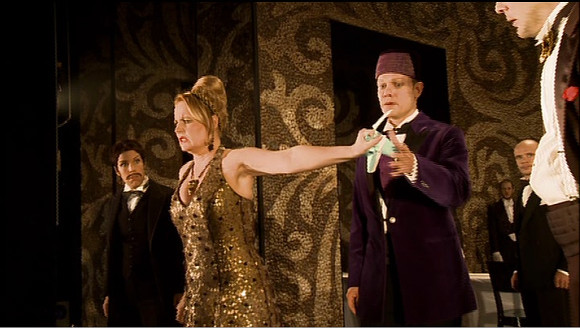
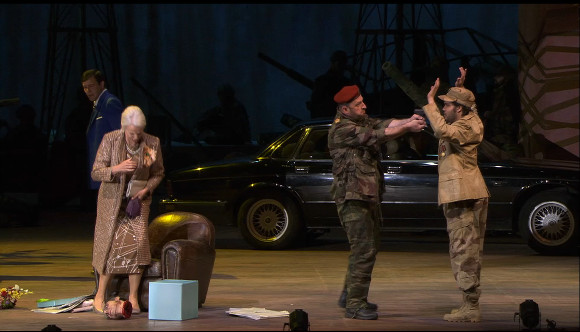
Handel’s Giulio Cesare is pretty well served in terms of video recordings.  The very fine Glyndebourne and Copenhagen versions get some serious competition from the 2012 production that inaugurated Cecilia Bartoli’s reign as director of the Salzburg Whitsun Festival.  The production is by Moshe Leiser and Patrice Caurier.  It’s set in somewhere like Iraq in an immediately post-war period.  It’s quite dark, probably darker than Negrin’s in Copenhagen and world’s away from McVicar’s almost RomCom version.  There’s a lot of violence and some pretty sleazy sex.  A lot of this centres around Tolomeo who is portrayed as beyond revolting.  There’s a scene where he rips guts out of a statue of Caesar and starts to gnaw on them and there is a fair bit in that vein.  Caesar and Cleopatra are portrayed ambiguously too.  Sure they are the “heroes” of the piece but Cleopatra’s delight in flogging off her country’s oil wealth to the Romans shows a degree of cynicism.  This is not a production for the Konzept averse but I think all the choices made have a point and the overall effect is coherent.  It’s not without humour either.  Cleopatra sings V’adore pupille in a 70s blonde wig while riding a cruise missile with Caesar watching through 3D glasses.
1.head

Continue reading

The three countertenors

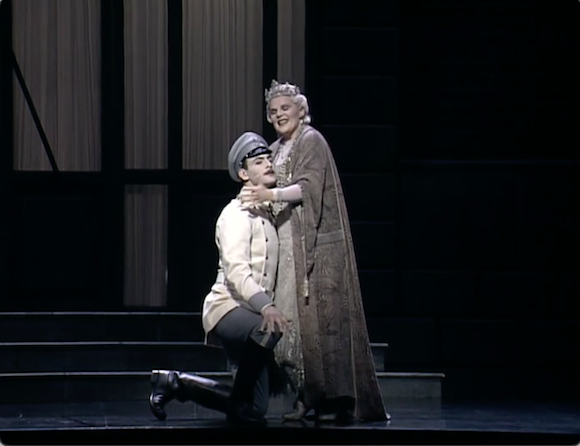
Handel’s Giulio Cesare presents an interesting casting challenge.  The piece has four high voiced male roles; Cesare, Nireno, Tolomeo and Sesto.  The original production featured three castrati and a soprano en travesti.  I have never seen Sesto cast as other than a trouser role and Nireno and Tolomeo are invariably sung by countertenors.  Cesare himself though seems mostly to go to low mezzo/contralto types.  Indeed it’s seen, I think, as something of a “plum” trouser role.  (Which is interesting as in the production that i will get to describing in a minute, Cesare wears plum trousers).  I’ve seen both Ewa Podleś and Sarah Connolly in the role.  For their 2005 production Royal Danish Opera cast Andreas Scholl as Cesare.  It’s a good choice.  He’s a masculine looking and sounding counter tenor and at least he is taller than his Cleopatra.  It also makes for an interesting set of countertenors.  Tolomeo is sung by the much less masculine Christopher Robson and Nireno by the “more a male soprano than a countertenor” Michael Maniaci.  Sesto goes, conventionally enough, to Tuva Semmingsen, who seems very much to specialize in these types of role.  Apart from the countertenors the piece was cast from the considerable resources of the RDO ensemble with Inger Dam-Jensen as Cleopatra, Randi Stene as Cornelia, John Lundgren as Curio and Palle Knudsen as Achilla.

1.cesare_achilla Continue reading

Love polygon

Handel’s Partenope is a bit unusual.  It feels lighter than a lot of Handel’s Italian operas and it is basically a romcom, albeit one that still has a vaguely classical setting.  Handel also plays with opera seria conventions by, for example, writing “heroic” arias for non-heroic texts and putting accompagnato in odd places.  The number of potential match ups that need to be tracked is fairly staggering.  Basically everybody is in love with, or pretending to be in love with, Partenope, queen of Partenope aka Naples.  These include the invading prince of Cumae, Emilio; Arsace, prince of Corinth; Armindo, prince of Rhodes and Eurimene, an Armenia who is really Rosmira, princess of Cypress and formerly betrothed to Arsace.  The only character who isn’t in love with Partenope is the philosophical captain of the guard, Ormonte, who is easy to spot as he’s a bass.  At the start of the piece Partenope is in love with Arsace but Eurimene/Rosmira isn’t having that and engineers a duel with Arsace.  This takes most of two acts but it’s the only essential bit of plot.  In Act 3 Arsace, who really doesn’t want to fight his former fiancée finally comes up with the wizard wheeze of demanding that the duel be fought bare chested.  Apparently this was perfectly normal under Neopolitan duelling conventions.  maybe it’s what gave Patrick O’Brian the idea of having Stephen Maturin always duel bare chested?  Anyway the modest Rosmira isn’t about to do any boob flashing (somewhat ironically as Inger Dam-Jensen, in the title role, has been bosom heaving with the best since the overture) so confesses to being, shock horror, female.  Arsace and Rosmira are reunited and Partenope awards herself as a consolation prize to Armindo.  Got that?

1.partenope Continue reading

Handel for the Handelians

I think maybe Handel’s Rodelinda is one for the hard-core Handelians. It’s got some lovely music but it’s long (200 minutes), not very dramatic (it’s based on Corneille) and, structurally, is a succession of recitative and da capo arias. There is no chorus and I only recall two numbers that weren’t solos; the concluding quintet and a rather lovely duo between Rodelinda and Bertarido at the end of Act 2. Jean-Marie Villégier’s 1998 production for Glyndebourne rather tends to emphasise the leaning to elegance rather than drama. The basic look and feel is “silent movie era”. Sets and costumes are near monochrome and that tends to be emphasised by the lighting. At least when there is a any. Much of this production is very dark, as was fashionable at the time.

r1

Continue reading