Call of Dutilleux

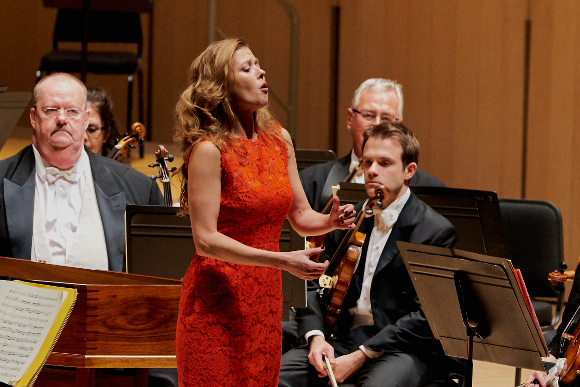
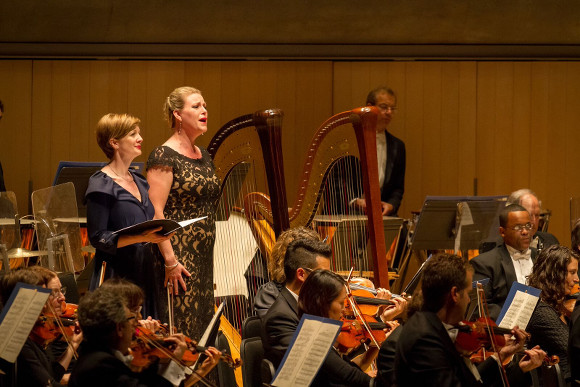
I suppose it’s a bit odd to go out to a symphony concert on a cold night out of interest in one twenty minute piece on the program but that’s what I did last night.  The item of interest was Henri Dutilleux’ Correspondances and the attraction was that the soloist was Barbara Hannigan.  It’s an unusual piece.  The five texts include, conventionally enough, three poems; two by Rilke and one by Prithwindra Mukherjee.  The two longer texts are letters; one from Solzhenitsyn to the Rostropoviches and one from Vincent Van Gogh to his brother.  The music is atmospheric and covers a wide range of moods from ecstatic to despairing.  It’s heavy on percussion and makes considerable demands on the vocal soloist.  Parts of it lie very high and it really needs the exquisite attention to each syllable of the text that is Hannigan’s trademark.  Little shifts in the vowels, the occasional drop into something approaching Sprechstimme and so on.  I thought the TSO and Peter Oundjian were really quite impressive here too.  The piece got the clarity and transparency it needs.  That said, it’s one of those pieces that few people, I think, will fully appreciate on one hearing.  Fortunately there is a very good recording of Hannigan singing it with the Orchestre Philharmonique de Radio France and Esa-Pekka Salonen.

Barbara Hannigan, Peter Oundjian 2  (Malcolm Cook photo)

The piece was bookended by Sibelius’ Swan of Tuonela and Berlioz’ Symphonie Fantastique.  The Sibelius was extremely well played with some lovely playing in particular from the cor anglais.  The Berlioz isn’t a piece I much care for and both of us were a bit under the weather so we skipped out after the Dutilleux.  If you missed last night’s performance it’s on again tonight at 8pm.

Photo credit: Malcolm Cook.

Requiem come to life?

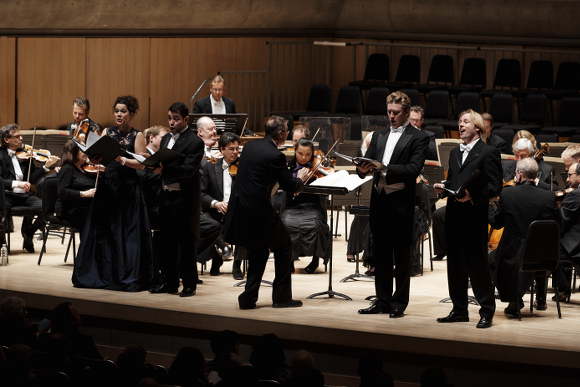
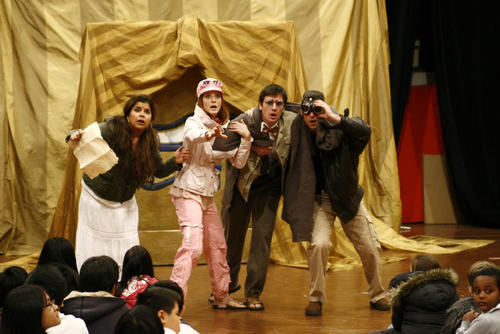
Joel Ivany’s much anticipated “semi-staged” version of Mozart’s Requiem K. 626 finally saw the light yesterday evening at Roy Thomson Hall.  There were some interesting ideas but, ultimately, I didn’t think I came away with any new insight into the piece or life or death or anything really(*).  I’ll go into the reasons but first I should describe how it was performed.  The mass is prefaced by the slow movement from the Clarinet Quintet.  The lights go down.  The five players enter via the aisles in the audience lower level and take their seats (sadly to applause which we had been asked to refrain from).  As the quintet is played (and it was very beautiful) the players are joined by the rest of the orchestra, the choirs, conductor and soloists enter through the audience and from the wings and deposited slips of paper (I think) on two benches at front of stage left and right.  Names of the dead?  Probably and that’s a nice touch though scarcely original.  The quintet concludes.  More unwanted applause.  At this point the orchestra are seated , more or less conventionally, around the conductor with the choirs around them.  There are lots of fancy chairs.  The soloists are more or less in conventional position in front of the audience.  Everyone, except the mezzo and the soprano, are in black.  The very crowded stage is quite dimly lit in bluish tones.  As the mass progresses, the soloists interact in various ways.  The choirs gesture in rather obvious ways; the text says “king” so we pump our fists, the text talks of “writing” so we make scribbly gestures.  At some point the soloists start to rearrange the pieces of paper with the names of the dead in a sort of game of Dearly Departed Patience.  The soloists exit through the orchestra.  The lights go down.  The End.

TSO Mozart Requiem (Malcolm Cook photo)

Continue reading

The Hannigan show

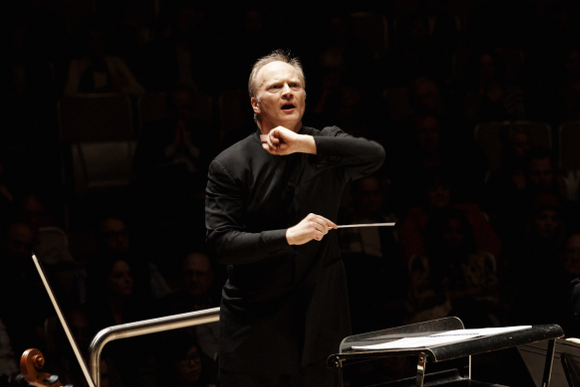
Last night at Roy Thomson Hall Barbara Hannigan made her North American conducting debut with the TSO.  And, of course, she sang too.  She kicked off with Luigi Nono’s Djamila Boupacha for solo voice.  It’s a short but haunting piece inspired by a woman activist from the Algerian War.  I don’t think I’ve ever heard a solo, unaccompanied, voice in that hall and the effect is eerie.  It’s also a hell of a sing and to navigate it with utter precision is quite some feat.  As the last note died away (precisely on pitch) the violins came in with the opening Haydn’s Symphony no. 49 “La Passione”.  It starts off with an Adagio that’s curiously similar in mood to the Nono piece and Hannigan was conducting without score or baton.  In fact it was more like an interpretive dance than conventional conducting.  She has amazing arms and hands; the arms and hands of a ballerina in fact and as she summoned the strings to a sort of shimmering sound I couldn’t help but reminded of Swan Lake.  Corny perhaps but very real and quite disturbing.  And the orchestra, quite a small subset of the TSO, responded.  This was four movements of really lovely, chamber music like playing.

hannigan1 Continue reading

Mahler Resurrection

Mahler’s Symphony No.2 in C Minor “Resurrection” is a massive beast using multiple percussionists, a very large brass section (who rather disconcertingly troop on and off stage multiple times), choir and two vocal soloists and it lasts an hour and a half.  It’s also a very peculiar animal emotionally; combining almost naive folk dance tunes with passages of haunting beauty and extreme bombast.  Last night, in the second of two performances at Roy Thomson Hall, Peter Oundjian and the TSO give it a spectacularly unrestrained performance.

mahler2 Continue reading

Andrew Davis and the Verdi Requiem

It’s forty years since Sir Andrew Davis first conducted the TSO and to celebrate the fact the TSO programmed a run of Verdi Requiems with Sir Andrew conducting.  I caught the last performance last night.  It’s in some ways a curious piece; very operatic and not especially liturgical but it does have its subtleties; the very quiet opening and the tenor solo Ingemisco for example but there’s also some moments of drama that are far from subtle.  The Dies irae is appropriately loud, even terrifying and it’s used as an accent before the Lacrymosa and during the Libera me.  It’s quite a compelling 90 minutes or so.

vreq1 Continue reading

Mild und Leise… occasionally

The TSO’s program last night was too tempting to miss; Adrianne Pieczonka singing Strauss and Wagner and a Beethoven 7th plus Gianandrea Noseda conducting.  So I went.

_DSC5922Things started off with Casella’s Italia.  This is a sort of mash up of Pucciniesque bombast and Neapolitan popular tunes.  I’m surprised it never featured in a Warner Bros cartoon.  Perhaps it did.  In any event Nosada is probably the ideal conductor for it; infusing it with a kind of manic energy.  Next up were the Strauss Vier letzte lieder.  Here manic energy is exactly what’s not needed and Nosada seemed to have some difficulty adjusting.  Too often Adrianne Pieczonka’s beautiful singing was covered by an over loud orchestra.  Roy Thomson Hall is tricky but George Benjamin showed exactly how to manage the acoustic last weekend.  Nosada wasn’t so successful.

Continue reading

Mozart fragments

Last night, at Roy Thomson Hall, the TSO presented a two part Mozart program.  The first half consisted of pieces from two abandoned opera projects; the buffa Lo sposo deluso and the Singspiel Zaide.  The second half consisted of the better known, but incomplete, Mass in C Minor.

L to R: Guilmette, Fortier-Lazure, Bintner, Tessier.  Photo - Malcolm Cook

L to R: Guilmette, Fortier-Lazure, Bintner, Tessier. Photo – Malcolm Cook

Continue reading

Guglielmo Tell in concert

1. Luca Salsi HD-1

Luca Salsi

The operatic forces of Teatro Reggio di Torino are on a four city tour of North America.  Last night, at Roy Thomson Hall, they performed a concert version of Rossini’s Guglielmo Tell.  It was strictly concert style without any of the “semi staging” touches that are normal here so just music stands at the front of the stage and concert dress.  It’s in some ways a very odd way to experience a piece like this because some of the most dramatic scenes aren’t sung but are accompanied by the orchestra.  Take the canonical scene where Tell shoots the arrow off his son’s head.  We get the build up and it’s fairly obvious what the hushed orchestra is all about and then we get the chorus announcing basically “Gee by golly, he did it”.  Maybe the supertitles could be used as a commentary track at such points? Continue reading

Ok, so how did I miss this?

simonewallisSaturday (7.30pm) and Sunday (3pm), at Roy Thomson Hall, the TSO has a programme that includes operatic lollipops from Simone Osborne and Wallis Giunta.  Joana Carneiro conducts.  I had to go all the way to Sudbury to find a picture with wallis and Simone. Anyway, here’s the programme for the concert:

Mozart: Overture to The Marriage of Figaro
Mozart: “Letter Duet” from The Marriage of Figaro
Offenbach: Intermezzo and Barcarolle from The Tales of Hoffmann
Delibes: “Flower Duet” from Lakmé
Beethoven: Symphony No. 6 “Pastoral” – Mvt. I
Glinka: Overture to Ruslan and Lyudmila
Villa-Lobos: Bachianas brasileiras No. 5
Tchaikovsky: Romeo and Juliet Fantasy-Overture

So three lovely ladies (plus the TSO) at one low (not especially actually) price.