Beware of the leopard!

Clémentine Margaine prowled the RBA like an exotic and rather dangerous feline.  A total stage animal, she created a stunning series of female personae, from the virginal to the very much not, to bring to life a well curated selection of Spanish and French pieces.  She started with the 7 Canciones populares Españoles of de Falla which set the tone as they communicate a wide variety moods and temperaments in a very short space of time.  Each little song was fully invested with its own drama. And her eyes.  Incredible!  Granados’ La maja dolorosa followed.  By this point I was really beginning to understand why Ms. Margaine is so sought after.  It’s a big, dark, sexy voice.  I would probably have realised the sheer size of the voice more on Wednesday if I hadn’t been comparing her to the absolutely enormous sound of Anita Rashvelishvili.  It’s a wonderfully expressive instrument perhaps lacking a really strong upward extension but, overall, lovely to listen to.

margaine

Continue reading

Spirit Dreaming

CBSimgLast night I braved the storm to catch an intriguingly curated show at Trinity St. Paul’s.  Talisker Players’ Spirit Dreaming was a selection of music in which “western” composers explore the ideas of colonized peoples through the medium of vocal chamber music.  The music was interspersed with readings from creation myths from around the world.  It was very interesting to see how changing ideas of “cultural appropriation” and different cultural contexts; French and British colonies, Brazil, northern Finland, influenced works which range in time from the 1920s to the 2010s.
Continue reading

Ravel double bill

In 2012 Glyndebourne staged an interesting and contrasting double bill of Ravel one-acters in productions by Laurent Pelly.  The first was L’heure espagnole.  It’s a sort of Feydeau farce set to music.  The plot is classic bedroom farce with the twist that most of the doors the lovers come in or out of belong to clocks.  Concepción is the bored wife of a nerdy clockmaker.  She’s not overly impressed by her two lovers; a prolix poet and a smug banker, who show up while hubby is out doing the municipal clocks.  She’s much more taken by the slightly simple but very muscular muleteer who spends most of his time lugging lover infested clocks up and down stairs for her.  Pelly wisely takes the piece at face value and brings off a mad cap forty five minutes timed to the split second.

1.lovers Continue reading

Natalie Dessay showcase

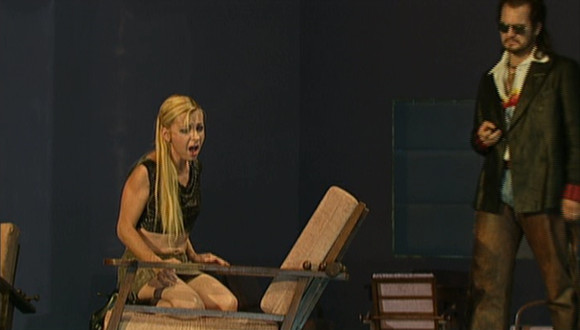
Le miracle d’une voix is a compilation of scenes from various recordings in which Natalie Dessay featured made between 1993 and 2003.  It’s especially interesting in that a couple of pieces feature more than once.  There are three Les oiseaux dans les charmilles; Olymia’s aria from Les contes d’Hoffmann and two Grossmächtigen Prinzessin from Ariadne auf Naxos.  Thrse demonstarte what I have always believed to be Dessay’s greatest strength; her ability to recreate a character to fit in a particular production.  The two Zerbunetta arias illustrate this perfectly.  In the first, a Salzburg production from 2001, Zerbinetta is a depressed, heavy drinking, prostitute who celebrates a kind of deeply sad sisterhood with Ariadne before being dragged off by a very sleazy Russell Braun.  In the second, from the Palais Garnier in 2003, she’s a bubble headed tourist in bikini and wrap who pesters poor Ariadne all around what looks like a Mediterranean building site.  They are completely different characterisations but both highly effective.  The same is true of the three Olympias who range from very conventional doll to inmate in some sort of asylum or home.

1.zerbinetta Continue reading

Philippe Sly and Julius Drake at Walter Hall

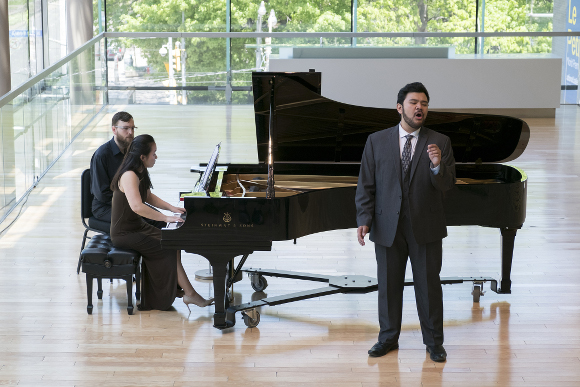
Phillippe-SlyUp and coming Canadian bass-baritone Philippe Sly was joined last night by veteran collaborative pianist Julius Drake for a program of chansons and lieder at Walter Hall.  The 490 seat hall was almost full which is rather nice to see for a song recital in Toronto.  The first half was devoted to chansons by Duparc, Ropartz and Ravel.  I was struck by the restraint of Sly’s singing.  It was conversational and not operatic at all but very expressive.  I think that takes a lot of guts in a young singer.  He let the words and music do the talking and didn’t exaggerate.  This was perhaps best shown in the drinking song from the Don Quichotte songs of Ravel.  He was very funny but sounded like a drunk, not somebody overacting the idea of a drunk.  Continue reading

Toronto Summer Music Festival kicks off

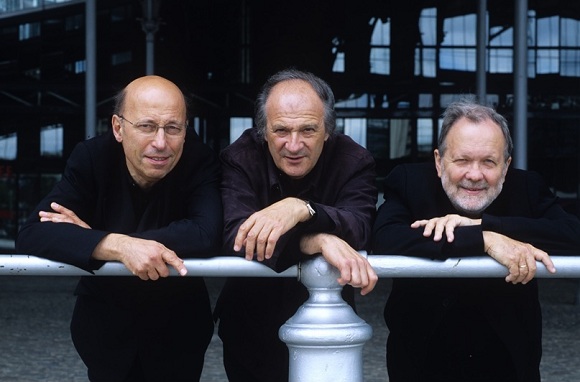
Last night saw the first concert of the Toronto Summer Music festival which runs at a variety of venues until August 3rd.  The theme for the festival is Paris La Belle Époque and this was reflected in last night’s opening concert being given by the distinguished French trio Trio Pennetier Pasquier Pidoux.  One might question though to what extent works written in 1914 and 1923 can be said to belong to the themed era.  It didn’t seem to bother a packed Koerner Hall.  The reception to all three pieces given was raucous.

Trio Pennetier Pasquier Pidoux (From left to right:  Roland Pidoux, cello; Régis Pasquier, violin; and Jean-Claude Photo credit: Guy Vivien

Trio Pennetier Pasquier Pidoux (From left to right:
Roland Pidoux, cello; Régis Pasquier, violin; and Jean-Claude
Photo credit: Guy Vivien

Continue reading

Philanthropists in Music

salon1Yesterday afternoon saw the final concert of the season for Off Centre Music Salon; the concert series organised by Boris Zarankin and Inna Perkis at the Glenn Gould Studio.  This one, as the title suggests, celebrating philanthropy in music by putting together a concert of works by composers who were supported by patrons.  It was very much salon style with many short sets by various combinations of performers.  There was some instrumental music; an impressive performance of Khachaturian’s Toccata in E flat minor by twelve year old William Leathers, reprised later on accordion by Michael Bridge.  Jacques Israelievitch and Boris Zarankin collaborated on a bravura rendition of Stravinsky’s Suite Italienne and Zarankin and Perkis gave their traditional one piano/four hands performance, this time an arrangement of Beethoven’s Egmont overture, which was received with enthusiasm.

Continue reading

Le Docteur Miracle and L’Heure Espagnole

Last night lemur_catta and I braved the blizzard to see students from the Glenn Gould School and the Royal Conservatory Orchestra perform at Koerner Hall. The bill was two French one act comic operas; Bizet’s Le docteur Miracle and Ravel’s L’heure espagnole. Both have extremely silly plots but rather lovely music.

The Bizet piece concerns an officer who is in love with the mayor’s daughter (or maybe his wife, or maybe both. This is French opera) and wins her hand by disguising himself as “Docteur Miracle” and “curing” the mayor who thinks he has been poisoned by an omelette. The omelette gets a lot of air time. In last night’s version heavy use is made of three ballet dancers with omelette making headgear. I have no idea if this idea is original or in the libretto but it was very funny. It’s a pretty conventional early classical piece musically; arias for the soprano, tenor and baritone leads and a lot of ensemble numbers. The dialogue is spoken. It was generally well sung with the stand out being the daughter, a coloratura soprano part, played by Jennifer Taverner. The ensembles worked well except that the very young looking tenor, Zachary Finkelstein, was somewhat underpowered and tended to disappear. Solo, his voice was pleasant enough, if light. Pretty decent performances from baritone Maciej Bujnowicz and mezzo Danielle MacMillan as the mayor and his wife. Excellent work from the orchestra and conductor Uri Mayer.

After the interval we had the much more modern sounding L’heure espagnole by Ravel. In this piece the clockmaker’s wife takes advantage of her husband’s day out fixing the municipal clocks to find a lover. This is complicated by the arrival of a muleteer who needs his watch mending. She gets him out of the way by having him haul clock cases from the shop to her bedroom and back. At various points her two would be lovers; a dull grandee and a verbose poet are concealed in the clock cases and a lot of singing takes place through windows in the front of the clocks. Finally she decides that someone who can tirelessly haul loaded clock cases up and down stairs may have more of what she is after than the other two and takes the muleteer off to bed, sans clock. The work concludes with a quintet confirming that it is, indeed, the muleteer’s day. The work is heavier in tone; through sung and fewer set piece numbers. Bujnowica and Finkelstein appeared again as the lovers but the stars were the bluff, strong baritone of Todd Delaney as the muleteer and Leigh_Anne Martin’s strong soprano as Concepcion. It’s the sort of role that one could easily imagine Anna Netrebko singing and Martin managed the same sense of sly, sexy fun that Trebs brings to roles like Norina. Tenor Andrew Byerlay played the clockmaker. This is a much more musically complex work than the Bizet and uses a pretty large orchestra. I didn’t think the orchestral work was as crisp as in the Bizet but it was fine really.

Koerner Hall is a visually lovely venue with acoustics that help everyone. It’s really pleasant to hear and watch opera in a venue that size, 1100 seats, where every seat, pretty much, is a good one and the sound is excellent. All in all, a fun evening. I’m more and more convinced that I would rather see young artists having fun and really trying to put on a show than watch rather bored experienced professionals do their 200th performance of a work in a routine production in a big opera house. There’s another show on Friday night and decent seats are only $30 so think about it!

The COC crowd were out in force and I spotted Alexander Neef, Simone Osborne and Ambur Braid among others in the audience. One has to give credit to Mr. Neef. He spends a lot of time talent spotting young singers. I guess, given his background in casting in Paris, it’s not so surprising.