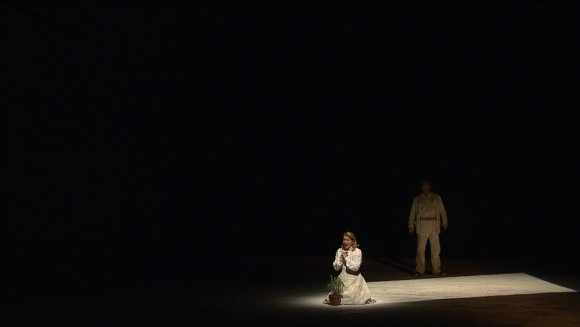
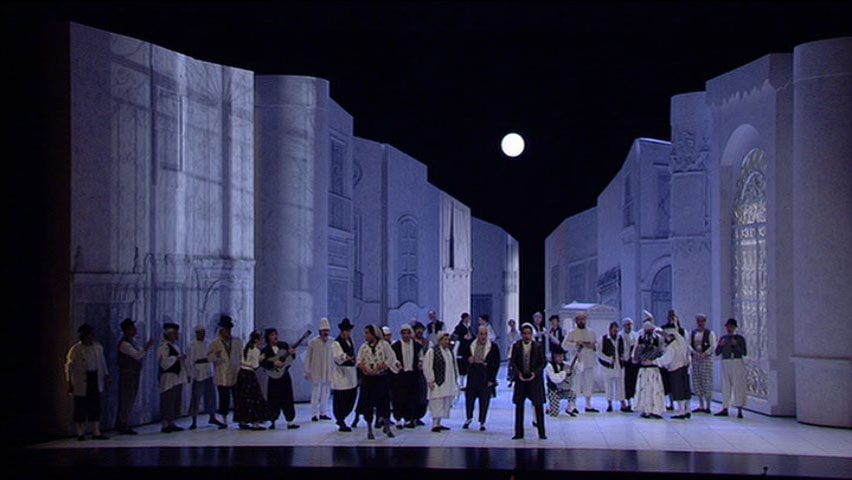
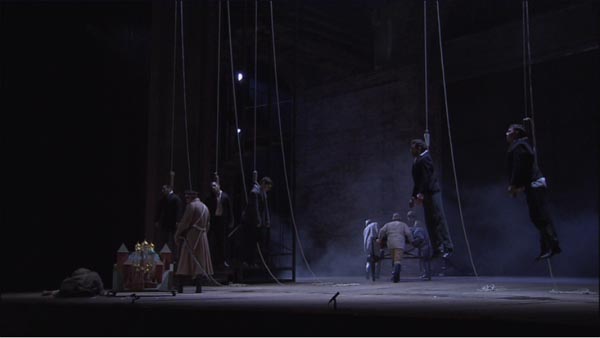
Stéphane Braunschweig’s production of Janáček’s Jenůfa, recorded at Madrid’s Teatro Real, is austere and effective. The sets are almost empty. Mill sails appear from a slot in the floor to suggest the family mill, there’s a cot for the baby in Act 2 and some church benches in Act 3. That’s it. The rest of the “setting” is carried by a very effective lighting plot. I don’t think there are any big ideas here but it’s an effective, straightforward way of telling the story. Braunschweig also makes effective use of the chorus, especially in Act 1.
Tag Archives: ramirez
Upcoming events
Ridiculously short notice I know but VOICEBOX/Opera in Concert’ are closing their season with Verdi’s Stiffelio this afternoon at the St. Lawrence Centre. This 1850 workconcerns an adultery in the house of a Protestant minister and was so severely censored by the Italian authorities that Verdi withdrew it in 1856 and it’s rarely seen. VOICEBOX will present the scholarly edition prepared from the Carrara family MS in the early 90’s. It’s a concert performance with piano accompaniment featuring Ernesto Ramirez, Laura Albino and Geoffrey Sirett.
On Wednesday there’s a rare performance of Gagliano’s La Dafne by Capella Intima and the Toronto Continuo Collective. An ensemble of dramatic voices accompanied by lutes, theorbos, harpsichord and viola da gamba will present Ovid’s tale of Apollo and Daphne. It’s at noon and forms part of the COC’s free concert series in the Richard Bradshaw Amphitheatre.
Finally, on March 3rd Toronto Masque Theatre is presenting a soirée on the history of the masque form. There will be panel discussions and performances by soprano Patricia O’Callaghan, guitarist Ken Whiteley and others. It’s at 7.30pm at 21 Shaftesbury Avenue, Toronto. Tickets are by donation ($20 suggested) and seating is limited so registration is required either online at torontomasquetheatre.com or by calling 416-410-4561.
Land of Smiles
Lehár’s Das Land des Lächelns must have seemed old fashioned even when it opened in 1929 in a Berlin that had already seen Wozzeck and Die Dreigroschenoper. With its waltzes and gentle chinoiserie it looks back rather than forward musically and makes few demands on its listeners. Similarly, the plot; a bittersweet romance between an Austrian aristocrat and a Chinese prince had nothing in it to disturb contemporaries though modern audiences might find the cultural appropriation a bit hard to take. However, if Turandot doesn’t bother you this likely won’t either.
Cool and refined Barbiere
Emilio Sagi’s 2005 production of Il Barbiere di Siviglia is incredibly elegant and restrained. It looks like something by Robert Carsen. The sets are all constructed and transformed in full view and just about everything is black and white until the final scene. There is a lot of background action and commentary from a talented group of dancers who give a very Spanish feel to the piece. The final scene bursts into vivid, even loud, colour and the finale is just gorgeous to look at. The direction of the actors is well thought out too though they do seem to sing from on top of furniture a lot of the time.
The other Khovanshchina
There are only two video recordings of Mussorgsky’s Khovanshchina currently available. The 1989 Vienna recording, which I wrote about yesterday, and a 2007 production from Barcelona’s Gran Teatre del Liceu which I’ve also just had a chance to see.
The two productions make for interesting contrasts on many levels. In Barcelona, music director Michal Boder, while opting to use the Shostakovich orchestration as a basis modifies it in places with elements of the Rimsky-Korsakoff version. He also uses Voronhov’s lower key alternative to the Stravinsky in the final chorus and he makes some cuts; most notably the Susannah scene in Act 3. He also gets quite a different sound from the orchestra. Where Abbado in Vienna is very refined, one might almost say Viennese, Boder is brasher. In places the music almost sounds like Shostakovich with the characteristic braying brass. Admittedly some of this may be due to the quality of the recorded sound. The Vienna recording is rather soft focussed Dolby 2.0 while Barcelona gets very crisp and detailed DTS 5.1 (There’s LPCM stereo too but I didn’t check it out).