Reflections on Tosca

Photo credit: Michael Cooper

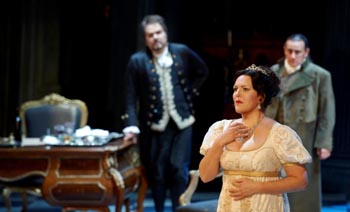
The only known photograph from this production as featured in every other print or internet review I've seen.

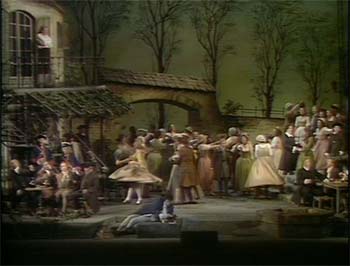
Puccini’s Tosca is on at the Canadian Opera Company right now. It’s this years “bums on seats” production. There are fourteen performances scheduled; compared to eight for most shows. It’s double casted. It’s a conservative friendly, traditionalist production seen before just four years ago and it features hone town diva, Adrienne Pieczonka. We saw it last night and were a bit disappointed. It wasn’t the sort of show one comes out of spluttering “travesty” or “disgrace” but it wasn’t the sort of performance that gets a standing ovation and excited deconstruction on the subway home either. It felt like a revival of a traditional production. It has to be said that my reaction, while more positive than some reviews I’ve read, wasn’t shared by a large chunk of the audience who switched from their customary coughing to an extended standing ovation. From the chatter I could hear in seats around me that was largely the reaction of the “once a year” crowd so, in a very important sense, this production accomplishes what it needs to do.

Still it’s sad to come out of a performance of Tosca relatively unmoved so let me try and dissect why. Paul Curran’s production is very traditional so there’s no gimmickry to either offend or help overcome shortcomings in the singing or acting department and, of course, there’s no sense of novelty. A reasonably seasoned opera goer is, inevitably, comparing it with other Toscas. Mr. Curran’s programme notes are quite explicit about the success criteria for an enterprise of this type.

The joy and challenge of directing Tosca is not only in the glorious music and razor-sharp libretto, but ideally in workingclosely with the talents of the singers playing and fleshing out their roles. As the curtain rises it is the characters and relationships we must believe in. Characters are built bar by bar, phrase by phrase and discussion by discussion. No word is too small that it might not be the trigger for a singer to find a new angle into their character’s life or psyche, and the job of the director, I believe, is in part to help the cast explore and discover just these subtleties.

The trouble is that not much of this happened. The three principals; Adrienne Pieczonka (Floria Tosca), Carlo Ventre (Cavaradossi) and Mark Delavan (Scarpia), are all established ‘A’ list singers and sang as well as one would expect but neither their characters nor the relationships between them came fully alight. I can take my Tosca somewhat overblown but lukewarm doesn’t really cut it. Delavan is a big man with lots of physical presence but here he struck (rather odd) poses and never really exuded any sense of menace. He didn’t even seem to be that into Tosca. His physical encounters with her in Act 2 suggested that their mutual priority was not upsetting the costume shop. You could find steamier scenes in any high school parking lot. This just reinforced the aloofness of Pieczonka’s very “in control” Tosca. Vissi d’arte, though beautifully sung, came out of nowhere. This wasn’t a woman on the edge of breakdown and when she stabs Scarpia our surprise isn’t that she’s done so but that she didn’t rip his balls off with her bare hands ten minutes earlier. The less said about Ventre’s acting the better though he too sang very well indeed and E luceva qualche stella was probably the emotional highlight of the evening.

Besides fine singing there was quite a lot to like in the production. The orchestra under Paolo Carignani sounded great. I really like the atmospheric lighting plot which used light level and tone to create a variety of effects, especially in Act 1 and in Act 3, where it managed to suggest night time without being so dark one couldn’t see. The chorus both adults and children were excellent and curran creates some pleasing visual arrangements in Act 1 (nice touch where Scarpia barges out past the bishop celebrant). Unfortunately none of this really overcomes the emotional hole at the centre of the production.

I’ve heard it said, from various quarters, that the second cast of Julie Makerov in the title role and Brendan Jovanovich as Cavaradossi (Delavan sings Scarpia in all performances) may up the EQ a bit so they may actually be a better bet. Sheer curiosity may even get me to go find out.

I’m sure what I’ve written above sounds really negative. It needs context. Expectations for COC productions have been raised very high by some truly excellent efforts in recent years and so a “pretty adequate” production that would have received rave reviews ten years ago barely cuts it today. That’s the price of success.

Old fashioned fun

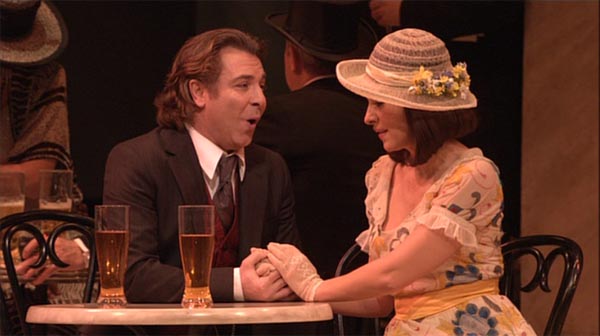
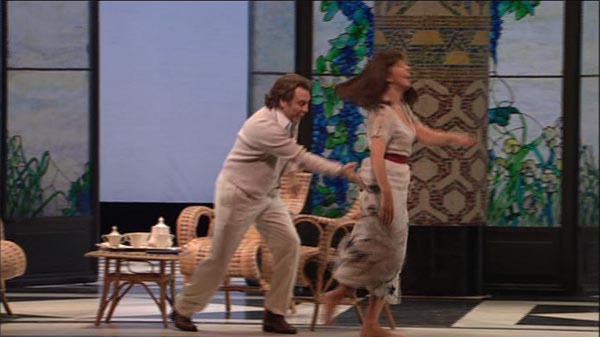
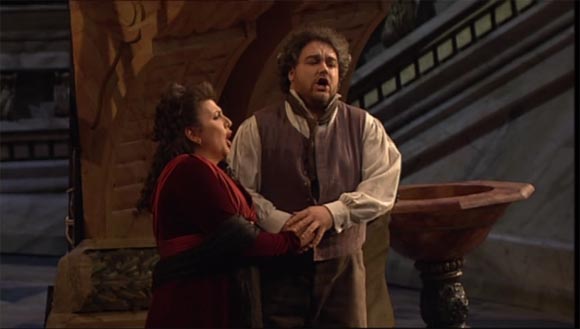
Puccini’s La Rondine has a plot that’s lightweight even by opera standards but it also has some really good tunes and plenty of opportunities for a star tenor and soprano to show off. In 2009 the Metropolitan Opera presented it as a vehicle for on again, off again couple Roberto Alagna and Angela Gheorghiu. Judging by the body language on and off stage this was definitely an “on again” phase. The production (Nicolas Joël), staging (Stephen Barlow) and design (Ezio Frigerio) don’t have a single thing in them that would cause concern to the most conservative of opera goers. The whole thing oozes old fashioned opulence. It’s the first time I’ve heard an audience applaud the sets! (Baldrick, you’ld laugh at a Shakespeare comedy). So no Regie here!

What we get is a beautifully sung and played performance. Gheorghiu sings gorgeously throughout and Alagna is not far behind. Their acting hows off some real sexual chemistry and if Gheorghiu tends to play the dive, well it’s that sort of role and that sort of production. They get well supported by Marius Brenciu, as the poet Prunier, and Lisette Oropesa, as the maid Lisette. These two basically provide the comic relief to the slightly cloying romantic main plot. Monica Yunus, Alyson Cambridge, Liz DeShong and Samuel Ramey take the other important roles and all are perfectly competent and true to character. The only aspect of the staging that doesn’t quite come off is the bar scene in Act 2. It’s all a bit too busy and there is some not very well thought through “drunk” choreography. Otherwise it’s basically a drawing room drama so not too, too hard to pull off. The orchestral playing is unsurprisingly good with the kind of music the Met orchestra excels in and Marco Armiliato conducting.

The video direction by Brian Large is OK. Given how much of the piece is two people talking, snogging or groping close ups seem a perfectly reasonable choice much of the time. The approach doesn’t work so well in Act 2 where a little more distance would have helped. Technically the DVD is an absolutely standard EMI treatment of a MetHD broadcast. The picture is very good 16:9 and the DTS 5.1 soundtrack is clear and spacious (LPCM stereo available too). English, French, German, Spanish and Italian subtitles and rather basic documentation in English with French and German PDF versions on the disk. Renée Fleming does the interval interviews which are about as revealing as usual (not at all).

All in all, it’s a lightweight piece but enjoyable and it would be hard to imagine a much better performance.

From corpse to corpse

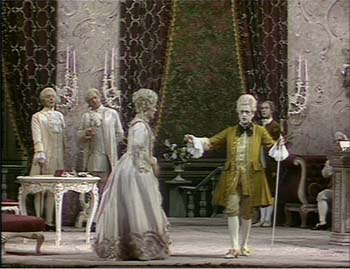
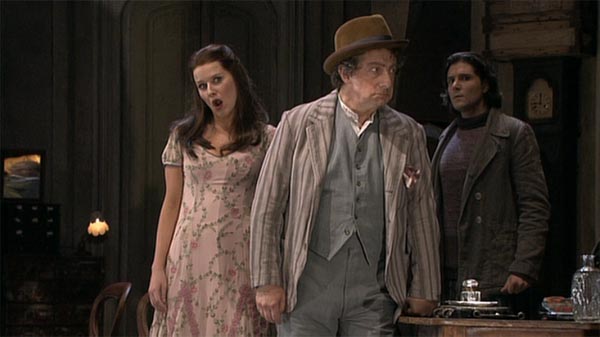
I managed to get my hands on the DVD of the Gianni Schicchi that formed the second half of the evening’s entertainment with The Miserly Knight that I reviewed yesterday (Glyndebourne 2004). It’s the same creative team of Jurowski and Arden and they reinforce the end on a corpse, start on a corpse symmetry by using the aerialist Matilda Leyser as the corpse in Schicchi. Both Jurowski and Arden stress the dark side of the work in interviews but to be honest it comes off here more as a madcap comedy. Perhaps that was inevitable when following the very dark and enigmatic Rachmaninov piece. It’s set around the time of the work’s composition and a unit set with balcony and bed and a cupboard to stuff the body in serve throughout. It’s workmanlike and effective. The blocking is very precise and effective. After all there are at least eight characters on stage throughout this piece. Arden moves and groups them with precision and my only beef is that (surprise) we miss much of her careful work because of closeupitis.

The performances are excellent. Alessandro Corbelli is superb in the title role confirming my opinion of him as one of the great comic baritones. The acid aunt Zita is wonderfully played by the seemingly timeless Felicity Palmer and the rest of the family back her up strongly with excellent ensemble work. Sally Matthews as Lauretta and Massimo Giordano as Rinuccio are the romantic interest and they are both good. Matthews manages a version of O mio babbino caro that is lovely to listen to and spectacularly insincere. She also acts very well and looks the part. Giodarno has a lovely Italianate tenor voice, acts well and is also most pleasant to listen to. Jurowski handles the score well building to some impressive climaxes where required, for example in the scene where the family are imagining all the good things the monks will get to eat from Buoso’s legacy.

The video direction isn’t as egregious here as in the Rachmaninov but it’s still annoying. The scene where Schicchi is preparing to impersonate Buoso is particularly irritating. Technical details and standard of execution are the same as for the Rachmaninov. The interviews with Jurowski, Arden and Corbelli are also equally good. I could listen to Jurowski talk about music and its relationships to other art forms and social developments for a long, long time. Just a reminder that this is also available as a double bill with the Rachmaninov on Blu-ray as well as separately on DVD.

It will be interesting to see how this compares to the upcoming COC production which will be paired with the very dark Eine florentinische Tragödie by Zemlinsky from Wilde’s play. It has a starry cast, Sir Andrew Davis conducting and Catherine Malfitano directing so we may be in for a treat.

Against the Grain’s Bohème

Last night we were as far removed from the elegant sophistication of the Four Seasons Centre as one can get. We were in the back room of the Tranzac for Against the Grain Theatre Company’s updated, Toronto version of Puccini’s much played La Bohème. The Tranzac is a club. It’s quite scruffy and for many years the Nomads hung out there. I have spent many a riotous evening there involving beer slides and too much booze. It also hosts music events; mostly folk and jazz. Last night’s show was in the big room at the back which, set up with tables as it was, holds maybe a hundred or so people. The bar was open throughout. The beer selection has improved markedly since I was last at the Tranzac with a good range of products from McAuslan’s and Mill Street.

Against the Grain is a newly formed company of youngish performers. Many of them are products of the COC’s Ensemble Studio. This was not an amateur show! What we got was a somewhat abridged version of La Bohème in a new English translation by Joel Ivany (who also directed) adapted to include the translation in place and time to contemporary Toronto sung with piano accompaniment and staged in and around the audience. The piece opens with Rudolfo and Marcello squatting at the Tranzac where, the libretto informs us, it is “fucking cold”. It rolls on from there in a similar vein and it’s very effective.

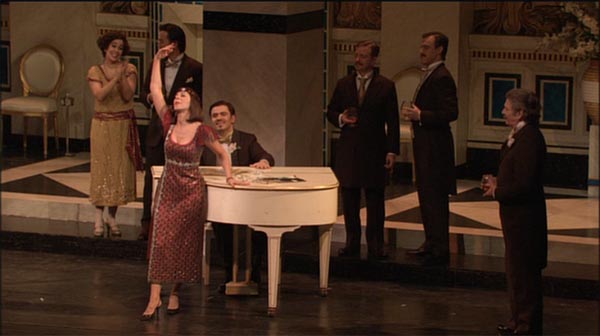
The singing was excellent. Adam Luther sang Rudolfo and showed that it was well within his compass, high notes and all. Laura Albino sang a serious Mimi capable of great and beautiful passion in her set pieces. Opera turned cabaret singer Lindsay Sutherland Boal was a thoroughly engaging Musetta. She pretty much stole the show in Act II when she worked the room in black corset and tight pants during her big aria. Christopher Mokrzewski was at the piano throughout and did a fine job.

All in all it was an enjoyable and worthwhile evening without the rather jarring aspect of displaying grinding poverty to the rich in their opera house finery. I really like that alongside the increasingly excellent offerings from the COC Toronto can offer opera in settings like the Tranzac.

There are two more performances; tonight and tomorrow.

La Fanciulla del West

Fanciulla is Puccini’s American opera. It’s set during the California gold rush and it was the first opera ever to premiere in New York, one hundred years and a couple of days ago. The soprano role, Minnie, is notoriously difficult to sing and so it isn’t produced all that often.

Continue reading