Thoughts on the Metropolitan Opera Live in HD series 2012/13

The Metropolitan Opera has announced the HD broadcast line up for next season.  Here it is with my entirely objective and unbiased comments.

Donizetti’s L’Elisir d’Amore New Production – October 13, 2012
Cond – Maurizio Benini, Dir – Bartlett Sher, Cast – Anna Netrebko, Matthew Polenzani, Mariusz Kwiecien, Ambrogio Maestri

Bartlett Sher?  Again?  Clearly Gelb’s “Broadway show of the year” (one of them, anyway).  Probably worth seeing for the cast who are capable of being funny in the drabbest production.

Verdi’s Otello – October 27, 2012
Cond – Semyon Bychkov, Dir – Elijah Moshinsky, Cast – Johan Botha, Renée Fleming

Well we are not going to see much acting here.  Probably one to stay home and listen to on the radio,

Adès’s The Tempest Met Premiere – November 10, 2012
Cond – Thomas Adès, Dir – Robert Lepage, Cast – Simon Keenlyside

Probably the highlight of the season.  A must see.

Mozart’s La Clemenza di Tito – December 1, 2012
Cond – Harry Bicket, Dir – Jean-Pierre Ponnelle, Cast – Elīna Garanča, Giuseppe Filianoti, Barbara Frittoli

Is this production any good?  I’ll probably go but I’m not as excited about this as I am about seeing Michael Schade in Christopher Alden’s production in February.

Verdi’s Un Ballo in Maschera New Production – December 8, 2012
Cond – Fabio Luisi, Dir – David Alden, Cast – Marcelo Álvarez, Karita Mattila, Dmitri Hvorostovsky, Kathleen Kim, Stephanie Blythe

This looks promising.  On the list.

Verdi’s Aida – December 15, 2012
Cond – Fabio Luisi, Dir – Sonja Frisell, Cast – Liudmyla Monastyrska, Roberto Alagna, Olga Borodina

I’d quite like to see Monastyrka but I’d rather gouge my eyes out with a spork then watch this dreadful old production again.  Thank you CBC Radio.

Berlioz’s Les Troyens – January 5, 2013
Cond – Fabio Luisi, Dir – Francesca Zambello, Cast – Deborah Voigt, Susan Graham, Marcello Giordani, Dwayne Croft

I have my doubts about Debbie as Cassandra but this is definitely worth a look.

Donizetti’s Maria Stuarda Met Premiere – January 19, 2013
Cond – Maurizio Benini, Dir – David McVicar, Cast – Joyce DiDonato, Elza van den Heever

Can McVicar raise his game to a higher level than his rather dismal Anna Bolena?  Worth going to see probably.

Verdi’s Rigoletto New Production – February 16, 2013
Cond – Michele Mariotti, Dir – Michael Mayer, Cast – Piotr Beczala, Željko Lucic, Diana Damrau

Another of Gelb’s Broadway buddies takes a crack at opera.  It’s been such a successful strategy after all.  The bland leading the bland?

Wagner’s Parsifal New Production – March 2, 2013
Cond – Daniele Gatti, Dir – François Girard, Cast – Jonas Kaufmann, Katarina Dalayman, Peter Mattei, Evgeny Nikitin, René Pape

Fabulous cast!  This is a co-pro with Opéra de Lyon and the COC so (a) the reviews from Lyon will be in before we have to decide and (b) I’ll eventually get to see it in Toronto.  Still, that cast…

Zandonai’s Francesca da Rimini – March 16, 2013
Cond – Marco Armiliato, Dir – Piero Faggioni, Cast – Eva-Maria Westbroek, Marcello Giordani are the doomed lovers.

This is a new piece for me.  Curiosity calls.

Handel’s Giulio Cesare New Production – April 27, 2013
Cond – Harry Bicket, Dir – David McVicar, Cast – David Daniels, Natalie Dessay

New production?  This is the Glyndebourne production set in 19th century British occupied Egypt complete with red coats, kilts etc.  It’s available on Blu-ray and DVD with a stronger cast (Connolly/de Niese) and period instruments. The Blu-ray has better production values than any MetHD broadcast I’ve ever seen so go buy that instead.

Bottom LIne

Yes: The Tempest, Un Ballo in Maschera, Les Troyens, Maria Stuarda, Parsifal, Francesca da Rimini

Maybe: L’Elisir d’Amore, La Clemenza di Tito

Not a chance: Otello, Aida, Rigoletto (is there a pattern here?), Giulio Cesare

In defence of Robert Lepage

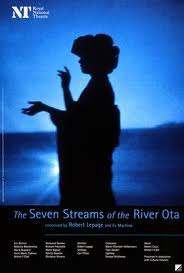
I am getting well pissed off with people taking ill informed shots at Robert Lepage based solely on his Ring cycle at the Metropolitan Opera. For three decades Lepage has been one of the most brilliant minds in the dramatic arts. His oeuvre spans straight theatre, film, circus, opera, multimedia performance art and stuff I don’t even know how to categorize. He acts, he directs, he designs. He also takes risks. In the nature of risk taking, sometimes they don’t come off and, frankly, I don’t think his Ring works. That said I think it shows the height (or depth) of poor taste and ignorance to launch ad hominem attacks on Lepage based on that one production and ignore all the things that have succeeded. The list is long; Elsinore and The Seven Streams of the River Ota would top my list but there have also been award winning opera productions such as Erwartung, Duke Bluebeard’s Castle and The Nightingale and other Short Tales along with a dozen movies, a Cirque du Soleil show that has run for years and an astonishing outdoor multi-media exhibition celebrating the history of Québec. There’s lots more if one cares to look. Even Shakespeare had his off days. Would anybody go on and on and on about how crap Shakespeare was based solely on seeing A Comedy of Errors?

Old fashioned fun

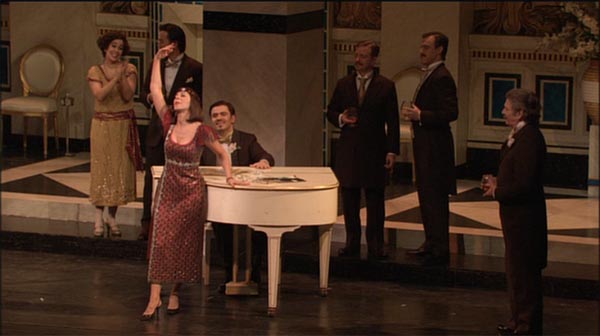
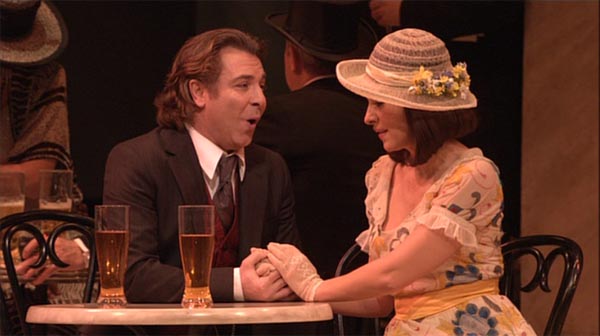
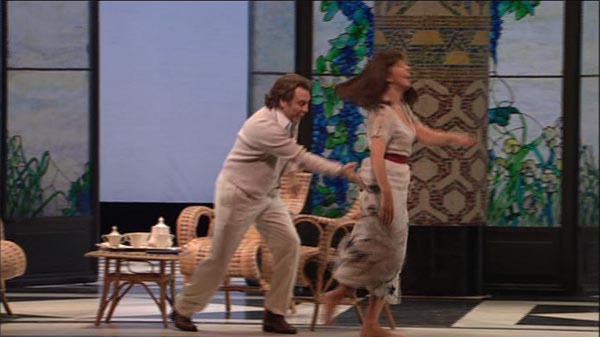
Puccini’s La Rondine has a plot that’s lightweight even by opera standards but it also has some really good tunes and plenty of opportunities for a star tenor and soprano to show off. In 2009 the Metropolitan Opera presented it as a vehicle for on again, off again couple Roberto Alagna and Angela Gheorghiu. Judging by the body language on and off stage this was definitely an “on again” phase. The production (Nicolas Joël), staging (Stephen Barlow) and design (Ezio Frigerio) don’t have a single thing in them that would cause concern to the most conservative of opera goers. The whole thing oozes old fashioned opulence. It’s the first time I’ve heard an audience applaud the sets! (Baldrick, you’ld laugh at a Shakespeare comedy). So no Regie here!

What we get is a beautifully sung and played performance. Gheorghiu sings gorgeously throughout and Alagna is not far behind. Their acting hows off some real sexual chemistry and if Gheorghiu tends to play the dive, well it’s that sort of role and that sort of production. They get well supported by Marius Brenciu, as the poet Prunier, and Lisette Oropesa, as the maid Lisette. These two basically provide the comic relief to the slightly cloying romantic main plot. Monica Yunus, Alyson Cambridge, Liz DeShong and Samuel Ramey take the other important roles and all are perfectly competent and true to character. The only aspect of the staging that doesn’t quite come off is the bar scene in Act 2. It’s all a bit too busy and there is some not very well thought through “drunk” choreography. Otherwise it’s basically a drawing room drama so not too, too hard to pull off. The orchestral playing is unsurprisingly good with the kind of music the Met orchestra excels in and Marco Armiliato conducting.

The video direction by Brian Large is OK. Given how much of the piece is two people talking, snogging or groping close ups seem a perfectly reasonable choice much of the time. The approach doesn’t work so well in Act 2 where a little more distance would have helped. Technically the DVD is an absolutely standard EMI treatment of a MetHD broadcast. The picture is very good 16:9 and the DTS 5.1 soundtrack is clear and spacious (LPCM stereo available too). English, French, German, Spanish and Italian subtitles and rather basic documentation in English with French and German PDF versions on the disk. Renée Fleming does the interval interviews which are about as revealing as usual (not at all).

All in all, it’s a lightweight piece but enjoyable and it would be hard to imagine a much better performance.

The Met’s Peter Grimes

I liked the 2008 MetHD broadcast of Britten’s Peter Grimes enough to buy the DVD as soon as it came out. After something of a hiatus I just watched it again.

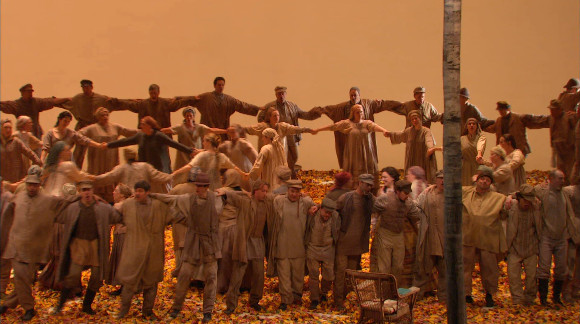
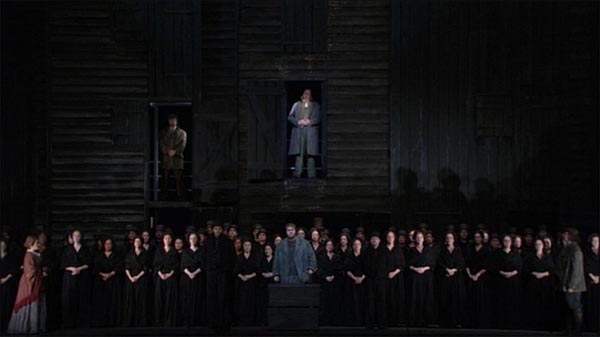
It’s an odd production. The director (Tony award winning – run for the hills) John Doyle, was the first to use, I think, what has now become a Met cliché; a wall with windows running the whole width and height of the set. In this case it can be moved forward and back but mostly it’s forward compressing the depth of the stage. The idea is to convey the claustrophobic nature of the Borough which is fair enough but mostly what it does it confine the enormous chorus to a space it barely fits in meaning there are few options but to have it face straight forward in serried ranks and sing. To be fair, there are scenes where it’s very effective; the opening inquest scene for example and “Peter, we’ve come to take you home” in Act 3. It’s much less successful in, for example, the pub scene. The production is also very dark. This always bothers me because despite eating vast quantities of carrots my night vision isn’t great. I don’t really get it.

Dark as a metaphor is pretty blatant and comes at a heavy cost in terms of the production’s ability to convey anything else. Only at the end, in the final chorus, is the wall removed and the stage lit less funereally. The sea interludes are played out in front of a blank wall. No effort is made to give them visual accompaniment. The “wall” and the naked Interludes both tend to banish the sea from the production. There’s really no sense that the Borough is a fishing village and therefore the whole role that the sea plays in the psyche of people who make their living from it is lost.

The video director, Gary Halvorson, appears either to hate the production or think that the cinema/DVD audience is too thick to get it because he relentlessly undermines it. Unable to present the dark, stark stage that Doyle has called for he gives us a compilation of super closeups and really weird camera angles; pointing up from the side of the pit, pointing down from what looks like the cheapest seats at the outermost edge of Ring 4 and so on. He also can’t accept that the director doesn’t want to distract from the music during the Interludes so we get a succession of close ups on audio members and, more especially, on conductor Donald Runnicles. This is particularly unfortunate as Runnicles conducts like a hyperactive and self regarding pterodactyl.

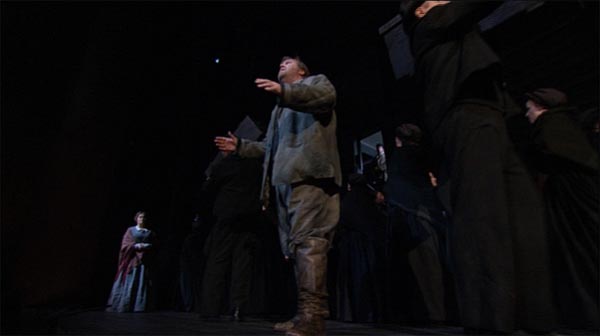
The above got over with there’s much to like in this DVD set. The performances are generally very good. Tony Dean Griffey is a highly effective Peter Grimes as well as singing very well. He’s close to Peter Pears in his almost dreamy interpretation. He lacks the intensity of Langridge or the brutality of Vickers but its a valid and compelling portrayal. Anthony Michaels-Moore almost steals the show as Balstrode. This is surely the best take on the role since Geraint Evans. The sense that he’s the one man who really wants to help Grimes but knows when enough is enough is overwhelming. There are good performances in the other male roles especially from Teddy Tahu Rhodes as Ned Keene. The women are more of a mixed bag. I still can’t really get into Patricia Racette’s Ellen Orford. She acts well and is sometimes very lyrical but at other times she seems shrill and her vibrato too much for my taste. The Auntie of Jill Groves though is really good. Even toned and with a suitably cynical but not unkind persona she nails the role. The Mrs. Sedley of the timeless(1) Felicity Palmer is also quite excellent. She’s acid without being unmusical and not at all caricature like. Donald Runnicles takes things at a generally rather leisurely pace which makes the first act in particular drag a bit but the tension does build and there’s no disputing the beauty of the orchestral playing. The chorus is excellent throughout.

Technically it’s a typical DVD transfer of a MetHD broadcast. The picture quality is very good and the DTS 5.1 sound is excellent (LPCM also available). There are subtitles in English, French, German, Italian and Spanish. There’s a track listing, synopsis and unhelpful essay printed in English (French and German versions in PDF on the disk). The interval features are typical but livened up a bit by Natalie Dessay who seems more willing to go off script than the other Met regulars (probably why she no longer seems to appear).

Bottom line, it’s good but I’m still searching for the ultimate DVD Grimes.

fn1 timeless as in I saw the, then, Ms. Palmer sing Pamina the month after I saw Vickers sing Grimes in 1975

Starvation, drugs and child abuse? It must be Christmas

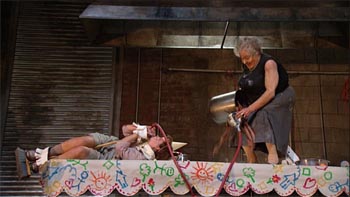
Humperdinck’s Hansel and Gretel was one of the earlier “Live in HD” broadcasts from the Metropolitan Opera and has been out on DVD for some time. The newness of the concept is immediately apparent in Renée Fleming’s almost awed tone as she introduces the work. She certainly sounds more blasé these days. Hansel and Gretel, given here in David Pountney’s English translation is an odd work. The libretto is much more than a Disney fairy tale. There is poverty, hunger, drunkenness, threats of beatings and murder. There is also a layer of religious sentimentality so thick it could only be 19th century and German. The score is astonishingly heavyweight given the subject matter. Humperdinck worked with Wagner and that is very, very apparent in this piece.

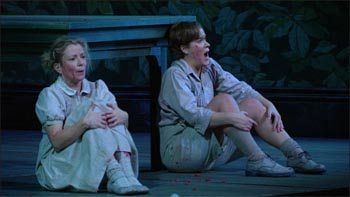
Unsurprisingly, modern directors have tended to emphasize the darker side of the work and Richard Jones is no exception. Hunger is the driving force here and each act is set in a kitchen. A poor peasant cottage in Act 1, a dream like banquetting facility in Act 2 and the Witch’s nightmarish cake factory cum kitchen in Act 3. Much food is thrown around and smeared over people. It’s pretty succesful as a concept if a bit one dimensional.

The performances are spectacular and based on some serious luxury casting. Alice Coote and Christine Schäfer as Hansel and Gretel are terrific, especially Schäfer. It’s a wonder to me that a beautiful and elegant woman like her can do grubby so well but she nails it every time (Cherubino in Salzburg, Lulu at Glyndebourne) and this is no exception. Alan Held is a booming father; as big in voice as he is in stature. Rosalind Plowright doesn’t sing prettily but she is utterly convincing as the depressed, shrewish, drug addled mother. Then there is the much missed Philip Langridge camping it up as the Witch. He’s like an incredibly messy Julia Child on speed. He’s hilarious. Sasha Cooke plays the Sandman and Lisette Oropesa plays the Dew Fairy complete with washing up joke. Vladimir Jurowski conducts the Metropolitan Opera Orchestra as if he was conducting The Ring and they play beautifully for him. The very well drilled Met Children’s Chorus also get a look in in the final scenes. Overall, the performance has a high degree of integrity and very high musical values. It’s a good bet for this work which I still can’t really bring myself to like.

Technically this is what you would expect from a Met “Live in HD”. No video director is credited (so far as I can tell) but it’s got about the usual quota of super close ups, including a completely gratuitous foot shot, which is actually a bit odd as the sets for Acts 1 and 2 are basically confined to a thirty foot cube so it would be easy to encompass the whole picture. The picture quality is good, not stunning, DVD standard. The DTS 5.1 soundtrack is excellent and is particularly good at bringing out the very precise orchestral playing. There is also LPCM stereo. It has the usual HD Broadcast extras. There are English, French, German, Spanish and Italian subtitles. The documentation (English only) includes track listings, a synopsis and a short essay. There is additional information in English, French and German in a PDF on the disc itself.

Will the Met’s Live in HD series significantly affect live opera?

I’ve been giving far too much thought to a range of issues surrounding the Metropolitan Opera’s Live in HD broadcasts to cinemas. They have attracted a wide audience and are much talked about, both as performances and as to their impact on live opera; the so-called HD Generation. That said, I’ve seen little analysis of what the broadcasts really are or of their audience or of how and why the HD audience reacts to them the way it does. I want to explore those questions and then go on to look at whether and how the HD broadcasts might influence the practice of live opera. Some of this will be speculative as I am certainly not privy to the kind of data about the audience and its reaction that I would need to do what I want to do well. Some of it will be coloured, perhaps highly coloured, by my own experiences with live music, electronically reproduced music and the tricky relationship between them.

Continue reading

Anna Bolena – MetHD broadcast

Today’s Metropolitan Opera “Live in HD” broadcast was Donizetti’s Anna Bolena. I was not overly impressed although whether this was a result of issues associated with the broadcast or what was happening in the house I’m not entirely sure. One issue was that, again, the cinema was forcing its sound system well past the point at which it could consistently and accurately reproduce music. It may be OK for car chases and explosions but they need to throttle the volume back for the opera broadcasts. I’m guessing that they could drop the sound 6dB and still be louder than it would sound in the house. Driving the speakers and amps at 25% of the pressure level they are currently flogging them at would surely reduce the harmonic distortion. This was particularly an issue because this was very “heavy” Donizetti. I don’t know the work well enough to know whether it has to be done this way but the Met cast large voices in almost all the major roles and Marco Amiliato in the pit seemed to be demanding a very loud and strident sound from the orchestra. It was quite dramatic but emphatically not bel canto; more like forte shouto really. The only singer who sounded idiomatic to me was Tamara Mumford as the page, Smeaton. It did get better after the interval and the big duet between Anna (Anna Netrebko) and Giovanna Seymour (Ekaterina Gubanova) was really quite affecting. Also as far as I could tell Netrebko was singing really well in the “mad scene” (which really isn’t all that mad as these things go) but unfortunately the person in the seat behind me was having extremely audible “gastric distress” and both the lemur and I were having the hardest time not dissolving into giggles during perhaps the most solemn part of the opera. And I thought the coughing at the Four Seasons Centre was bad.

Continue reading

Die Walküre

Once in a while an opera performance really blows you away and it becomes quite hard to write about, especially when the work is as long and dense as Die Walküre because even with a great performance one is in overload by the end. Yesterday’s broadcast from the Met was one of those experiences. Here’s what I think I saw!

Continue reading

Il Trovatore

Il Trovatore has gypsies, burning at the stake, dead babies, mistaken identity, poison, love, hate, revenge and enough plot holes to sink the Titanic. It also has some very effective dramatic moments and some utterly fabulous music. The biggest snag is probably that the utterly fantastic music needs a quartet of soloists who can deal with fiendishly difficult parts that require a combination of flawless bel canto technique coupled to Puccinian power and stamina. The power and stamina requirement being especially high in a barn like the Met. It also has a dramatical problem in that it consists if a sequence of fairly short scenes which means a production runs the risk of being chopped up by the changes of set.

Continue reading

Capriccio

Yesterday’s Met Live in HD transmission was Richard Strauss’ last opera Capriccio. It’s a curious work and I suspect how one thinks about it seriously affects how one reacts to it emotionally. On the surface it’s a sophisticated meta opera about opera with some side splittingly funny gags about unstageable production concepts accompanied by pastiche Wagner. Taken on that level it’s funny but perhaps, ultimately heartless. When one realises that the opera was written in 1941/2 it adds a new dimension. Why has Strauss set this opera in Enlightenment Paris? Where else could be more symbolic of everything the regime he is writing under is not? This work premiered a few weeks before the German defeat at Stalingrad. Does Strauss sense that german is losing the war? Is this less an affectionate farewell to the form from an elderly composer or an elegy for an artform that may not survive the destruction of European civilization which most would have thought the inevitable consequence of a Russo-American victory (who’s to say they weren’t right?). Any way these were the thoughts that were going through my head as I watched yesterday’s broadcast and no doubt helped give the work, for me, a greater emotional intensity.

Continue reading