Pelléas et Mélisande in the Tanenbaum Courtyard Garden

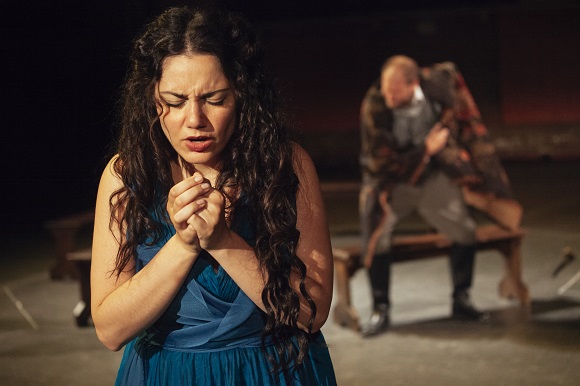
Hidden away up an alleyway behind the COC’s ioffice and rehearsal complex is a very beautiful garden.  I say hidden because I lived less than 200m away for 10 years before I discovered it.  Last night it made a rather magical setting for Against the Grain Theatre’s new production of Debussy’s Pelléas et Mélisande.  The piece is set in a gloomy castle and surrounding forest in Brittany.  The high, ivy covered walls and ironwork of the performance space, enhanced by Camelia Koo’s fractured flagstones forming patterns on the grass, evoked the essentially sunless world of Maeterlinck’s poem.  Costuming in the style of the period’s composition meshed nicely with the aesthetic of the roughly contemporary space.

blockd-3031 Continue reading

Beyond pale

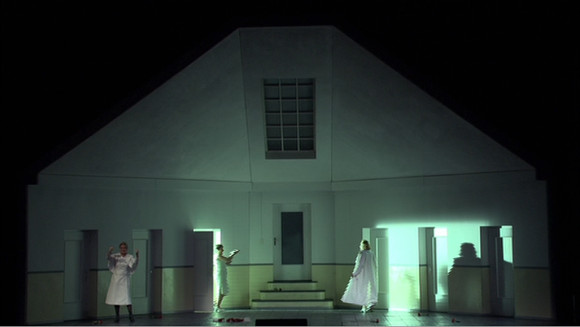
Paul Dukas’ Ariane et Barbe-bleue is a setting of a libretto by the symbolist poet and playwright Maeterlinck.  It’s roughly contemporary with both Debussy’s Pelléas et Mélisande and Strauss’ Salome.  It shows.  It really is a product of a particular fin de siècle world view.  Like Debussy’s piece, Ariane is loosely based on a folk tale.  In this case it’s the gory story of Duke Bluebeard and his six wives but here it’s curiously etiolated.  It’s as if Maeterlinck is reacting to the ultra-realism of, say, Zola, by retreating into a strange inner world.  It’s not even the troubled inner world of Freud or Jung either.  It’s colourless (and we’ll come back to that).  All this is reinforced by Maeterlinck’s style of telling rather than showing.  Much of what “action” there is takes place off stage and is narrated by the on stage characters.  Both words and music are used to fill in the gaps.

1.set Continue reading