
Britten’s Peter Grimes is pretty well served on DVD. Peter Pears’ performance was captured in a BBC broadcast in 1969 and John Vicker’s radical interpretation was captured on video in 1981. More recently Christopher Ventris and Tony Dean Griffey have also made it onto video disc. There is also Philip Langridge in Tim Albery’s 1994 ENO production which is the focus of this review.
 Discussions of interpreting Grimes tend to fall into a Pears vs. Vickers dichotomy. Vickers offers a rather brutal portrayal which is consistent with the libretto but tends to downplay the subtlety of the music while Pears is almost lyrical and dreamy. Notoriously the composer greatly preferred Pears’ version and had little good to say about Vickers. Langridge doesn’t really fit either of these models. His reading is intense, veers on madness from the beginning and is totally convincing in the “mad scene” in Act 3 Scene 2. What’s harder to reconcile with this reading is the violence that can’t be avoided. Langridge’s Peter just doesn’t come across as the sort of man who would suddenly strike a woman in the face. That said, it’s a fascinating and compelling reading. It’s also beautifully sung. Parts of the role lie cruelly high (certainly too high for Vickers) but Langridge copes with ease and beauty of tone. It’s a performance to stand alongside any of the others. He’s very well backed up by Alan Opie as Balstrode who is as good as anyone else who has taken on the role (and that’s an exalted list) Janice Cairns is a pretty good Ellen Orford. She starts a bit slow but by the second act she’s singing and acting beautifully. The rest of the cast is also pretty good. Unfortunately the orchestra (conducted by the usually excellent David Atherton) and chorus aren’t up to the standard one might hope for. They are certainly not in the same league as the Metropolitan Opera forces on the DVD recorded as part of the “Live in HD” series and they just don’t have either the punch in the gut impact in the final scene that one would like or the shimmering beauty that Runnicles finds in the Sea Interludes. Some of this may be the recording (see below) but some I think is intrinsic to the performance.
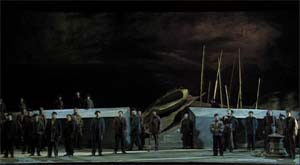 Tim Albery’s production is interesting. On one level it’s quite conventional with somewhat stylized but essentially naturalistic sets; fishing boats, nets, a tavern etc. Costumes too are in the same vein; set perhaps a few decades later than originally but not jarringly so. On another it’s less obvious. He makes use of video projections in the interludes. They are black and white and switch from grainy, almost posterized, sea scenes (including some rather odd fish) to projections of Peter and his apprentice later on. They also make an appearance during the storm scene in the pub.
  They look a bit clunky to me. Whether that’s deliberate or the best that 1994 technology could manage I’m not sure. The detailed stage direction, both of principals and chorus, is at times very good indeed. I suspect that it’s actually even better than the DVD allows us to see. The Act 1 scene between Balstrode and Grimes made me realize that Peter Grimes really is a tragedy. The protagonist has choices but his pride forces him towards his nemesis. I’ve never previously seen that so well brought out. The menace in the crowd scenes is palpable too. Where I’m less convinced is in Albery’s focus on the apprentice. We see visuals of him all the time and the opera closes on a projection of his corpse. He’s also portrayed as utterly terrified all the time. It’s somewhat at odds with the portrayal of Grimes and makes it quite hard to see why Ellen and Balstrode don’t smell a rat. Also, the focus on the relation between Peter and the boy downplay the role of the sea as a player in the drama. For me, the inexorability of the sea is a constant chorus element in this opera but it doesn’t come out in this production.
Now for the disappointing bit. The DVD sucks. I so wish I had seen this live! The video direction was very clearly for small screen (its from a BBC broadcast) and odd angles and super close-ups abound. One has to work quite hard to mentally reconstruct what Albery was aiming for. The sound too is poor. The only option is Dolby 2.0 and it lacks clarity. The chorus at times sounds pretty awful and I’m sure a big part of that is the recording. To cap it off there are no subtitles. That might not matter if the recording were super clean but it isn’t. The only documentation is a chapter listing. Now I was watching the North American release on the notorious Kultur label (when I hear the word “Kultur” I reach for my Browning). In Europe it was released on Euroarts and based on past experience and reviews that might well be a different story.
If the best you can do is a copy of the Kultur pressing I’d say this is definitely worth a look, if only for Langridge’s performance, but it’s by no means the best recording out there.
This recording was rebroadcast in HD by the BBC on June 1st 2025. My revised thoughts based on that broadcast are here.


