
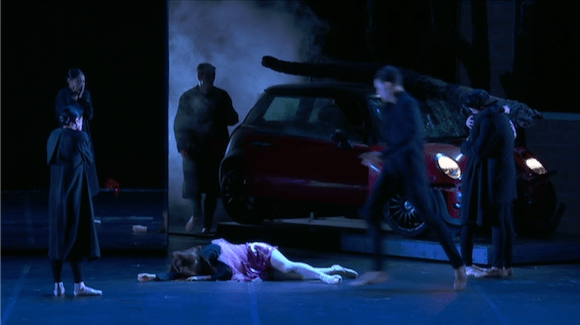
John Neumeier’s production of Gluck’s Orphée et Eurydice, recorded at Lyric Opera in Chicago (also seen in Neumeier’s home house of Staatsoper Hamburg and scheduled for this year’s Salzburg Whitsun Festival with the same principals) is quite unusual. Neumeier designed sets, costumes and lighting and served as both director and choreography. It’s very much his work. It’s also the Paris version rather than the Vienna (Italian) version more usually seen. Orphée is sung by a tenor and there’s a lot of ballet which extends the opera to three acts spread over two hours; maybe half an hour longer than an average production. Neumeier also chooses to give the story a modern frame. Orphée is a choreographer, Amour his assistant and Eurydice his prima ballerina as well as wife. The piece opens with a ballet rehearsal during the Overture. Orphée and Eurydice have a flaming row, She storms out and is hit by a car. At the end Eurydice, or her ghost, shows up during another rehearsal. The ending is in fact very unclear. As is the purpose of the frame. Is all the action supposed to be a dream or a trip? I couldn’t tell and it really didn’t seem to add anything.

 operaramblings