Die Fledermaus redux

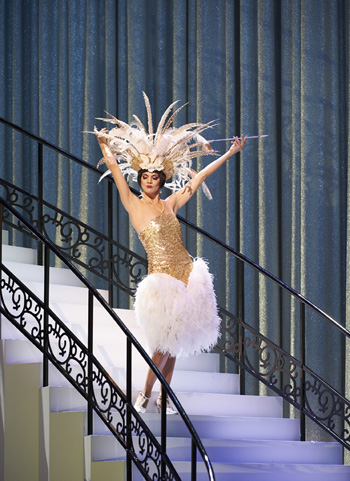
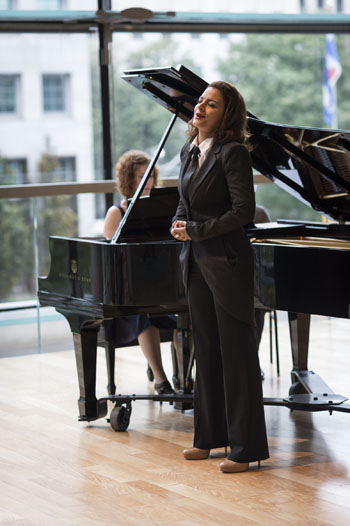
Mireille Asselin as Adele – Photo: Michael Cooper

I was back at the Four Seasons Centre last night for another look at the new Die Fledermaus; this time with Mireille Asselin as Adele.  There were a number of things about the production that I noticed more on a second look.  The most notable was the lighting (by Paul Palazzo).  It’s superb.  It’s atmospheric without falling into the trap of being so dark one can’t see anything.  Obviously too I saw the kind of prefiguring that goes on throughout the production differently knowing where things were going to go.  It’s clever and insightful without being too intrusive.  I also noticed one or two bits of comic business that either passed over me on opening night or have been added since.  Was the Fidelio joke there on opening night?  My overall verdict hasn’t changed.  It’s a funny, sexy production that can be enjoyed on many levels and one of the best things I’ve seen in ages.

So how was Mireille?  She was very good and very different from Ambur Braid.  Mireille is pretty much your classic soubrette; what I guess we are now calling an -ina voice.  It’s not a particularly big voice but she’s accurate and musical.  She’s also a very decent actress.  One feels that she’d be an ideal Adele in a perfectly conventional Fledermaus.  For this rather spikey, edgy version though I’d go with Ambur.  Her bigger, almost abrasive, voice and her more flamboyant acting (considerably helped by her rather striking appearance) really fit this production.  I’m glad I got a chance to see both of them.
Full review of the opening night with Ambur Braid as Adele

In the news

The good news this week is that Canadian Opera Company have extended the contract of Music Director Johannes Debus through 2017. This follows the announcement of a contract extension for General Director Alexander Neef. So, not only does COC get to keep a very good conductor who is well liked by the orchestra but it keeps the Neef/Debus team together for at least another five years. Neef and Debus seem to work together extremely well so this bodes well for a continuation of the combination of varied repertoire, interesting productions and starry casts that we have seen recently at the Four Seasons Centre.  Continue reading

Fifty shades of grey

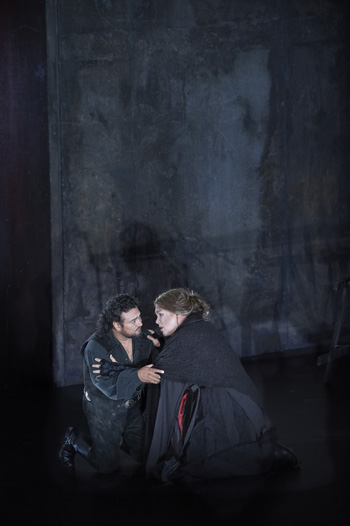
Verdi’s Il Trovatore notoriously has an episodic and highly improbable plot.  It’s also famously difficult to cast.  Creating a compelling production and staffing it with capable singers therefore presents a formidable double challenge.  The current Canadian Opera Company production gets it half right.  The problem is Charles Roubaud’s much travelled production.  There’s not an idea in it.  It’s not surprising that the director’s programme notes run to three short paragraphs.  Roubaud sets each scene in a sort of grey box of towering walls.  Unfortunately each grey box is just different enough that that the curtain comes down at the end of each scene and the stage crew spend what seems like an interminable amount of time setting up the next grey box.  We just aren’t used anymore to sitting quietly through interminable scene changes.  We expect slicker stagecraft and in a modern opera house there’s really no excuse for this 19th century approach.  Within in each grey box the grey clad cast come and go and in between mostly stand around.  Blocking is perfunctory, acting superfluous and old fashioned “park and bark” the order of the day.  It’s the sort of production that might have passed muster thirty years ago but really doesn’t cut it in 2012.
Continue reading

COC’s Fledermaus succeeds on several levels

Christopher Alden’s recent productions in Toronto; Rigoletto and Der Fliegender Holländer, were controversial, rather cerebral affairs that delighted his fans but tended to puzzle, and even infuriate, the more conservative critics and opera goers.  His Die Fledermaus, which opened last night at the Four Seasons Centre, has something for everybody.  There are two main threads uniting the three acts.  The first is the piece as an allegory of Austrian bourgeois society from an insecure pre WW1 period through a period of unbridled hedonism in the 1920s to the beginnings of Fascism.  The second is a much more explicit depiction of Falke as the ringmaster of the whole circus.  He goes from manipulative Freudian psychiatrist in Act 1 to Orlofsky’s confidante in Act 2 to, bat costumed, sitting astride the giant watch that hangs above the stage; the only character aloof from the takeover of the drama by the sinisterly Fascistic Frosch. All this is strung together by prefiguring later elements in earlier scenes.  In Act 1 the party goers from Act 2 invade the scene via the fractured wall of Rosalinde’s bedroom as Gabriel imagines the delights to come.  A silent but frenetic Frosch appears on stage at various points in the first two acts although his identity isn’t apparent until the coup de theâtre that carries us into Act 3.  Additionally Alden does not shy away from bat imagery, including it’s darker overtones.  There are bat shadows on the backdrop during the overture, Falke first appears as a Dracula look alike, the ‘ballet’ are batgirls and we close out with Falke, again dressed as a bat, overseeing the denouement.  There’s a lot going on  and I shall be very happy to see this again and delve deeper (a recurrent theme with Alden productions).  Continue reading

Sneak preview of Die Fledermaus

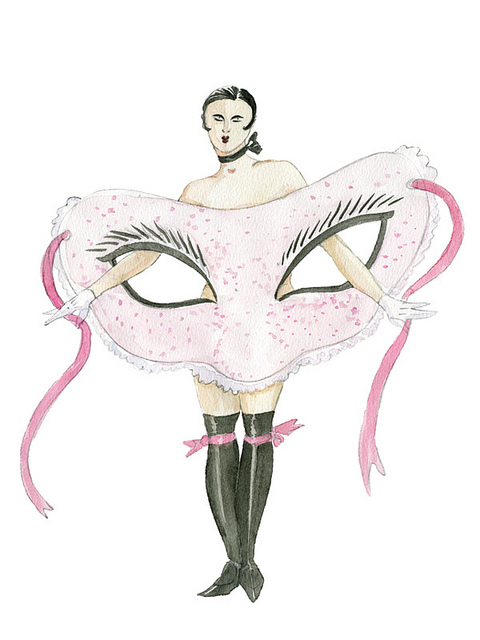
Female chorus member – Sketch: Constance Hoffman

There’s an event on in Toronto this weekend called “CultureDays”.  The COC’s contribution last night was an open orchestra dress rehearsal of Christopher Alden’s new production of Die Fledermaus preceded by a talk in the Richard Bradshaw Auditorium by set designer Allen Moyer and costume designer Constance Hoffman moderated by the CBC’s Brent Bambury.  The event was “first come, first served” and restricted to 500 tickets so we decided to be early.  Doors opened at 1815 for a 1830 talk so the plan was to meet the lemur at the opera house at 1700, grab a bite to eat and then join the line-up.  I got there early as I was through at work and preferred to sit in the sunshine at the Four Seasons Centre rather than at my desk so I got there around 1615.  There was already a line up!  By the time the lemur showed up just before 1700 there was quite a line up so we changed plan and the lemur went off to fetch burritos to eat in the line.  Just as well as they ended up turning people away.  Continue reading

The review – COC Studio Ensemble in concert

(front row, l-r): Ambur Braid and Cameron McPhail; (second row, l-r): Jenna Douglas, Claire de Sévigné and Mireille Asselin; (third row, l-r): Neil Craighead, Owen McCausland and Sasha Djihanian; (fourth row, l-r): Rihab Chaieb and Timothy Cheung. Photo: Chris Hutcheson

So, as promised here are my thoughts on yesterday’s Ensemble Studio recital at the Four Seasons Centre.  It’s always interesting to see the Ensemble Studio together; to see how returning members have developed since last heard and to hear the newcomers.  This is what we got.
Soprano Claire de Sévigné gave us “Chacun le sait” from La fille du régiment.  It’s a good piece for a young singer and shee sang it with spirit and enthusiasm and acted with gusto.  Perfectly idiomatic French too of course.  She has a lovely voice and is clearly one to watch.

Continue reading

Here we go again

Photo credit: Chris Hutcheson.

Today was the first concert of the season in the free concert series at the Four Seasons Centre featuring the very talented artists of the COC’s Ensemble Studio.  I promise that there will be a proper review very soon but right now all I can offer is a treat for that section of my readership who have a thing for cross dressing mezzos.  You know who you are!

Not a DVD review

Nixon in China at the COC

There are an awful lot of opera DVDs about.  It sometimes seems like there’s a new Tosca or Traviata out every week, often for no apparent reason.  It’s perhaps surprising then that some works don’t make it to DVD.  One particularly egregious case would seem to be John Adams’ Nixon in China.  It’s a good piece and has had plenty of productions both in North America and elsewhere.  A couple of years ago I saw it twice in 24 hours; on a Friday evening at COC followed by the HD broadcast from the Met the following afternoon and I’ve been listening to an audio recording of the COC version on my walk to and from work.  But there’s no DVD!  I guess that the Met probably planned to release the HD recording but James Maddalena, the Nixon in the recording, was so obviously ill I was actually surprised that he continued after the interval and I guess that scuppered that. Continue reading

The Big COC Podcast

The first in a new series of the Canadian Opera Company’s The Big COC Podcast is now up on the COC website and at iTunes. (On iTunes search for “The Big COC Podcast”).  It features Gianmarco Segato of the COC, Wayne Gooding of Opera Canada, Leslie Barcza of barczablog and myself. You can hear us talk about operetta in general, the COC’s upcoming Die Fledermaus, Evgeni Nikitin’s tattoos, John Teraud’s “boulder and a hard place” article and the problems of getting the word out to potential audiences in a post-newspaper world.