Yesterday afternoon saw the final concert of the season for Off Centre Music Salon; the concert series organised by Boris Zarankin and Inna Perkis at the Glenn Gould Studio. This one, as the title suggests, celebrating philanthropy in music by putting together a concert of works by composers who were supported by patrons. It was very much salon style with many short sets by various combinations of performers. There was some instrumental music; an impressive performance of Khachaturian’s Toccata in E flat minor by twelve year old William Leathers, reprised later on accordion by Michael Bridge. Jacques Israelievitch and Boris Zarankin collaborated on a bravura rendition of Stravinsky’s Suite Italienne and Zarankin and Perkis gave their traditional one piano/four hands performance, this time an arrangement of Beethoven’s Egmont overture, which was received with enthusiasm.
Today’s free lunchtime concert in the Richard Bradshaw Amphitheatre was given by Canadian bass, Robert Pomakov and the Gryphon Trio (Annalee Patipatanakoon – violin, Roman Borys – cello, Jamie Parker – piano).
First up we got Parker and Pomakov performing Beethoven’s An die ferne Geliebte. Pomakov has a big voice as I knew from having heard his Monterone twice this month at the Four Seasons Centre. I was impressed by how well he could scale back his volume and even more impressed by the wide and appropriate range of tone colours he deployed. He doesn’t sound entirely secure at ppp but for a voice of his type he was pretty good! Next the Gryphons gave us the Elegia from Arensky’s piano trio. I don’t know this work at all but they sounded very accomplished and musical. The finale was Mussorgsky’s Songs and Dances of Death in Gary Kulesha’s arrangement for voice and piano trio. This time Pomakov could let rip with all his considerable power accompanied with equal fervour by the Gryphons. The whole thing was very impressive and very loud!
The scary thing is that Pomakov has only just turned thirty and already has this huge sound. Apparently he’s had it for a while because he’s sung in twenty COC productions going back ten seasons. I did check out Youtube to see if I could find Pomakov and there is one clip of him singing the Russian National Anthem at the World Cup of Hockey in 2004. Here it is.
Apparently the 2000 production of Beethoven’s Fidelio at the Met was controversial. It’s very hard to see why. Although Jürgen Flimm has moved the setting to the mid 20th century and some unspecified country that looks vaguely Germanic the storyline is followed to the letter, bar a few changes to dialogue, and there is no risk at all of any dangerous ideas surfacing. It’s actually a very good example of what the Met does when it’s on form; assemble an all star cast, stick them in an inoffensive production and let the music do its thing. Here we have an enviable cast. Leonora/Fidelio is sung by Karita Matila who looks and sounds spectacular (although maybe the fact that she’s the only “male” among the principals with no facial hair should have triggered a little cluefulness). Vocally she is most assured and never seems under any strain at all. She acts well too. Ben Heppner, as Florestan, is also vocally solid and even quite lyrical in the big trio “Euch werde Lohn in besseren Welten”. The acting though is best passed over in discrete silence. René Pape is fascinating as Rocco, the gaoler. I’m used to seeing Pape playing magisterial roles like Boris Gudonov or Sarastro. Here, the big voice is coupled with almost bumbling acting as he plays a morally weak character. It’s most interesting. A young Matthew Polenzani, one of my favourite tenors, sings Jacquino and he sings quite beautifully. Marzellini is Jennifer Welch-Babidge who I had never heard before but was sufficiently impressed to go look her up. It seems she’s busy with four kids in Utah and doesn’t spend much time at all in opera houses these days. It’s rather a pity. Falk Struckmann’s Don Pizarro is appropriately villainish and musically solid like everyone else. James Levine conducts and right from the overture launches us into a very intense, muscular reading of the score backed up by a very high standard orchestra. Musically and dramatically this is very satisfying albeit in a thoroughly conservative way.
The production was recorded for TV broadcast and it shows. The sets are already pretty claustrophobic but Brian Large’s video direction amplifies that. One gets the feeling that this is being directed for a 27 inch screen and it looks a bit lost on anything much larger. That said, the picture is more than decent and the DTS 5.1 soundtrack is top notch (Dolby 5.1 and LPCM stereo are also offered). The English subtitles are a bit odd. For some reason “Gouverneur” is translated as “Colonel” and “König” as “President”. I didn’t check the French, German, Spanish or Chinese subs for similar oddness. Bonus material is minimal but the documentation is fairly decent. All in all it’s a typical Deutsche Grammophon release of its period.
This excerpt from Act 1 (Gut, Söhnchen, gut) is pretty typical.

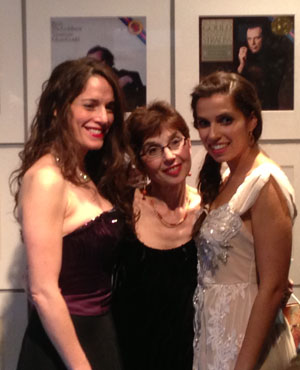 Yesterday afternoon saw the final concert of the season for Off Centre Music Salon; the concert series organised by Boris Zarankin and Inna Perkis at the Glenn Gould Studio. This one, as the title suggests, celebrating philanthropy in music by putting together a concert of works by composers who were supported by patrons. It was very much salon style with many short sets by various combinations of performers. There was some instrumental music; an impressive performance of Khachaturian’s Toccata in E flat minor by twelve year old William Leathers, reprised later on accordion by Michael Bridge. Jacques Israelievitch and Boris Zarankin collaborated on a bravura rendition of Stravinsky’s Suite Italienne and Zarankin and Perkis gave their traditional one piano/four hands performance, this time an arrangement of Beethoven’s Egmont overture, which was received with enthusiasm.
 operaramblings