A touch of Jamie in the night

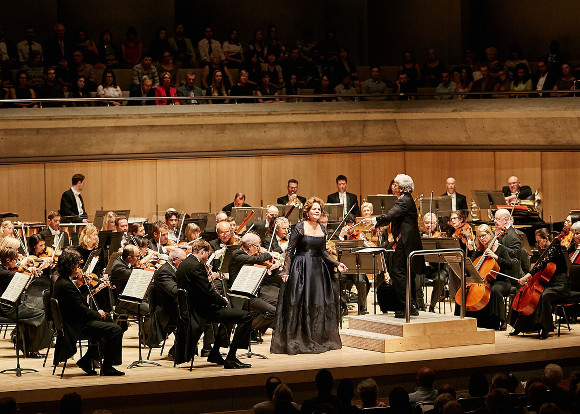
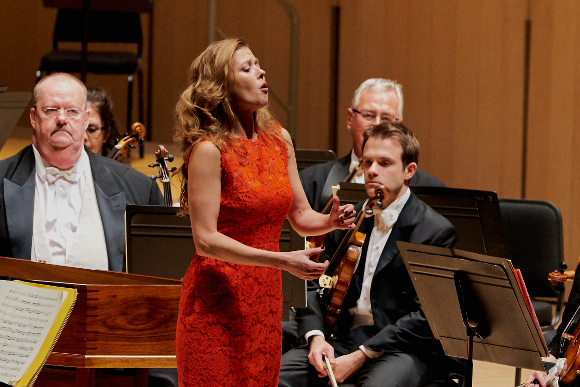
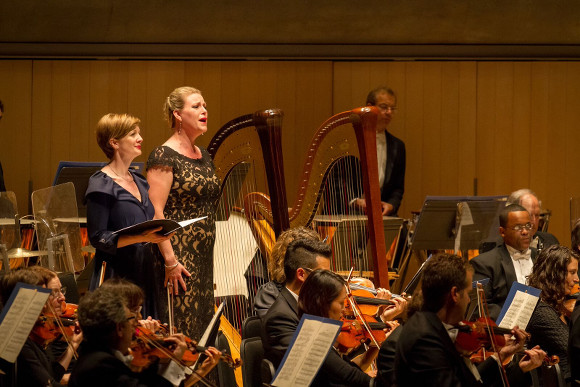
There must have been a lot of cash slopping around in the music world in Mahler’s day.  Imagine taking a new work to a symphony management today and saying “I’ve got this hour and a half long piece that needs a star mezzo and three choirs for about ten minutes.  Fancy giving it a shot?  Oh and it needs a bazillion players in the brass section.”  Anyway that’s Mahler’s 3rd symphony for you and the TSO did it last night with Jamie Barton as soloist and the ladies of three choirs plus a children’s chorus.  All in all it had far too much of the Mahler I don’t much care for; repetitively bombastic, and not enough of the kind I do; the bits with a kind of ethereal transcendent beauty.  And it really goes on a bit.  The last movement in particular has so many climaxes, and anti climaxes, that, at the end, the audience weren’t sure that it was really, finally over.  I’ll take the 2nd or the 8th or one of the shorter pieces over this one anytime.
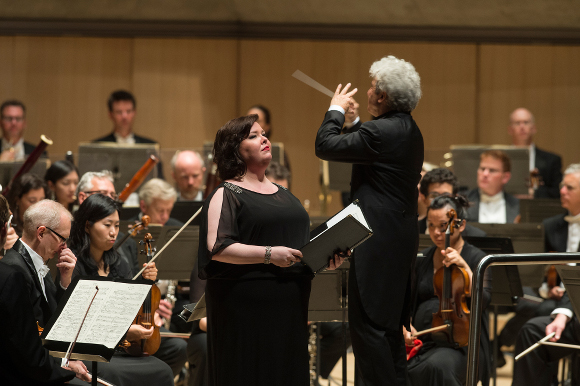
jamie-barton-peter-oundjian_-3-jag-photography

Continue reading

Renée Fleming at the TSO

The TSO’s season opener on Wednesday night featured Renée Fleming in one of her rare visits to Toronto.  As one might expect for a crowd friendly season opener it was largely a collection of “lollipops” though the all Ravel first half of the program perhaps had higher ambitions.  The orchestra kicked off with Ravel’s Alborada del gracioso; a rather vulgar piece full of castanets, twiddly Spanish tunes and solo bassoon standing in for a clown.  I guess one could at least say that Peter Oundjian and the orchestra were well into the spirit of the thing.  It was followed up with Schéhérazade.  I’m not sure what the score markings on this are… perhaps “très langueurezzzzz”.  It was a very Renée performance with beauty of tone (even in the soprano killing acoustic) dominating over drama or diction (though again  I’m cognisant that the hall swallows words).  It was a bit understated and I heard comments in the interval from people less well seated than myself that “they couldn’t hear a thing”.

renee2

Continue reading

The 13th on the 13th

On Babi Yar there are no monuments

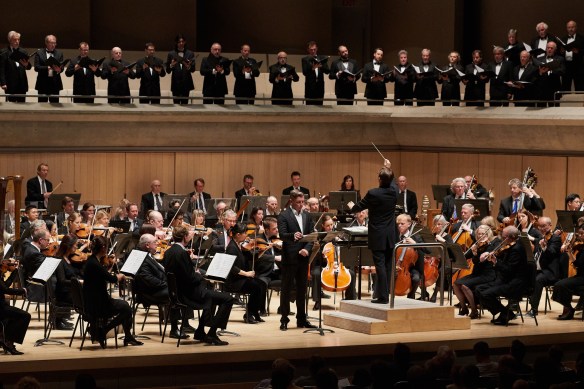
The real monument to those; young and old, Jew and gentile, who died in the horror that was Babi Yar are Yevtushenko’s words and Shostakovich’s searing setting of them in the opening movement of his thirteenth symphony.  It’s a symphony that combines sheer horror with the kind of blistering irony that is unique to Shostakovich.  It’s a work that I first met in my teens and like so much Shostakovich it has run like a leitmotif through my adult life.  So I was deeply moved to hear it given a red blooded, almost balls out Russian style, performance by the TSO last night.  No doubt a Russian conductor; Andrey Boreyko, and a superb Russian bass soloist; Petr Migunov, played a large part in that but so did the players of the TSO and the men of the Amadeus Choir and Elmer Iseler Singers.  The brass was strident and the percussion very loud where it needed to be though there was delicacy too from the rumble of the opening line quoted above to the faint dying away of the last note.  Most excellent.

Petr Migunov, Andrey Boreyko (Malcolm Cook photo).jpg

There was also a very nice performance of Mozart’s Violin Concerto No. 5 but that’s not what I was there for.  This program will be repeated at Roy Thomson Hall tonight at at 7.30pm and tomorrow at 3pm at the George Weston Recital Hall.

Photo credit: Malcolm Cook

Knocking at the Hellgate

Brett Dean 6235 (Mark Coulsen) LOW RESThe TSO’s New Creations Festival wrapped up last night at Roy Thomson Hall with a concert featuring Brett Dean’s suite Knocking at the Hellgate, drawn from his 2004 opera Bliss.  But first came a piece by Radiohead guitarist Jonny Greenwood.  Water is a tone poem (if one can still use that term) inspired by soome lines from Philip Larkin:

If I were called in
To construct a religion
I should make use of water.

Written for a chamber orchestra including two tanpuras and amplified piano, it’s an atmospheric piece mixing elements of minimalism and dissonance with extended techniques in the strings and note bending in an extremely competent way.  A fairly gentle introduction to what was to follow!

Continue reading

Call of Dutilleux

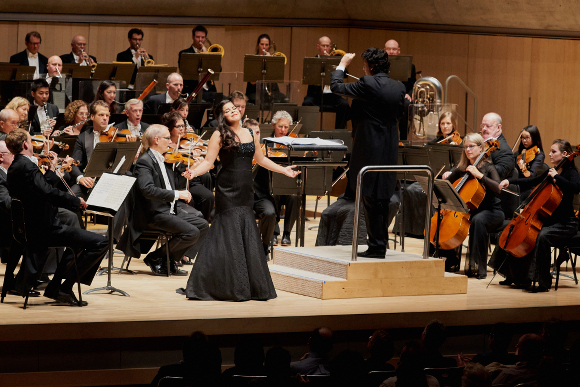
I suppose it’s a bit odd to go out to a symphony concert on a cold night out of interest in one twenty minute piece on the program but that’s what I did last night.  The item of interest was Henri Dutilleux’ Correspondances and the attraction was that the soloist was Barbara Hannigan.  It’s an unusual piece.  The five texts include, conventionally enough, three poems; two by Rilke and one by Prithwindra Mukherjee.  The two longer texts are letters; one from Solzhenitsyn to the Rostropoviches and one from Vincent Van Gogh to his brother.  The music is atmospheric and covers a wide range of moods from ecstatic to despairing.  It’s heavy on percussion and makes considerable demands on the vocal soloist.  Parts of it lie very high and it really needs the exquisite attention to each syllable of the text that is Hannigan’s trademark.  Little shifts in the vowels, the occasional drop into something approaching Sprechstimme and so on.  I thought the TSO and Peter Oundjian were really quite impressive here too.  The piece got the clarity and transparency it needs.  That said, it’s one of those pieces that few people, I think, will fully appreciate on one hearing.  Fortunately there is a very good recording of Hannigan singing it with the Orchestre Philharmonique de Radio France and Esa-Pekka Salonen.

Barbara Hannigan, Peter Oundjian 2  (Malcolm Cook photo)

The piece was bookended by Sibelius’ Swan of Tuonela and Berlioz’ Symphonie Fantastique.  The Sibelius was extremely well played with some lovely playing in particular from the cor anglais.  The Berlioz isn’t a piece I much care for and both of us were a bit under the weather so we skipped out after the Dutilleux.  If you missed last night’s performance it’s on again tonight at 8pm.

Photo credit: Malcolm Cook.

Requiem come to life?

Joel Ivany’s much anticipated “semi-staged” version of Mozart’s Requiem K. 626 finally saw the light yesterday evening at Roy Thomson Hall.  There were some interesting ideas but, ultimately, I didn’t think I came away with any new insight into the piece or life or death or anything really(*).  I’ll go into the reasons but first I should describe how it was performed.  The mass is prefaced by the slow movement from the Clarinet Quintet.  The lights go down.  The five players enter via the aisles in the audience lower level and take their seats (sadly to applause which we had been asked to refrain from).  As the quintet is played (and it was very beautiful) the players are joined by the rest of the orchestra, the choirs, conductor and soloists enter through the audience and from the wings and deposited slips of paper (I think) on two benches at front of stage left and right.  Names of the dead?  Probably and that’s a nice touch though scarcely original.  The quintet concludes.  More unwanted applause.  At this point the orchestra are seated , more or less conventionally, around the conductor with the choirs around them.  There are lots of fancy chairs.  The soloists are more or less in conventional position in front of the audience.  Everyone, except the mezzo and the soprano, are in black.  The very crowded stage is quite dimly lit in bluish tones.  As the mass progresses, the soloists interact in various ways.  The choirs gesture in rather obvious ways; the text says “king” so we pump our fists, the text talks of “writing” so we make scribbly gestures.  At some point the soloists start to rearrange the pieces of paper with the names of the dead in a sort of game of Dearly Departed Patience.  The soloists exit through the orchestra.  The lights go down.  The End.

TSO Mozart Requiem (Malcolm Cook photo)

Continue reading

Big, fat Messiah

Sir Andrew Davis is in town conducting his own orchestration of Handel’s Messiah.  In the modern world this is probably as close as it gets to Sir Malcolm Sargent and the Huddersfield Choral Society.  He conducts the TSO with brass and woodwinds that Handel never saw and lots of percussion including snare drum, sleigh bells, tambourines and marimba. He also has the not inconsiderable heft of the Toronto Mendelssohn Choir.

TSO Messiah 2015_Sir Andrew Davis (Malcolm Cook photo)

Continue reading

Mahler 4 at the TSO

Last night’s TSO concert was pretty satisfying.  It kicked off with The Dance of the Seven Veils from Salome.  I don’t think I’ve ever really listened to this without visuals before so that was interesting.  I thought Michael Sanderling did a good job of maintaining clarity while building towards the big climax.  For the rest of the program the orchestra was joined by Simone Osborne.  We got some “lollipops” in the first half.  The Song to the Moon from Rusalka, Depuis le jour from Louise and, unannounced, Vilja from The Merry Widow. Lovely singing, here sensitively accompanied by Sanderling and the orchestra.  Simone was clearly audible throughout which doesn’t always happen at Roy Thomson Hall.

Simone Osborne

Continue reading

The Hannigan show

Last night at Roy Thomson Hall Barbara Hannigan made her North American conducting debut with the TSO.  And, of course, she sang too.  She kicked off with Luigi Nono’s Djamila Boupacha for solo voice.  It’s a short but haunting piece inspired by a woman activist from the Algerian War.  I don’t think I’ve ever heard a solo, unaccompanied, voice in that hall and the effect is eerie.  It’s also a hell of a sing and to navigate it with utter precision is quite some feat.  As the last note died away (precisely on pitch) the violins came in with the opening Haydn’s Symphony no. 49 “La Passione”.  It starts off with an Adagio that’s curiously similar in mood to the Nono piece and Hannigan was conducting without score or baton.  In fact it was more like an interpretive dance than conventional conducting.  She has amazing arms and hands; the arms and hands of a ballerina in fact and as she summoned the strings to a sort of shimmering sound I couldn’t help but reminded of Swan Lake.  Corny perhaps but very real and quite disturbing.  And the orchestra, quite a small subset of the TSO, responded.  This was four movements of really lovely, chamber music like playing.

hannigan1 Continue reading

Mahler Resurrection

Mahler’s Symphony No.2 in C Minor “Resurrection” is a massive beast using multiple percussionists, a very large brass section (who rather disconcertingly troop on and off stage multiple times), choir and two vocal soloists and it lasts an hour and a half.  It’s also a very peculiar animal emotionally; combining almost naive folk dance tunes with passages of haunting beauty and extreme bombast.  Last night, in the second of two performances at Roy Thomson Hall, Peter Oundjian and the TSO give it a spectacularly unrestrained performance.

mahler2 Continue reading