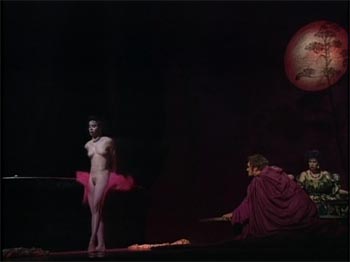
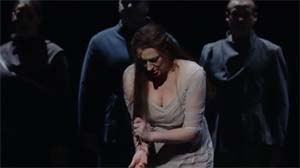
Sir Peter Hall’s production of Strauss’ Salome caused a bit of a sensation when it was first seen at the Royal Opera House and when it was broadcast on Channel 4 because Lady Hall, Maria Ewing, finishes up naked at the end of the Dance of the Seven Veils. How well does it wear after twenty years? First a couple of caveats. My DVD copy is the Kultur release of a few years ago. It now seems to be available from Opus Arte and it’s possible, indeed likely that some of the sound issues have been fixed in that release. If anybody has seen the Opus Arte version please let me know in comments. Anyway, the Kultur release has rather muffled sound with the voices balanced well back from the orchestra and no real solidity to the sound stage which is a pity in this particular work and obviously affects my view.
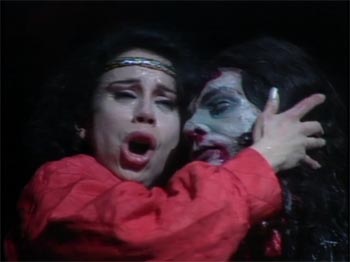
The production is really pretty conventional. There are lots of greens, greys and blue. It’s quite dark and the set is stagey and conventional. Almost all the visual interest revolves around Ewing’s Salome though Michael Devlin’s scantily clad and palely made up Jochanaan is quite arresting too. Narraboth (Robin Legate) is an unremarkable actor and Herod (Kenneth Riegel) and Herodias (Gillian Knight) look uncomfortably like a couple of drag queens. The latter though does manage a pretty effective hissy fit. For the sound reasons mentioned above it’s hard to be sure whether the rather insipid vocal performances by Devlin and Leggate are really their faults. There’s also no change in acoustic when Jochanaan is singing from the cistern which is odd. Riegel and Knight do better at projecting themselves beyond the orchestra and turn in OK performances.
All that said, one feels from beginning to end that this was set up to be the Maria Ewing show. One really can’t fault her acting which is quite compelling and manages by turns to be chilling, hypnotic, seductive, perverse, frenzied and orgasmic. The choreographer (Elizabeth Keen) does a pretty good job of creating credible dance moves for someone who clearly isn’t a great dancer though there’s no doubting her commitment to what she does. Vocally she gets away with a voice that’s really not big enough for the role. Somehow she manages a lot of projection from not so much volume and her vocal acting is good. It’s an extreme case of Ewing pretty much making things work when really they ought not to. The orchestra under Edward Downes sounds OK but also suffers from the recording.
The recording, directed by Derek Bailey, is about what one would expect from a 1992 TV broadcast. The picture quality is acceptable but not great 4:3 with hard coded English subtitles. Sound, as mentioned, is barely adequate. There are no extras and no documentation.
This is probably worth having a look at as a record of an iconic performance by Ewing but I can’t imagine anyone would choose it as the definitive Salome.
And just for fun, here’s a non-operatic bonus; a set of pictures of my copy of the 1938 edition of Wilde’s Salomé with pochoir illustrations by André Derain.
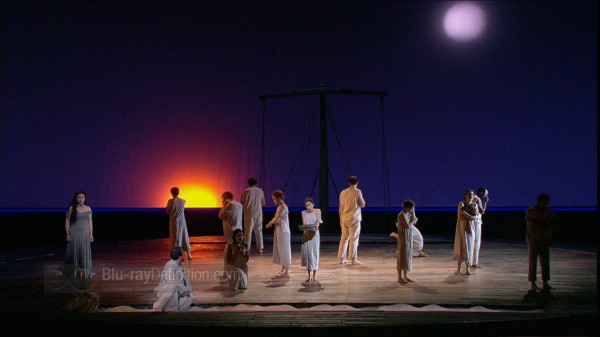
Harrison Birtwistle’s The Minotaur premiered at the Royal Opera House in 2008 and got a DVD and Blu-ray release on Opus Arte not long after. It’s the sort of work I’m susceptible to. It’s a truly integrated music drama based on a classical, indeed universal, theme carried off without any kowtowing to current ideas of trendiness. I’ve watched it a few times now and like most modern works of substance it reveals more with a bit of time and effort.
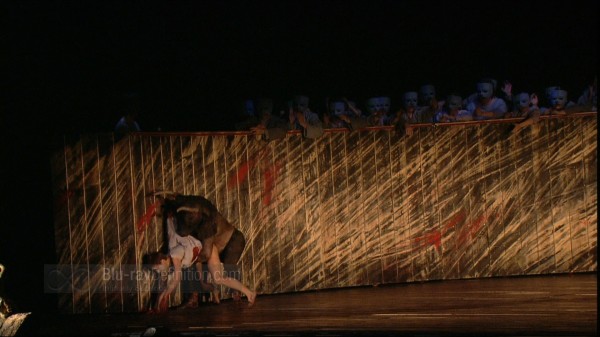
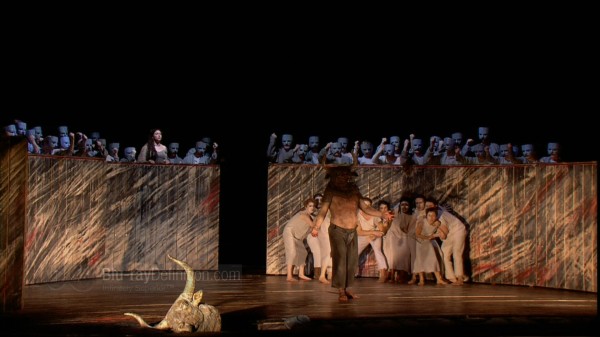
Librettist David Harsent’s take on the Minotaur myth is not at odds with versions many people will be familiar with (though whether in this day and age I’m not at all sure it’s safe to assume, as Harsent does, that “people are going in with a basic knowledge of the story”) but it does add some interesting ideas. His Minotaur, Asterios in this story, is articulate as a human only in his dreams and his dying moments. At these times he sings in English. As the awake monster in the Labyrinth he is restricted to inarticulate grunts. Also original is Harsent’s take on the relationship between Theseus and Ariadne. He sees this as a thoroughly corrupt relationship based on mutual need but riddles with disgust rather than love and so looking forward to the abandonment on Naxos. It works rather well. With those concepts in place we get a pretty straightforward account of the standard myth with some thoroughly brutal scenes of Asterios killing (and in one case raping) the Innocents in the Labyrinth to the blood curdling encouragement of a masked chorus of spectators. Another non-canonical addition at this point is the introduction of the truly horrific Keres who appear to feast on the bodies and the souls of the victims. It all leads up naturally to the death of Asterios at the hands of Theseus.
Birtwistle’s score is dense, multilayered and uncompromising. It’s clearly Birtwistle and makes no concessions to the current trend to try and make opera sound like a Broadway show. It’s not an easy listen but it repays a bit of effort and contains many interesting and deft ideas. For example Ariadne is paired throughout with the alto saxophone. Sometimes it takes up her singing line and carries it forward, sometimes it doubles her line and so on but nowhere does the saxophone interact with any other character. There’s a similar relationship between Theseus and the more conventional woodwind elements of the orchestra.
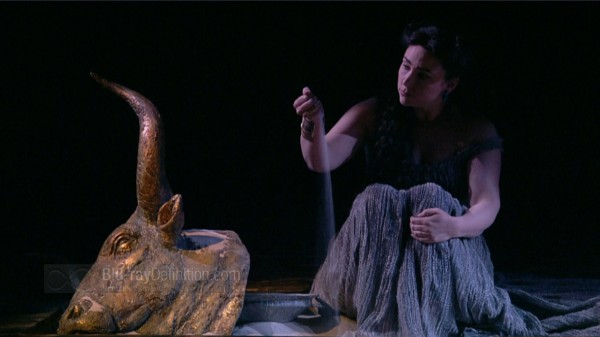
The design and direction; Alison Chitty and Stephen Langridge respectively, are very well integrated and are brilliantly supported by the lighting design of Paul Pyant. The result is some quite striking stage imagery that supports the changing moods of the piece really well. They also give us the mask that Asterios wears. It’s a framework affair so depending on the lighting Asterios can be fully beast or his human face under the mask can be made more present. It’s subtle and effective.
The performances are pretty much flawless. John Tomlinson, as Asterios, excels in a piece created for him. Christine Rice as Ariadne manages some really difficult music and a really long sing (she’s on stage nearly all the time) equally well. Johan Reuter (Theseus) has slightly off English intonation but sings powerfully and acts well. There are some excellent performances in the minor roles. For my money the best of these is the First Innocent of Rebecca Bottone who manages to look incredibly fragile but totally convincing during what is perhaps the most visceral scene of all where she is raped and killed by Asterios. There are very good cameos too from Amanda Echalaz as Ker and Philip Langridge as Hiereus. Antonio Pappano conducts and gets the necessary out of both orchestra and chorus.
The video direction is very good indeed. It appears to be a joint effort by Leo Warner and Mark Grimmer. The balance of setting shots and close ups is judicious and the close ups aren’t too close. They eschew silly camera angles. The picture on Blu-ray is 16:9 1080i and very good indeed. Sound is DTS 5.0 HD Master Audio and presents a vivid sound picture with good depth and breadth (PCM stereo also available). There are English, French, German, Spanish and Italian subtitles. The documentation includes a useful essay on the music and the disk has a 32 minute “Making of” documentary that is more informative than most of its kind.
All in all, this is a very impressive work, beautifully realised on stage and well presented on disk.
For the record the Opus Arte trailer and the whole piece are available on YouTube but the AV quality is appalling.
Simon Boccanegra was the work that persuaded me that maybe I did like Verdi after all. It’s a terrific score and if the plot isn’t without it’s artificialities it’s full of strong characters and strong emotions which Verdi brings to life with fabulous orchestral and vocal writing.
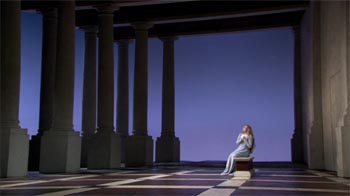
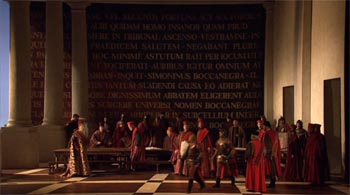
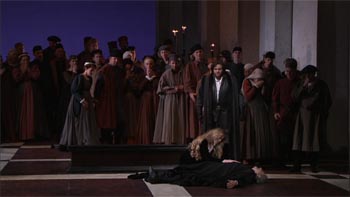
The most recent DVD version to appear is of the 2010 Royal Opera House production that was broadcast live on the BBC. It features Placido Domingo in his baritone incarnation in the title role. There’s a strong supporting cast with Ferrucio Furlanetto as his arch enemy, Fiesco; Jonathan Summers as the villain, Paolo; Joseph Calleja as the young rebel, Gabriele Adorno and Marina Polpavskaya as Boccanegra’s “lost” daughter, Amelia/Maria. The singing and acting are generally very strong. Placido is, of course, terrific. What more can one say? Furlanetto is a strong foil; excellent in both the prologue and the crucial final scenes. Summers is more than adequate though I might have hoped for more of a frisson when he curses himself. The real star for me is Calleja. He has a gorgeous voice and can float out a lovely pianissimo. His big aria early in the second act is particularly good but he is excellent all through the piece. The one weak link is Poplavskaya’s Amelia. It’s not bad. She acts well and looks the part but one really wishes for more beauty of tone. Pieczonka, in the Met HD broadcast, was much closer to the required vocal quality. Ensemble work throughout is excellent and there are some big set pieces! Antonio Pappano conducts brilliantly. He gets really good playing from the orchestra which is pretty crucial as there are some cruelly exposed woodwind and brass lines. He manages drama and urgency while still giving the singers room to do their thing when they need it. All in all, this is musically very satisfying.
The production, by Elijah Moshinsky, is pretty conventional. It’s a period setting with simple designs that suggest renaissance paintings. There are a few nice touches like the graffiti on the walls in the exterior scenes but mostly the look is just undistracting. There’s nothing beyond the text in the way the story is told either. Blocking is fairly basic and there’s a fair bit of “park and bark”. One senses that Moshinsky’s efforts have gone into character development rather than in trying to make any bold statement.
Sue Judd directed for TV and video and it’s a conventional TV view with too many close ups. She needs to watch some of François Roussillon’s recent work. We also get little chats from Pappano between scenes. These probably work OK first time through but I think would get pretty tedious on repeat viewing. There are short bonus features on WorshippingWorking with Placido Domingo and Rehearsals with Elijah Moshinsky. The technical quality is very good. It was filmed in HD and the picture is clear and detailed. The DTS 5.1 sound is really excellent; detailed, very spacious and coping very well with the more congested passages. There is also LPCM stereo. This really deserves a Blu-ray release but it’s on EMI who so far seem not to have gone that route(1). There are English, French, Spanish, German and Italian subtitles. The documentation is missing from my library copy but apparently contains a track listing, synopsis and “notes”.
This is definitely worth a look and it will be very interesting to do a detailed “compare and contrast” if I can get my hands on the Sony DVD release of the 2010 Met HD broadcast with Domingo, Morris, Giodarno and Pieczonka.
fn1. EMI was recently sold to Universal; parent of Deutsche Grammophon, and Decca so I suppose anything is possible.
One of the trickiest things about opera productions; baroque opera anyway, is what to do about the dance elements. Time was when opera and ballet were joined at the hip but not so much nowadays beyond sharing premises. In 2009 the Royal Opera House made the bold decision to have choreographer Wayne McGregor direct the combined forces of the Royal Opera and the Royal Ballet in a production of Henry Purcell’s pocket masterpiece Dido and Aeneas. The result was broadcast by the BBC and subsequently released on DVD and Blu-Ray by Opus Arte. It’s a fascinating and rewarding production.
Sets and costumes are very spare. Aeneas and the chorus are in greatcoats and wide trousers. The ladies are in unfussy gowns. The dancers are in singlets and booty shorts (both sexes). Carefully detailed direction of the singers and their gestures, bold choreography and imaginative lighting carry the visual side of the production. The use of top quality dancers and a top notch choreographer allows the dance elements to realise their full potential (and not a castanet in sight!). The result is visually stunning.
Now add a superb singing cast. Lucy Crowe almost steals the show as Belinda. She’s fresh and vivacious and her clean sound is just right for Purcell. But it is “almost” because we have Sarah Connolly’s monumental Dido to set against it.(1) She is one of the great Didos. I have heard Kirkby, Te Kanawa, Ewing and Baker in the role and even Flagstad but none exceed the combination of searing intensity and pathos that Connolly brings to the role. She is superb. Other elements of the singing are also admirable. Lucas Meachem is a hunky Aeneas and manages the tricky low notes better than most. The sorceress and witches; Sara Fulgoni with Eri Nakamura and Pumeza Matshikiza playing Siamese twins, don’t do the camped up distorted thing that is so often inflicted on the role. Fulgoni sings with quite a lot of vibrato which is sufficient to create some musical distance between her and the non infernal characters. The minor roles are all pretty good too. The regular Covent Garden orchestra is replaced by the Orchestra of the Age of Enlightenment under Christopher Hogwood. This is a move that other large houses might think about for earlier repertoire.
All this goodness builds to a searing climax in which Dido slits her wrists with the “tushes far exceeding those that Venus’ huntsman slew” and dies while a haunting projection of a horse plays back of stage. All in all it’s an hour of magic.
Video direction is much better than average. Close ups are minimised and we get to see the choreography in its broadest sense. The picture is superb 16:9 anamorphic (1080i on the Blu-Ray) and sound options are PCM stereo and DTS 5.1 (PCM 2.0 and PCM 5.1 on Blu-Ray). There are English, French, Spanish, German and Italian subtitle options.
Highly recommended.
(1) I do think the balance of voice types between Belinda and Dido is important. It’s like Carmen and Micaëla. If the voices are too similar much texture is lost. Crowe and Connolly are an ideal combination.
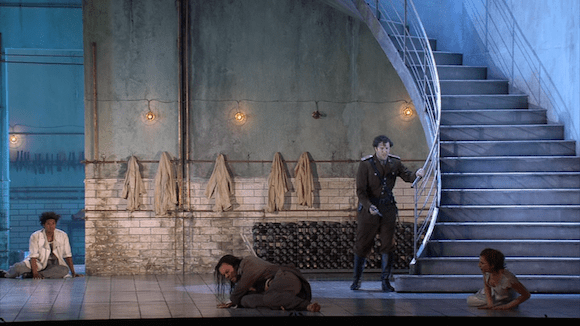
Strauss’ Salome is not for the faint hearted. It contains perversions including, but not limited to, necrophilia, paedophilia and incest. I think this makes David McVicar an obvious choice as director. In fact, by McVicar standards, this 2008 Covent Garden production is fairly restrained and straightforward. McVicar gves the work a 1930s setting which works just fine. The action evolves on a rather elegant two level set; upstairs is Herod’s banquet and downstairs is a sort of guardroom including Jokanaan’s cistern. It’s all quite elegant in light blues and greys and essentially all the action takes place downstairs. There are a few supers including a naked woman and another not far off floating around for no apparent reason except perhaps to suggest that the Judean army is not the Brigade of Guards.
Yesterday lemur_catta and I flogged out to the wastelands of North York to watch Carmen in 3D at the Empress Walk multiplex. It was a very different experience from a crowded Theatre 1 at the Scotiabank for the Met HD broadcasts as there were only about 20 people in the theatre. This is understandable enough as this one wasn’t live and is playing twice per day for a week.
The performance was recorded earlier this season at the Royal Opera House. It’s the Zambello production that was released on DVD and BluRay by Opus Arte with Anna-Catharina Antonacci and Jonas Kaufmann in the leading roles. This recording uses a much younger and less well known cast. Christine Rice plays Carmen, Bryan Hymel is Don Jose, Maija Kovalevska sings Micaela and Aris Argiris is Escamillo. The conductor is Constantinos Carydis. So, very much a repertoire revival cast and thus perhaps an odd choice for a high risk venture such as ROH’s first foray into 3D but see general comments about opera films below.
The production is very conventional; period costumes, animals (including a horse in a bar) and so on but it’s directed in some detail and by no means a repertoire “park and bark” performance. It’s fine if unexceptional. So what does 3D do for it? When it’s used with restraint it definitely adds a sense of depth. It’s never “realistic” as it gives more depth than would ever get sitting in the house. Even up in the nosebleeds there is more foreshortening than in the broadcast. The real trouble is it isn’t used with restraint. Give an opera video director a gimmick and they will go nuts. They are bad enough without gimmicks. We had acrobats tumbling into the audience, confetti apparently falling on the first few rows of the stalls and, weirdest of all, close up disembodied head, or head and torso, shots of singers apparently floating over the orchestra pit. This peaked during Micaela’s final aria where she got a sort of Joan of Arc like treatment made weirder by the fact that as they faded back to a more realistic shot there was “real” Micaela clearly on stage and “radiant” Micaela floating around in the ether in front of her. The technology also seems to cause a few focus problems in unexpected places. In contrast to the visual exaggerations the sound stage was quite flat. It might almost have been a good stereo recording from the 1960s and it was much more restrained than the close miking used in the MetHD broadcasts. I think that’s a plus but it was somewhat at odds with the visuals. There was generally less distortion than on recent Met shows too. I’m not sure whether that’s a function of the theatre or the recording or the fact that Carmen isn’t an especially noisy opera.
So with the usual caveats about reviewing singing on a recording here are my thoughts on the performances. Christine Rice was very good indeed. She is a genuine mezzo which I think is preferable in this role and she sang with a lot of passion. She also has the looks and the acting ability for the role. There were definite echoes of Maria Ewing there. Bryan Hymel was fine as Don Jose. He is very much a lyric rather than a dramatic tenor so musically it was quite different from hearing Kaufmann in the role but quite appropriate. He, too, acted well and looked the part. Chemistry between the two was pretty good though not perhaps as smoky as Kaufmann and Antonacci. Maija Kovalevska made a very appealing Micaela. She manages to look and sound like a young girl which few singers in the role manage. She sang sweetly and accurately and it made for an interesting dramatic point. This Micaela is no match at all for Carmen as a woman, as an object of desire (though she is certainly pretty). She really does represent the respectable life that Don Jose rejects. She’s totally believable as the little girl from the village that his mother wants him to marry. That’s an aspect of the plot that rather gets lost with a more obviously mature Micaela. Watching parts of the Antonacci version again points this up. A soprano Carmen opposite a more mature and powerful Micaela (Norah Amsellem) doesn’t have nearly the dramatic contrast. The one disappointment in the casting was Aris Argyris’ Escamillo. He sings well enough but there’s no swagger. He just doesn’t convince as the toreador who Carmen falls head over heels in love with. Ildebrando d’Arcangelo on disk shows how it should be done! Orchestra and chorus and the minor roles were all fine. Overall, I’d say it was a good but not a great Carmen. There are better versions available on disk (Ewing for example or Garanca (my review of the HD broadcast) if you buy into the “Carmen in love with Death” vibe of that production) but it’s worth seeing or, of course, the Antonacci/Kaufmann version of this production.
So, another opera house gets on the cinema bandwagon with “3D” rather than “Live in HD” as the USP. What are they trying to do and are they succeeding? Is it supposed to increase the audience for live opera? Is it just an additional revenue stream? I don’t think there is any evidence that the former is happening and we are told that the Met is just now breaking even (in season 5) on its broadcasts. No consumer goods company would willingly launch a product that took five years to reach break even. I don’t think they know what they are trying to achieve. They seem to me to be like IT firms who have management consulting arms and can’t make up their minds whether they are a profit centre or a loss leader for integration work. Strategic clarity is rare!
This lack of clarity has practical consequences. If the aim is to bring more people into the theatre then, clearly, the product should represent the live experience as faithfully as possible. Close ups of the principals’ tonsils are only going to mislead the person who does show up to the opera house and is looking at the stage from the Upper Circle. The sound values too are going to create a false impression of what an opera house sounds like. Anyone who has been following my reviews of opera in cinemas will know what I think they need to do; faff about less and give us more of a “best seat in the house” view of the show. One wonders in fact whether opera company GMs bother to check out what their product looks and sounds like in a movie theatre.
Conversely, if the product is a stand alone film for a new audience I don’t really see the need to record live productions. There have been plenty of films of operas and they have used a variety of “tricks”. One can film on location (and have the singers recorded in the studio and lip synched too if one like). One can use actors who look the part and dub in the voices. One can use singers who are visually the part but too lightweight for the role in the opera house. All of these things have been done more or less successfully in the past. Perhaps, ultimately, the big thing about just documenting a live performance is that relatively little extra expense is involved.
I guess, bottom line, I’m not totally convinced by the whole “opera in cinema” thing. I think it could be very good if they put the video directors on a tighter leash but right now I think one is better off going to see a live show, even if it’s a bunch of young enthusiasts with a few video projections in a disused warehouse. I’ve got at least as much pleasure and insight out of shows by Opera Erratica and the Royal Conservatory as out of 9/10 star studded, multi million dollar production broadcasts.
For reference, here’s the annoying Blu-ray trailer:
Last night I lasted about thirty minutes in to Mark-Anthony Turnage’s much hyped Anna Nicole. I quite liked the orchestral writing and Eva-Marie Westbroek was acting up a storm but in the end I just felt “meh”. Watching Tony Pappano’s doco on “fallen women” in opera that was meant to contextualize Anna Nicole I think I understand why. Turnage and his librettist are trying to do to “us” what Verdi did with La Traviata; challenge our hypocrisy at colluding in the creation of Anna-Nicole Smith while deploring her life. Doesn’t work for me. Until the opera came along I scarcely knew who she was. I hate the “cult of celebrity”. I despise everything about it and the people who feed off it so trying to guilt trip me over voyeuristic fascination in this particular specimen was doomed to fall flat. It did.
Also, not nearly so edgy as Turnage and company seem to think. The painfully fake Texas accents underlie what is, essentially, an assertion of British cultural superiority over the crass Americans. If the Royal Opera House wanted to make an opera about the cult of mindless celebrity and they had any balls they’d make it about the vacuity of Princess Diana and her family. Not much chance of that!

 Sir Peter Hall’s production of Strauss’ Salome caused a bit of a sensation when it was first seen at the Royal Opera House and when it was broadcast on Channel 4 because Lady Hall, Maria Ewing, finishes up naked at the end of the Dance of the Seven Veils. How well does it wear after twenty years? First a couple of caveats. My DVD copy is the Kultur release of a few years ago. It now seems to be available from Opus Arte and it’s possible, indeed likely that some of the sound issues have been fixed in that release. If anybody has seen the Opus Arte version please let me know in comments. Anyway, the Kultur release has rather muffled sound with the voices balanced well back from the orchestra and no real solidity to the sound stage which is a pity in this particular work and obviously affects my view.
 The production is really pretty conventional. There are lots of greens, greys and blue. It’s quite dark and the set is stagey and conventional. Almost all the visual interest revolves around Ewing’s Salome though Michael Devlin’s scantily clad and palely made up Jochanaan is quite arresting too. Narraboth (Robin Legate) is an unremarkable actor and Herod (Kenneth Riegel) and Herodias (Gillian Knight) look uncomfortably like a couple of drag queens. The latter though does manage a pretty effective hissy fit. For the sound reasons mentioned above it’s hard to be sure whether the rather insipid vocal performances by Devlin and Leggate are really their faults. There’s also no change in acoustic when Jochanaan is singing from the cistern which is odd. Riegel and Knight do better at projecting themselves beyond the orchestra and turn in OK performances.
 All that said, one feels from beginning to end that this was set up to be the Maria Ewing show. One really can’t fault her acting which is quite compelling and manages by turns to be chilling, hypnotic, seductive, perverse, frenzied and orgasmic. The choreographer (Elizabeth Keen) does a pretty good job of creating credible dance moves for someone who clearly isn’t a great dancer though there’s no doubting her commitment to what she does. Vocally she gets away with a voice that’s really not big enough for the role. Somehow she manages a lot of projection from not so much volume and her vocal acting is good. It’s an extreme case of Ewing pretty much making things work when really they ought not to. The orchestra under Edward Downes sounds OK but also suffers from the recording.
 The recording, directed by Derek Bailey, is about what one would expect from a 1992 TV broadcast. The picture quality is acceptable but not great 4:3 with hard coded English subtitles. Sound, as mentioned, is barely adequate. There are no extras and no documentation.


 operaramblings