Ein sonderbar Ding

Coincidence and irony just ran into each other at high velocity.  Last night my DVD of Boulevard Solitude arrived which, among other things, sent my mind back to the long, hot summer of 1976 when, between IRA bomb scares and hitch hiking around Germany I saw the Covent Garden premiere of We Come to the River; a work which deeply confused my teenage self and put something of a damper on my infatuation with European Modernism.  So, I’m a bit ambivalent about Henze’s music but nonetheless much saddened by the news of his death for truly he was one of the giants of Modernism.  By way of irony the news arrived while I was listening to Adrienne Pieczonka singing “Die Zeit; die ist ein sonderbar Ding”.  So very, very true.

There’s a thoughtful obituary over at The Boulezian.

Reflections on Tosca

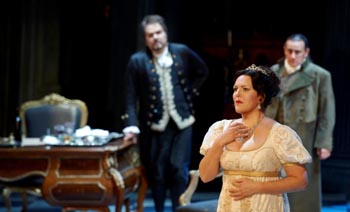
Photo credit: Michael Cooper

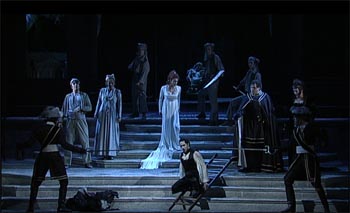
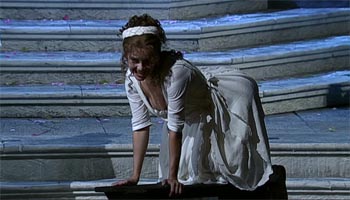
The only known photograph from this production as featured in every other print or internet review I've seen.

Puccini’s Tosca is on at the Canadian Opera Company right now. It’s this years “bums on seats” production. There are fourteen performances scheduled; compared to eight for most shows. It’s double casted. It’s a conservative friendly, traditionalist production seen before just four years ago and it features hone town diva, Adrienne Pieczonka. We saw it last night and were a bit disappointed. It wasn’t the sort of show one comes out of spluttering “travesty” or “disgrace” but it wasn’t the sort of performance that gets a standing ovation and excited deconstruction on the subway home either. It felt like a revival of a traditional production. It has to be said that my reaction, while more positive than some reviews I’ve read, wasn’t shared by a large chunk of the audience who switched from their customary coughing to an extended standing ovation. From the chatter I could hear in seats around me that was largely the reaction of the “once a year” crowd so, in a very important sense, this production accomplishes what it needs to do.

Still it’s sad to come out of a performance of Tosca relatively unmoved so let me try and dissect why. Paul Curran’s production is very traditional so there’s no gimmickry to either offend or help overcome shortcomings in the singing or acting department and, of course, there’s no sense of novelty. A reasonably seasoned opera goer is, inevitably, comparing it with other Toscas. Mr. Curran’s programme notes are quite explicit about the success criteria for an enterprise of this type.

The joy and challenge of directing Tosca is not only in the glorious music and razor-sharp libretto, but ideally in workingclosely with the talents of the singers playing and fleshing out their roles. As the curtain rises it is the characters and relationships we must believe in. Characters are built bar by bar, phrase by phrase and discussion by discussion. No word is too small that it might not be the trigger for a singer to find a new angle into their character’s life or psyche, and the job of the director, I believe, is in part to help the cast explore and discover just these subtleties.

The trouble is that not much of this happened. The three principals; Adrienne Pieczonka (Floria Tosca), Carlo Ventre (Cavaradossi) and Mark Delavan (Scarpia), are all established ‘A’ list singers and sang as well as one would expect but neither their characters nor the relationships between them came fully alight. I can take my Tosca somewhat overblown but lukewarm doesn’t really cut it. Delavan is a big man with lots of physical presence but here he struck (rather odd) poses and never really exuded any sense of menace. He didn’t even seem to be that into Tosca. His physical encounters with her in Act 2 suggested that their mutual priority was not upsetting the costume shop. You could find steamier scenes in any high school parking lot. This just reinforced the aloofness of Pieczonka’s very “in control” Tosca. Vissi d’arte, though beautifully sung, came out of nowhere. This wasn’t a woman on the edge of breakdown and when she stabs Scarpia our surprise isn’t that she’s done so but that she didn’t rip his balls off with her bare hands ten minutes earlier. The less said about Ventre’s acting the better though he too sang very well indeed and E luceva qualche stella was probably the emotional highlight of the evening.

Besides fine singing there was quite a lot to like in the production. The orchestra under Paolo Carignani sounded great. I really like the atmospheric lighting plot which used light level and tone to create a variety of effects, especially in Act 1 and in Act 3, where it managed to suggest night time without being so dark one couldn’t see. The chorus both adults and children were excellent and curran creates some pleasing visual arrangements in Act 1 (nice touch where Scarpia barges out past the bishop celebrant). Unfortunately none of this really overcomes the emotional hole at the centre of the production.

I’ve heard it said, from various quarters, that the second cast of Julie Makerov in the title role and Brendan Jovanovich as Cavaradossi (Delavan sings Scarpia in all performances) may up the EQ a bit so they may actually be a better bet. Sheer curiosity may even get me to go find out.

I’m sure what I’ve written above sounds really negative. It needs context. Expectations for COC productions have been raised very high by some truly excellent efforts in recent years and so a “pretty adequate” production that would have received rave reviews ten years ago barely cuts it today. That’s the price of success.

Domingo’s Boccanegra

Simon Boccanegra was the work that persuaded me that maybe I did like Verdi after all. It’s a terrific score and if the plot isn’t without it’s artificialities it’s full of strong characters and strong emotions which Verdi brings to life with fabulous orchestral and vocal writing.

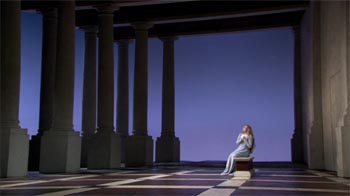
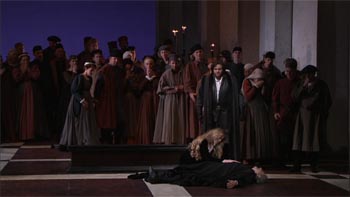
The most recent DVD version to appear is of the 2010 Royal Opera House production that was broadcast live on the BBC. It features Placido Domingo in his baritone incarnation in the title role. There’s a strong supporting cast with Ferrucio Furlanetto as his arch enemy, Fiesco; Jonathan Summers as the villain, Paolo; Joseph Calleja as the young rebel, Gabriele Adorno and Marina Polpavskaya as Boccanegra’s “lost” daughter, Amelia/Maria. The singing and acting are generally very strong. Placido is, of course, terrific. What more can one say? Furlanetto is a strong foil; excellent in both the prologue and the crucial final scenes. Summers is more than adequate though I might have hoped for more of a frisson when he curses himself. The real star for me is Calleja. He has a gorgeous voice and can float out a lovely pianissimo. His big aria early in the second act is particularly good but he is excellent all through the piece. The one weak link is Poplavskaya’s Amelia. It’s not bad. She acts well and looks the part but one really wishes for more beauty of tone. Pieczonka, in the Met HD broadcast, was much closer to the required vocal quality. Ensemble work throughout is excellent and there are some big set pieces! Antonio Pappano conducts brilliantly. He gets really good playing from the orchestra which is pretty crucial as there are some cruelly exposed woodwind and brass lines. He manages drama and urgency while still giving the singers room to do their thing when they need it. All in all, this is musically very satisfying.

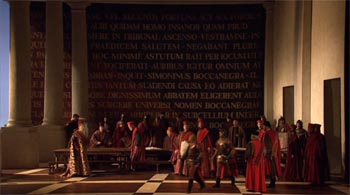
The production, by Elijah Moshinsky, is pretty conventional. It’s a period setting with simple designs that suggest renaissance paintings. There are a few nice touches like the graffiti on the walls in the exterior scenes but mostly the look is just undistracting. There’s nothing beyond the text in the way the story is told either. Blocking is fairly basic and there’s a fair bit of “park and bark”. One senses that Moshinsky’s efforts have gone into character development rather than in trying to make any bold statement.

Sue Judd directed for TV and video and it’s a conventional TV view with too many close ups. She needs to watch some of François Roussillon’s recent work. We also get little chats from Pappano between scenes. These probably work OK first time through but I think would get pretty tedious on repeat viewing. There are short bonus features on  WorshippingWorking with Placido Domingo and Rehearsals with Elijah Moshinsky. The technical quality is very good. It was filmed in HD and the picture is clear and detailed. The DTS 5.1 sound is really excellent; detailed, very spacious and coping very well with the more congested passages. There is also LPCM stereo. This really deserves a Blu-ray release but it’s on EMI who so far seem not to have gone that route(1). There are English, French, Spanish, German and Italian subtitles. The documentation is missing from my library copy but apparently contains a track listing, synopsis and “notes”.

This is definitely worth a look and it will be very interesting to do a detailed “compare and contrast” if I can get my hands on the Sony DVD release of the 2010 Met HD broadcast with Domingo, Morris, Giodarno and Pieczonka.

fn1. EMI was recently sold to Universal; parent of Deutsche Grammophon, and Decca so I suppose anything is possible.

Puzzling but well sung Don Giovanni

I looked at the cast list for the 1999 Wiener Staatsoper Don Giovanni and almost drooled. Carlos Alvarez, Franz-Josef Selig, Ildebrando d’Arcangelo, Adrianne Pieczonka, Anna Catarina Antonacci, Michael Schade, Angelika Kirchschlager and Lorenzo Regazzo. Add to that Riccardo Muti in the pit and musically it’s going to be hard to miss. So, unsurprisingly it turns out musically excellent across the board. I particularly enjoyed Michael Schade’s Don Ottavio. His supremely stylish singing and excellent acting added up to perhaps the best interpretation I’ve seen of perhaps opera’s dullest character. One might have reservations about Pieczonka’s Donna Anna but I think it’s a matter of taste. She can sing very prettily as she shows in her final duet with Schade but when she ups the volume she has great power but significantly less beauty of tone. It really boils down to one’s personal feelings about casting a genuine dramatic soprano in the role. I guess casting a mezzo as Zerlina is a bit unusual too but Kirchschlager is very good indeed. All in all it’s as well sung a Don Giovanni as I have heard.

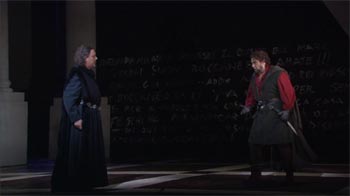
So, what about Roberto de Simon’s production and, supporting it, the acting? First, this production was performed at the Theater an der Wien so space on stage is tight and there’s a tendency for the singers to migrate to front centre stage for their big numbers giving a bit of a “park and bark” feeling. This is reinforced on the DVD by excessive use of close ups. If there is anything else going on we mostly don’t see it. This is a problem because there are some potentially interesting ideas in the production that don’t seem to be fully developed and that may be because the DVD viewer doesn’t see them develop. The first “big idea” is that as the piece progresses the costumes get more modern. Characters update roughly a hundred years on each appearance starting in the 16th century and going up to around 1900. The progression though is uneven and even my resident costume historian had trouble decoding some of the statements. It has to be said too that the early costumes in particular are sometimes bizarrely stylized. Don Giovanni gets visibly younger as the action progresses too. Add to that that there are two statues of the Commendatore; a 16th century one and a 19th century one. The former accepts Don Giovanni’s dinner invitation but the latter shows up. What are we to read into these elements and are they connected? To say that the characters are “timeless archetypes” seems to be a total “so what?” but I don’t have a deeper explanation. The second element is a flirtation with commedia. It’s never full on but we see glimpses of Harlequin in Leporello. In the opening scene he’s wearing what looks like a Harlequin costume that’s been desaturated in Photoshop as well as clown face. Don Giovanni’s acting too has some commedia elements. In particular there’s heavy use of the right-hand-shielding-left-side-of-the-face gesture in the opening scene with Donna Anna and it recurs in the final scene with the statue of the Commendatore. It gives Don Giovanni a sort of cheeky chappy quality at two of the most serious moments of the opera. Why? I don’t know. There are other, more or less isolated, visual references to the commedia sprinkled through the piece.

The final element of commedia is that Masetto is played as a complete clod. He’s the stock dim peasant rather than someone who recognizes Don Giovanni for what he is, the class enemy, from the get go. This is then set against an even more knowing than usual Zerlina.  Certainly in “Batti, batti” she appears to be offering far more than poor old Masetto can begin to grasp. Whatever it’s all supposed to mean, the cast give it their all and are clearly acting their hearts out and at least it’s never dull.

The biggest problem with the disc though is the video direction. Once again it’s Brian “close up” Large. With such a small stage it ought to be quite easy to show us what is happening but instead we get super close up on super close up. I particularly hate it when several people are singing and the director is just showing us a headshot of one of them. It interferes with my ability to hear the rest apart from anything else. Besides I don’t have a tonsil fetish. This comes to a final utterly annoying climax in the confrontation between the Commendatore and Don Giovanni. Large keeps cutting back and forth between full screen head shots of the pair of them. Ugh!

Technically it’s OK for a 1999 DVD recording. The picture is decent 16:9 and the LPCM stereo soundtrack is OK but not stunning. There are English, French, German, Italian and Spanish subtitles. There are no extras which is no surprise as it’s all squashed onto one DVD9 disc.

All in all, definitely worth a look but if you figure out what the director is driving at please let me know!

Ariadne auf Naxos

Last night’s Ariadne auf Naxos at the Four Seasons Centre was a delight. It’s a peculiar opera and clearly a section of the audience hadn’t done their homework and were rather confused. It’s in two parts. In the prologue arrangements are being made for two pieces to be performed at a big party at the home of “The richest man in Vienna”. The first is an opera seria; Ariadne in fact written by a young earnest composer and to be performed by a stereotypically haughty diva and tenor. The second is a buffo piece to be performed by the dancer Zerbinetta and her troop of Harlequins. There is much huffing and puffing by the serious opera crowd, especially the composer, about having to perform in such undignified company but the boss is the boss and money talks. The final indignity is when the Major Domo announces his master’s decision that both pieces must be presented simultaneously. Last night this was played out in modern dress on a set that faithfully, at least as I remember it, recreated the rather drab back stage areas of the Four Seasons Centre. I have no idea how many people got the joke but I thought it was funny. Alice Coote, as the composer, and Richard Stilwell, as his mentor, the music master, were excellent and everyone else contributed as needed to make for a very funny first half. It was almost, but not quite, enough to distract attention from some truly gorgeous orchestral playing by the COC Orchestra under Sir Andrew Davis.

The opera proper is a classical myth based story about Ariadne being abandoned by Theseus and wishing to die on her desert island where she is accompanied only by three nymphs who comment on her condition. Ariadne’s big aria, “Es gibt ein Reich”, is all about longing for solace in death. Adrienne Pieczonka sang gorgeously and was well supported by the three nymphs; Simone Osborne, Teiya Kasahara, Lauren Segal. The orchestral playing just kept hitting the spot. All this was played out in front of a very drab backdrop with holes torn in it through which Zerbinetta and her boys were observing the action. This is where it gets weird again as first the Harlequins appear and try to cheer Ariadne up with a bit of comic singing and dancing. She is unmoved. The boys having failed, Zerbinetta herself appears and explains her views on their shared plight as women and her rather cynical philosophy of love. This happens in a coloratura aria of truly fiendish length and difficulty (“Großmächtige Prinzessin”). Jane Archibald brought it off with aplomb and brought the house down. Then it all gets serious again. Bacchus arrives (raving about having been bewitched by Circe, or not). Bacchus and Ariadne sing at each other heroically and rather at cross purposes until they realise that they have redeemed, transformed or something each other through love. Zerbinetta briefly reappears to remind everyone that “a new God always comes”. Ariadne and Bacchus get even more ecstatic, all sorts of starry things start to appear projected on the stage and backdrops, the orchestra goes nuts, and the curtain falls. It shouldn’t work. It’s Strauss and Hofmannsthal perhaps being too clever for their own good but, miraculously, it does work and the music is fabulous. When the performances are as good as last night it’s all really rather wonderful.

The audience reaction was interesting. A non trivial number of seats were empty after the interval and one couple left rather abruptly half way through the opera proper. Those who stayed were very enthusiastic. Makes me wonder what’s happening with the COC audience. Thoughts on that will form part of a season round up post I think.