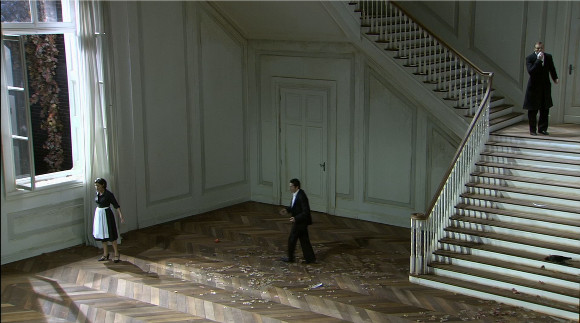
I’ve watched the Blu-ray version of the 2006 Salzburg production of Le Nozze di Figaro a few times now but sitting through it with notepad at the ready made me realise how much I hadn’t seen on the previous viewings. My notes are copious. I usually take a couple of pages or so. This time I covered four pages and it could easily have been more. You have been warned.
I’ve been wondering about whether to bother with the Decker production of La Traviata when it gets its MetHD broadcast in April since I own the Blu-ray of the original Salzburg 2005 production. So, it seemed like a good time to take another look at the disc.
I like this production more every time I see it. The overall concept of a Violetta who knows she is dying and is pretty consciously counting off the days works really well. The set is basically a curved wall with a clock and some sofas. There’s a lot of empty space and that’s entirely deliberate and serves effectively to reinforce Violetta’s alienation. The use of the chorus is interesting too. This is no jolly band of party goers. Rather, the chorus comes across as quite feral; a pack of wild dogs in evening dress. The character of the doctor does double duty too. He haunts the set almost throughout and from the very beginning. It’s hard not to think of him as Death though I don’t think Decker ever came clean on whether it’s supposed to be that explicit. When Violetta sings of “sterile pleasure” it’s quite clear what she means.
In Act 2, the country idyll is symbolised by flowery drapes over the sofas and, crucially, the clock. It’s the only time the clock is hidden. Violetta and Alfredo romp in flowery dressing gowns and underwear. The Germont senior arrives and as Violetta’s hopes dissolve she rips the flowery drapes away revealing both the clock and herself. The countdown has begun again. Back in Paris, the chorus is more cruel than ever playing out a vicious pantomime of Violetta before becoming a crowd of leering onlookers as Alfredo stuffs money into Violetta’s dress and mouth. The entry of Germont senior parallels actions of the doctor/Death earlier in the piece. There’s no break at the end of Act 2. The doctor very slowly forces the chorus off stage taking the clock and the pantomime Violetta with them to leave the stage completely bare. The rest of the action plays out with the characters widely spaced across this vast empty space.
It’s all very well thought through and consistent. There are many, many deft directorial touches (probably far more than we see on disc – see below) and the overall effect is very powerful.
It’s pretty much a dream cast. Netrebko in 2005 was just about perfect in every way for Violetta and she throws herself into the role with abandon. She’s not at all afraid to take physical risks and she sings really well. Her voice has power and brightness and her coloratura is spot on. She can also be lyrical and affecting when needed. Her interpretation is absolutely at one with Decker’s. Her “sempre libera” is quite chilling and there is real intensity in “Addio del passata”. Rolando Villazon’s Alfredo is a very good match. Salzburg caught him, too, at his very best and he doesn’t put a foot wrong. I’d go on at more length but this really is the Netrebko show! Thomas Hampson as Germont senior is a bit more of a conumdrum. Is he sincere or is his whole persona an elaborate bourgeois facade? Hampson doesn’t really tell us though he sings with his customary refinement and intelligence. Luigi Roni as the doctor deserves a special mention too. He only has a few lines to sing but his overall presence is huge. Carlo Rizzi conducts a polished performance from the Wiener Philharmoniker.
So where’s the fly in the ointment? Surprise! It’s the video direction of Brian Large. Emptiness and space are central to this production and Large can’t bear to give us space. We do get just enough framing shots to allow us, with a bit of imagination, to figure out what the director is doing but mostly it’s relentless close ups. He produces a particularly pointless example of switching back and forth between close ups in “Che e cio?” when he seems to think he’s filming Wimbledon. It doesn’t help that the framing shots we do get are, unaccountably, taken from high stage left. So grrr (and not the word I have written on my notepad because my mother may read this).
Technically the disc is very good. The picture is 1080i HD (maybe just a hint of ghosting on low light level shots) and the sound is very vivid DTS HD Master Audio 5.1 (LPCM stereo optional). Subtitles are IT, FR, EN, ES, DE, IT and CH. The documentation is a bit more generous than usual with a track listing and a synopsis in EN, FR and DE. There’s a useful and entertaining “making of” documentary which suggests that directing Villazon and Netrebko is easier and a lot more fun than directing Hampson! (Some people are perhaps just too smart).
So after all that how do I feel about seeing the Met production? If I could see it live I’d be there in a moment. Can I bear to see it butchered by another inept video director? I don’t know. It should be a good vehicle for Natalie Dessay though.
Pretty much all of this production is available on YouTube if that’s your thing. Here’s an excerpt.
Today’s Metropolitan Opera “Live in HD” broadcast was Donizetti’s Anna Bolena. I was not overly impressed although whether this was a result of issues associated with the broadcast or what was happening in the house I’m not entirely sure. One issue was that, again, the cinema was forcing its sound system well past the point at which it could consistently and accurately reproduce music. It may be OK for car chases and explosions but they need to throttle the volume back for the opera broadcasts. I’m guessing that they could drop the sound 6dB and still be louder than it would sound in the house. Driving the speakers and amps at 25% of the pressure level they are currently flogging them at would surely reduce the harmonic distortion. This was particularly an issue because this was very “heavy” Donizetti. I don’t know the work well enough to know whether it has to be done this way but the Met cast large voices in almost all the major roles and Marco Amiliato in the pit seemed to be demanding a very loud and strident sound from the orchestra. It was quite dramatic but emphatically not bel canto; more like forte shouto really. The only singer who sounded idiomatic to me was Tamara Mumford as the page, Smeaton. It did get better after the interval and the big duet between Anna (Anna Netrebko) and Giovanna Seymour (Ekaterina Gubanova) was really quite affecting. Also as far as I could tell Netrebko was singing really well in the “mad scene” (which really isn’t all that mad as these things go) but unfortunately the person in the seat behind me was having extremely audible “gastric distress” and both the lemur and I were having the hardest time not dissolving into giggles during perhaps the most solemn part of the opera. And I thought the coughing at the Four Seasons Centre was bad.

 operaramblings