
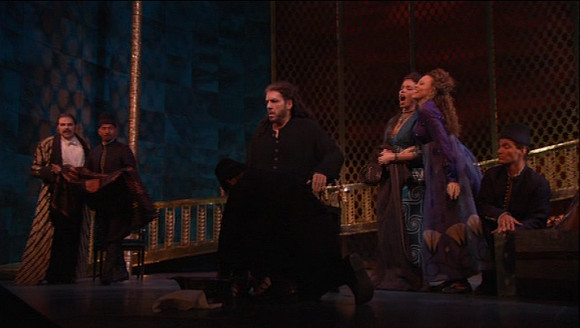
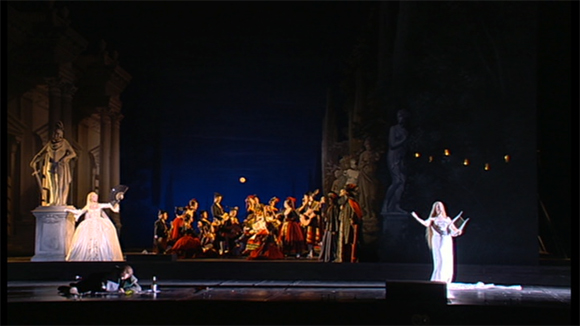
The 2009 production of Mozart’s Le nozze di Figaro from Madrid’s Teatro Real had me doing a bit of a double take. It’s all pouffy wigs, breeches and heaving bosoms. In fact it’s so traditional that it wouldn’t be out of place in Winnipeg or Omaha but comes as something of a surprise in a major European house. In the “Making of” feature, included as an extra, director Emilio Sagi suggests that the opera is so “perfect” that only a “hyper-realist” approach is appropriate. It’s an interesting idea but “hyper-realist” here turns out to mean a bunch of established opera conventions that bear as much of a relationship to “reality” as, say, a James Bond film does. There is one minor directorial intervention. A air of buxom extras appear in almost every scene. I’m not entirely sure why. Perhaps they are the Wonderbra of the production as their sole purpose seems to be to uplift the cleavage quotient. For the record, the piece is presented uncut so Basilio and Marcellina get their big arias in the last act. The traditional approach, I know, has its adherents. I’m not one of them. I could have used a few ideas!

 operaramblings