
Peter Hall’s 1981 Glyndebourne production of Britten’s A Midsummer Night’s Dream was quite celebrated in its day. How does it wear, thirty years later? The bottom line is it looks and sounds a bit tired.
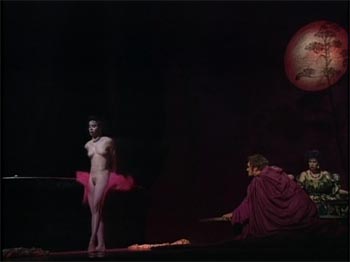
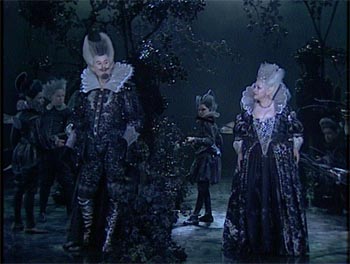 The production was innovative in its day. The scenery in the forest is inhabited by supers who make it, in a sense, “enchanted” and the lighting is interesting (at least so far as one can tell on the DVD). The problem is it never manages to generate any sense of menace from the world of the Fairies without which, to me at least, Dream (Britten’s version or Shakespeare’s) is insipid. Part of this lies in the old fashioned counter tenor sound of James Bowman and part in the very childlike fairies. As a result the first act starts very slowly and the Hermia (Cynthia Buchan) and Lysander (Ryland Davies) scene fails to spark. The “I swear to thee” duet is really slow and a bit lack lustre. Things do liven up a bit with the entry of Demetrius (Dale Duesing) and Helena (Felicity Lott). All in all Act One is a bit of a snooze.
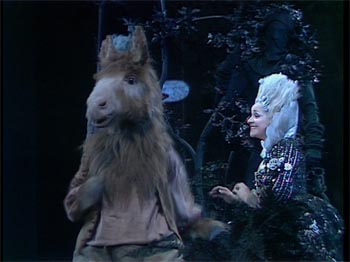
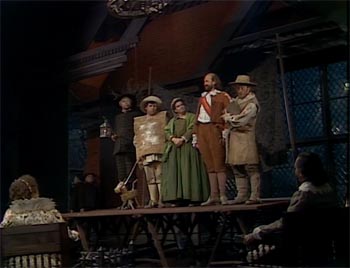
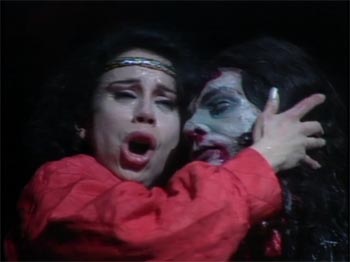
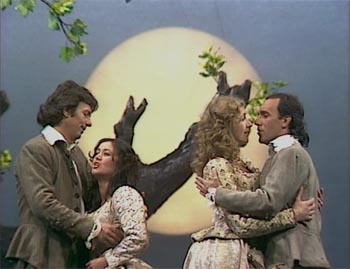 Act Two is better and the cat fight between Hermia and Helena is funny but there is still little element of menace. Oberon can’t even make “This is thy negligence” threatening and even the scenes with Bottom having an ass’ head don’t really have any bite. The Act Three lovers’ quartet is lively but Act Three really turns on whether the Rude Mechanicals are actually funny. That takes close to a miracle from both director and singers and a miracle just doesn’t happen here. Both Bottom (Curt Applegren) and Flute (Patrick Power) have their moments but it never gels. Throughout it’s fairly static with only Damien Nash’s “cheeky chappy” Puck creating much movement. So, lack of both menace and humour rather undermines some interesting design elements.
 Musically this is pretty mixed too. Especially in the first act the orchestral playing seems oddly unfocussed. It’s partly a matter of tempi. Bernard Haitink is eight minutes slower overall compared to the composer’s studio recording for Decca. He also fails to get the rhythmic attack and dynamic range out of the LPO that Britten gets from the LSO. (Part of the problem here may be the soft recorded sound versus John Culshaw’s excellent Decca recording). The overall effect is a bit insipid. The singing is OK but really only Duesing and Lott stand out vocally. Ileana Cotrubas as Tytania is oddly anonymous.
 Dave Heather directed for TV and video and it’s a typical early 1980s directed for TV effort. I don’t think the whole stage (and this is the old, small Glyndebourne stage) is visible even once. The picture is 1981 quality too. It’s soft by DVD standards. There is flickering on the subtitles. Don’t watch from too close on a modern TV. The Dolby 2.0 sound is barely average. There’s no real depth and at times the orchestra seems to be muffled. It’s not remotely as good as the sound on the 1966 studio recording. There are English, French and Spanish subtitles, no extras and minimal documentation.
I haven’t seen the only other Dream currently available but it’s a recent Robert Carsen production from Barcelona with Harry Bicket in the pit and David Daniels as Oberon plus video direction is by the excellent Francois Roussillon. I’d certainly advise taking a look at that before buying this one.


 operaramblings