
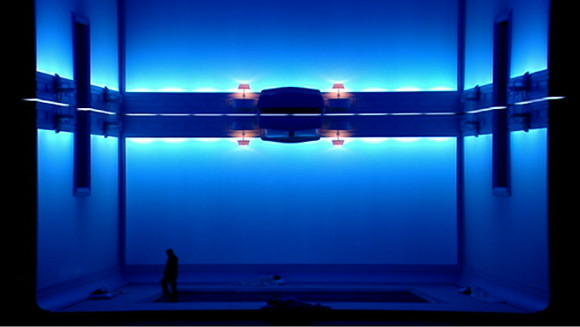
I’m a big fan of Robert Carsen. His Orfeo ed Euridice was one of the highlights of last year’s COC season and his Iphigénie en Tauride promises to be one of the events of the upcoming season. So, as you can imagine, I had high expectations for the DVD of his 2002 Paris production of Dvořák’s Rusalka with Renée Fleming in the title role. I wasn’t disappointed. The production is pure magic. It’s almost a mathematician’s production. In Act 1 he gives us symmetry in the horizontal plane. There’s a bedroom reflected horizontally floating above the water sprites’ abode which resolves itself into the bedroom that is the setting for Rusalka’s initial encounter with the prince. In Act 2 we get the same bedroom but in a left right symmetry and the movements of the characters are also mirrored with non singing actors mirroring the singers. The symmetry continues with Rusalka balanced against the foreign princess. It’s very cool. I’m guessing that Carsen is suggesting the distance between the world of the sprites and the human world diminishing then opening up again. In Act 3 we get geometrical chaos as Ježibaba’s hut is presented at crazy angles poised above the stage and all sorts of dissolution goes on before we again get the symmetrical bedroom in which the final tragedy plays out. The general concept is supported by a superb lighting plot (Carsen and Peter van Praet) that brilliantly brings out the moods of the different scenes. And there’s no clutter. Scene follows scene pretty much seamlessly. It’s terrific stagecraft.
More Carsen genius
6
 operaramblings