Ossian meets Anne of Green Gables

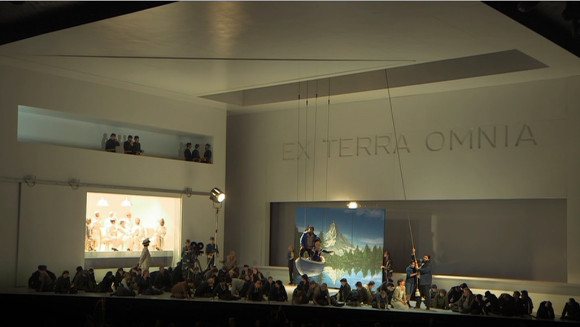
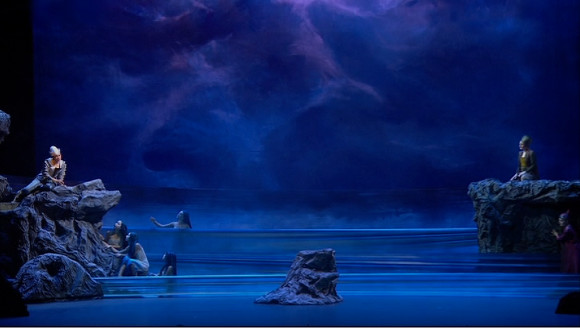
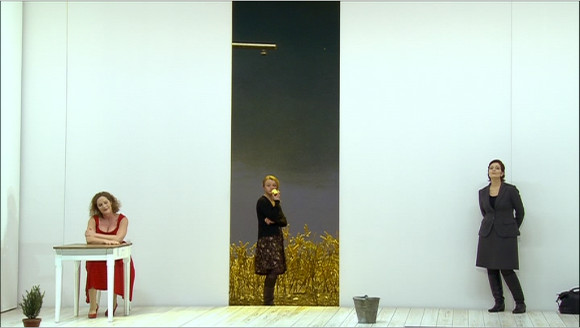
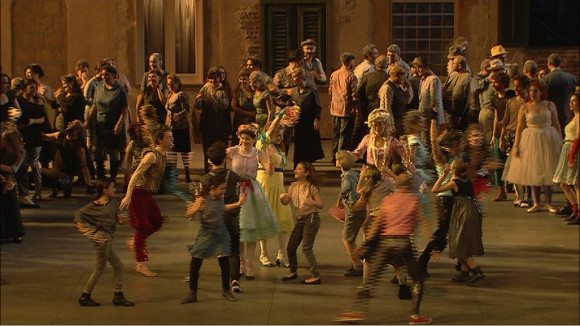
Rossini’s La donna del Lago is based on the Walter Scott poem, itself a deliberately romantic view of Scottish history, simplified until not much is left but the rivalry for the heroine’s hand by her three suitors and a completely unexplained war between the king of Scotland and the Clan Alpine.  Dramatically it’s thin indeed but it’s Rossini so there is crazy virtuosic music and it’s very hard to cast.  One needs two mezzos; one a mistress of Rossinian coloratura, the other more dramatic, and two tenors; both of which can do the crazy high stuff.  The supporting roles aren’t easy either.  Realistically only a major house could cast this adequately.

1.anne

Continue reading

Guillaume Tell

Rossini’s last opera, Guillaume Tell, was written for Paris and is an extremely ambitious piece of great musical sophistication.  It’s also very long.  Performed uncut, a rarity, it runs something like four hours including ballets.  It’s also hard to cast with the role of Arnold Melcthal in particular making unusual demands.  It’s a high tenor role combining the flexibility needs of a typical Rossini role with something much more heroic.  The soprano role of Mathilde has some of the same issues; signature Rossini coloratura is combined with the sort of dramatic heft one might more associate with early Wagner.

1.boat

Continue reading

Dido as tragédie lyrique

The influence of the myth that Purcell’s Dido and Aeneas was written for a girls’ school seems to have had a long lasting influence on performance practice resulting in presentations that are very short and uncomplicated.  In reexamining the work for the Opéra de Rouen Haute-Normandie, Vincent Dumestre of Le Poème Harmonique and stage directors Cécile Roussat and Julien Lubek come to different conclusions and, accordingly, present the work quite differently.  They argue that the work was written for the court of Charles II though quite possibly never performed there owing to the death of the king and the turmoil that followed.  They further argue that existing score fragments show numerous places where dance movements should be inserted and that this indicates something akin to Lully’s tragédies lyriques, especially as Lully was much in vogue in London at the time.

1.duet

Continue reading

400

It’s taken since May 16th 2014 to get from 300 to 400 recordings in the DVD review database.  But now we are there with 84 Blu-rays and 316 DVDs.  Surprisingly the Toronto Public Library is still a major source of material though one can see that the statistics are perhaps skewing a little more to my personal tastes.  This despite someone at TPL having a taste for 19th century turkeys from French and Belgian regional houses.  So, here’s the round up of the summary stats.

language400Italian is still the most common language with 30% of recordings but German has moved up relatively from 24% to 27%.  Perhaps surprisingly the proportion of recordings in English has hardly changed at all at 13%.  I would have thought that the proportion of contemporary works, many/most in English would have impacted the stats more.
Continue reading

Hyper traditional Figaro

The 2009 production of Mozart’s Le nozze di Figaro from Madrid’s Teatro Real had me doing a bit of a double take.  It’s all pouffy wigs, breeches and heaving bosoms.  In fact it’s so traditional that it wouldn’t be out of place in Winnipeg or Omaha but comes as something of a surprise in a major European house.  In the “Making of” feature, included as an extra, director Emilio Sagi suggests that the opera is so “perfect” that only a “hyper-realist” approach is appropriate.  It’s an interesting idea but “hyper-realist” here turns out to mean a bunch of established opera conventions that bear as much of a relationship to “reality” as, say, a James Bond film does.  There is one minor directorial intervention.  A air of buxom extras appear in almost every scene.  I’m not entirely sure why.  Perhaps they are the Wonderbra of the production as their sole purpose seems to be to uplift the cleavage quotient.  For the record, the piece is presented uncut so Basilio and Marcellina get their big arias in the last act.  The traditional approach, I know, has its adherents.  I’m not one of them.  I could have used a few ideas!

1.act1

Continue reading

Tarkovsky’s Godunov

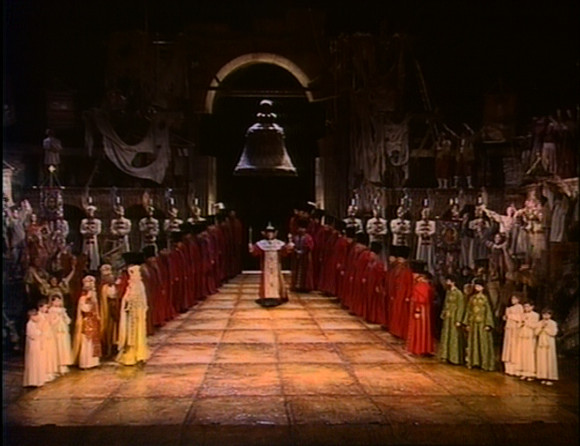
Andrei Tarkovsky’s 1983 production of Mussorgsky’s Boris Godunov for Covent Garden was restaged in 1990 by the Kirov in St. Petersburg with, Tarkovsky by this time no more, Stephen Lawless directing.  It being Tarkovsky I had expectations of something really interesting (perhaps a four hour silent opera?) but it’s not really.  In fact Tarkovsky seems to have been intimidated by the form or foiled by its technical limitations into producing a lavish but ultimately not very consequential production.  The AMOP crowd would thoroughly approve I think.

1.bell

Continue reading

It’s in the blood

I guess previous times I’ve seen Janáček’s Jenůfa I haven’t really noticed the role that the idea of “bad blood” or inherited depravity plays in the plot but it’s there almost as starkly as in certain works by Zola and Buchan.  Perhaps one of the strengths of Christof Loy’s very clean 2014 production for the Deutsche Oper is that it tends to show up such details.  It’s certainly a very low key setting.  All the action takes place in a plain white room with minimal furnishing.  Costuming is modern (sort of); maybe 1950s or so.  Sometimes one gets a hint of rather more going on on the edge of the stage but Brian Large’s typically close up video direction makes it hard to be sure.  So, at least on disk, it’s all about the characters and their interactions and they are drawn pretty clearly.

jenufa1

Continue reading

All girls like honey wine

Richard Strauss operas do tend to have somewhat weird plots but perhaps none more so than his early and seldom performed piece Feuersnot.  We are in mediaeval Munich on St. John’s Eve when apparently large bonfires and, one suspects, other things, are traditional.  The children are gathering firewood and the magician Kunrad is stalking the mayor’s daughter Diemut.  To her, apparent at least, disgust and the scandal of the townspeople, he kisses her.  She gets her revenge by pretending she’s going to winch him up to her room but leaves him stranded halfway where he is mocked by the other girls.  He calls on the spirit of his mentor, an even greater magician, to help him extinguish all the lights and fires in the town.  This bit is very Wagnerian because who was mistreated by the people of Munich?  And who is his equally mistreated heir?  You’ve got it in one right?  Anyway, the townspeople rather whimsically persuade Diemut that it’s her maidenly duty to get the lights turned back on.  After all, people have sacrificed a lot more than a quick shag to the needs of the energy industry.  All it’s missing is a wordly crustacean really.

1.crowd

Continue reading

Barbara Hannigan – Concert Documentary

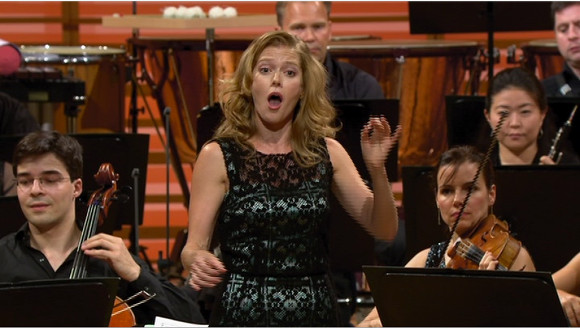
The Hannigan obsession continues.  This time I’ve been looking at a DVD, Barbara Hannigan – Concert Documentary.  It’s in two parts.  There’s a recording of Hannigan as soloist and conductor with the Mahler Chamber Orchestra at the 2014 Lucerne Festival and there’s a documentary, I’m a creative animal, looking at her life and work.

1.conducting

Continue reading

Making sense of La Sonnambula

I’m not a huge bel canto fan so it’s probably no surprise that I had, previous to this DVD, only seen Bellini’s La sonnambula once.  That was in Mary Zimmermann’s messy production at the Met which had left me with the impression that it was a rather feeble comedy with formulaic music and not much improved by Zimmermann’s attempts to sex it up.  I did wonder if it might be improved by the full on Regie treatment and so I was quite happy to have a chance to see the DVD of Jossi Wieler and Sergio Morabito’s 2013 Stuttgart production, especially as it had played to significant critical acclaim and won a bunch of awards.  I was surprised and impressed.  Far from being a cavalcade of extraneous elements (the usual charge levelled at Regie), this production probed the libretto and the source materials in a highly intelligent way to produce something really rather moving.  The music is still what it is; tuneful, well crafted but hardly deep, but there you go.

1.inn

Continue reading