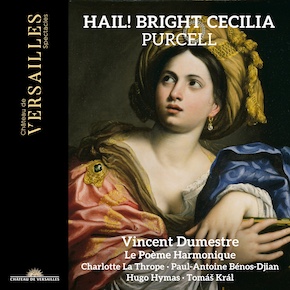
Hail! Bright Cecilia

Château de Versailles Spectacles have produced a really classy period instruments recording of Purcell’s Hail! Bright Cecilia with a bonus of Blow’s Welcome Every Guest.  The band s La Poème Harmonique under the direction of their founder Vincent Dumestre.  It’s a very authentic period sound and the small chorus is precise and sings in excellent English.

The Blow piece is short but but interesting and it gets a sprightly and almost jazzy reading.  Both baritone Tomáš Král and teHugo Hymas are excellent and have perfect English,  “The sacred Nine” is particularly enjoyable.

Continue reading

Mon amant de Saint-Jean

monamourdesaint-jeanThis is a really interesting and unusual album.  French mezzo-soprano Stéphanie d’Oustrac teams up with a small baroque ensemble, Le Poème Harmonique (accordion, theorbo, strings, bassoon/flute) led by Vincent Dumestre to present a selection of music that ranges from traditional songs through 17th century opera/oratorio arias to cabaret music and modern chansons.
The music is grouped into Three “life stages”; Jeunesse, Les vieux airs and Les amours passée; a sort of lifetime of music.  I was really excited after the first four numbers because they were touching a whole bunch of things I really love; jazzy cabaret on played freely on baroque instruments, traditional music sounding a bit like a band like Malicorne, a freedom of vocal expression etc.  It did quieten down a bit after that with arias by Cavalli and Monteverdi sung in a properly period appropriate way but also other music freely interpreted by all the musicians.  It finishes up in a fun way too.  There’s a very silly song; Les canards Tyroliens, which features yodelling and coloratura ducks. Then there’s a tango and a plangent rendering of the title track.

Continue reading

Dido as tragédie lyrique

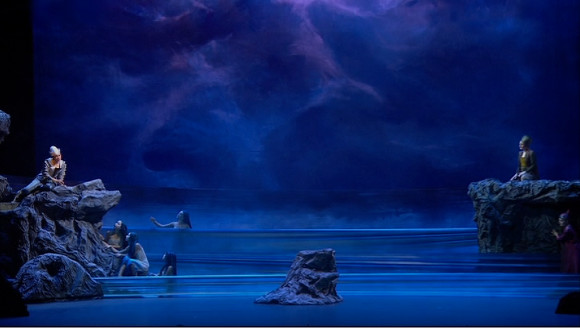
The influence of the myth that Purcell’s Dido and Aeneas was written for a girls’ school seems to have had a long lasting influence on performance practice resulting in presentations that are very short and uncomplicated.  In reexamining the work for the Opéra de Rouen Haute-Normandie, Vincent Dumestre of Le Poème Harmonique and stage directors Cécile Roussat and Julien Lubek come to different conclusions and, accordingly, present the work quite differently.  They argue that the work was written for the court of Charles II though quite possibly never performed there owing to the death of the king and the turmoil that followed.  They further argue that existing score fragments show numerous places where dance movements should be inserted and that this indicates something akin to Lully’s tragédies lyriques, especially as Lully was much in vogue in London at the time.

1.duet

Continue reading

Historically informed performance à l’outrance

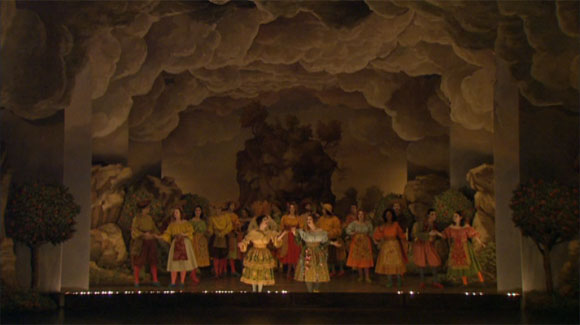
The works of the French baroque are a rather specialized taste.  Some people love them, some not so much.  There are also strong views on performance style.  Some people favour an essentially modern treatment as in Robert Carsen’s Paris Garnier production of Rameau’s Les Boréades.  Others are fans of the fantasy baroque approach taken by the likes of Opera Atelier.  I’ve seen good examples of both approaches.  What I haven’t seen before is a rigorous attempt to recreate a 17th century staging complete with period appropriate scenery and stage effects.  In 2008 such an attempt was made at the Théâtre de l’Opéra Comique in Paris.  The work involved was the first true opera in French; Lully’s Cadmus et Hermione.  The results are very interesting.

Continue reading