Words and music and pictures?

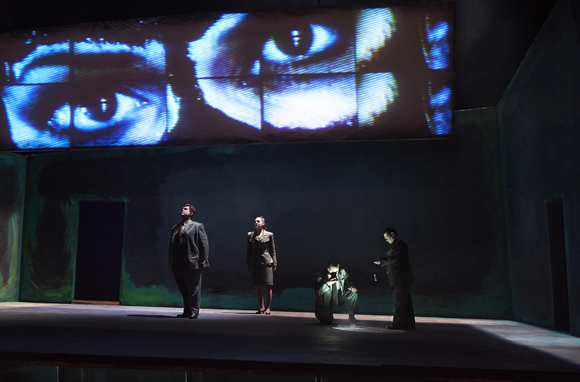
Richard Strauss’ Salome opens April 21st at Canadian Opera Company in a production by Atom Egoyan.  Curiously, this is a piece I know well in three languages as besides the Hedwig Lachmann German translation I own a bilingual edition containing both the original French text and Wilde’s own English translation.  My copy is one of a limited edition published by the Limited Edition Club in 1938.  It contains the English text with reproductions of the original Beardsley illustrations as well as a separate volume of the French text illustrated with pochoirs by Fauvist André Derain.  Here’s an example.

salome_6

There are a dozen photos of text and illustrations from the French volume here for people who like that sort of thing.

Don’t lose your head

penguinsJust spotted new discount deals on the COC website. For the three spring productions; David Alden’s Lucia di Lammermoor, Robert Carsen’s Dialogues des Carmélites and Atom Egoyan’s Salome, they are offering 25% off if you buy two of the three and 33% off for all three.  You get to pick your dates and tickets are available in all sections except the cheapest and most expensive.  The 33% deal brings prices down to around season subscription rates.  There are also $22 and $35 tickets available for both the under 30s who attend COC performances.

On a per dead nun basis you won’t find cheaper anywhere!

And now for something completely different

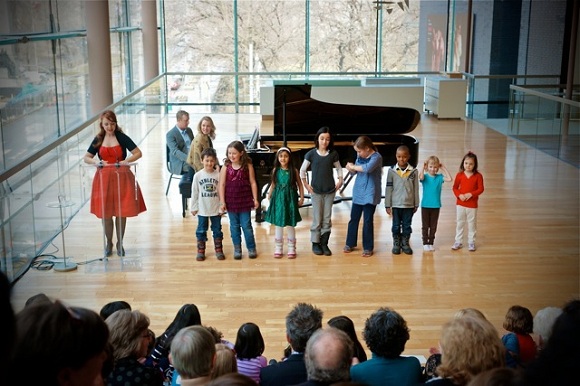
It’s March break in Toronto which means lots of children friendly activities.  Yesterday’s lunchtime concert at the Four Seasons Centre was one of them.  It was a session/performance by soprano/educator Kyra Millan together with sidekicks baritone Jesse Clark and pianist Christina Faye.  There were lots of kids, mostly quite young, there.  Some had even brought their parents.

DSC01328

Continue reading

Ex Alden semper aliquot novis

12-13-04-MC-D-814Last night saw the final performance of the COC’s run of La clemenza di Tito.  I had seen the Ensemble Studio performance a couple of weeks ago and really enjoyed it but had some questions and reservations about the production.  Last night many of those issues were resolved. It seemed more closely directed and the characterizations were more fully rehearsed.  A good example of this would be Michael Schade’s intensely neurotic Tito which was central to the concept.  Many things make sense if one sees Tito as being in love with an idea of himself.  In this context his betrayal by Sesto is particularly hurtful because it implies that his closest confidante isn’t buying it and his “clemency” is necessary to restore his faith in his own self-projection.  This Tito gives Robert Gleadow’s Publio space and reason to be more than the dutiful, rather thick plod.  He’s the one who has seen through Tito but must “play the game”.  His final, rather sharp, exchanges with Vitellia suggest a genuine capacity for malevolence.  This is, after all, an Imperial Court, where by definition life is dangerous and nothing what it seems.

Continue reading

An anti-Valentine

selig_franz_josefToday’s lunchtime recital in the Richard Bradshaw Amphitheatre was a recital of Schubert and Strauss songs on the theme “Love’s Dark Shore”.  The performers were German bass Franz-Josef Selig, in town singing King Marke in Tristan und Isolde, and the COC’s own Rachel Andrist at the piano.  There wasn’t much about “Love” in the pieces chosen but there was plenty of death, depression and despair.  One might think it would be a complete downer but nobody could possibly be depressed witnessing the artistry of Selig.

Those who have heard Selig in Tristan know that he has a massive voice.  It was fascinating to hear him turn it to lieder.  He is a very German lieder singer in the best possible way.  He enunciates with great clarity and gets full value out of the meaning of every phrase.  He clearly loves the texts.  He also manages his huge voice wonderfully.  Mostly he sang quite quietly with beautiful legato and perfect control but when he wanted volume it was there in abundance and without strain.  He also has a real range of tone colour and sheer beauty of tone.  Often he sounded more like a baritone than a bass but he could get almost tectonically low when he needed to.  It was very impressive.  Rachel’s accompaniment was perfectly fine too though I think most of the audience was focussed on the voice.

I did hear a few grumbles about the unrelieved darkness of the material but I felt the works suited the singer and it was, as these things are, a fairly short programme so the lack of variety didn’t really bother me.  All in all, a very worthwhile way to spend one’s lunch break.

Back to Tristan

Last night the lemur and I braved the biggest snow storm in several years to catch Tristan und Isolde at the Four Seasons Centre.  It was the same production I saw last Tuesday but with Michael Baba and Margaret Jane Wray replacing Ben Heppner and Melanie Diener in the title roles.  I was also sitting at the front of the Orchestra Ring which is a very different sight line than the back of Ring 3.  There’s no way to avoid saying this, it was hugely disappointing and especially so as it was the first time the lemur had seen the show and I had been talking it up excitedly since Tuesday.  Baba and Wray sounded underpowered and under-rehearsed.  The big Act 2 duet, O sink’ hernieder, Nacht der Liebe, that had left me literally shaking on Tuesday merely left me shaking my head.  What had been a glorious, transcendent, hypnotic wave of sound had turned to mush.  It was a relief when Franz-Josef Selig, King Marke, took over.  At last we got some Wagnerian singing of style and class.  Act 3 wasn’t much better.  To be fair, the rest of the cast was just as good as on opening night and the orchestra deservedly got the loudest and longest applause of the night.  But Tristan und Isolde needs, as Isolde points out, Tristan and Isolde.

Tristan und Isolde - 0013 - Credit Chris Hutcheson

Continue reading