Andrew Davis and the Verdi Requiem

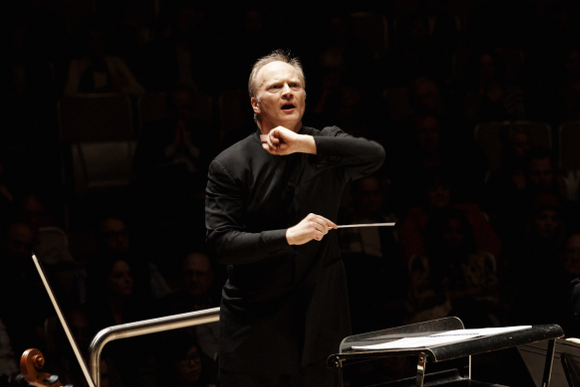
It’s forty years since Sir Andrew Davis first conducted the TSO and to celebrate the fact the TSO programmed a run of Verdi Requiems with Sir Andrew conducting.  I caught the last performance last night.  It’s in some ways a curious piece; very operatic and not especially liturgical but it does have its subtleties; the very quiet opening and the tenor solo Ingemisco for example but there’s also some moments of drama that are far from subtle.  The Dies irae is appropriately loud, even terrifying and it’s used as an accent before the Lacrymosa and during the Libera me.  It’s quite a compelling 90 minutes or so.

vreq1 Continue reading

Mild und Leise… occasionally

The TSO’s program last night was too tempting to miss; Adrianne Pieczonka singing Strauss and Wagner and a Beethoven 7th plus Gianandrea Noseda conducting.  So I went.

_DSC5922Things started off with Casella’s Italia.  This is a sort of mash up of Pucciniesque bombast and Neapolitan popular tunes.  I’m surprised it never featured in a Warner Bros cartoon.  Perhaps it did.  In any event Nosada is probably the ideal conductor for it; infusing it with a kind of manic energy.  Next up were the Strauss Vier letzte lieder.  Here manic energy is exactly what’s not needed and Nosada seemed to have some difficulty adjusting.  Too often Adrianne Pieczonka’s beautiful singing was covered by an over loud orchestra.  Roy Thomson Hall is tricky but George Benjamin showed exactly how to manage the acoustic last weekend.  Nosada wasn’t so successful.

Continue reading

Addicted to purity and violence

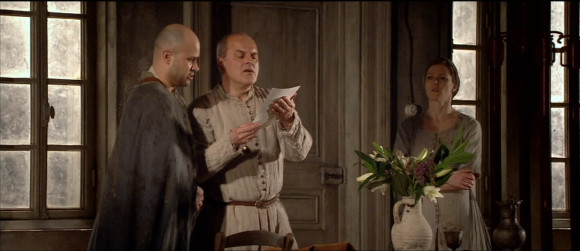
In George Benjamin’s Written on Skin The Man, The Protector, is described as “addicted to purity and violence”.  One could perhaps say the same about the score.  Seeing it presented in a minimally staged version at Roy Thomson Hall last night perhaps emphasised those aspects compared to watching a fully staged version (review of Katie Mitchell’s production at the ROH here).  Being able to see the conductor and orchestra made the combination of a traditional orchestra with older instruments; viola da gamba, glass harmonica etc (and lots of percussion) more obvious.  The music can be very violent but it can also be incredibly quiet and it’s a measure of Benjamin’s skill as a conductor that through these extreme changes of dynamics he rarely, if ever, covered his singers.

2.boyandprotector

Bejun Mehta, Christopher Purves and Barbara Hannigan in the ROH production

Continue reading

Mozart fragments

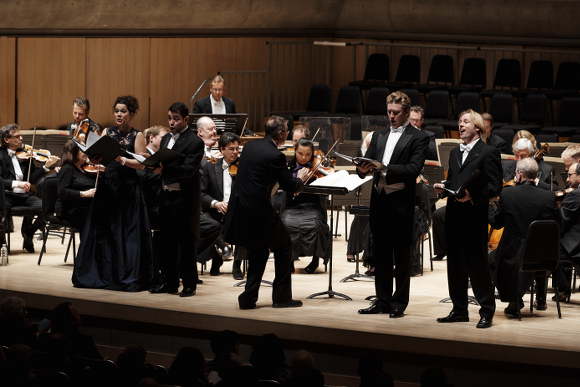
Last night, at Roy Thomson Hall, the TSO presented a two part Mozart program.  The first half consisted of pieces from two abandoned opera projects; the buffa Lo sposo deluso and the Singspiel Zaide.  The second half consisted of the better known, but incomplete, Mass in C Minor.

L to R: Guilmette, Fortier-Lazure, Bintner, Tessier.  Photo - Malcolm Cook

L to R: Guilmette, Fortier-Lazure, Bintner, Tessier. Photo – Malcolm Cook

Continue reading

Comfort ye my people

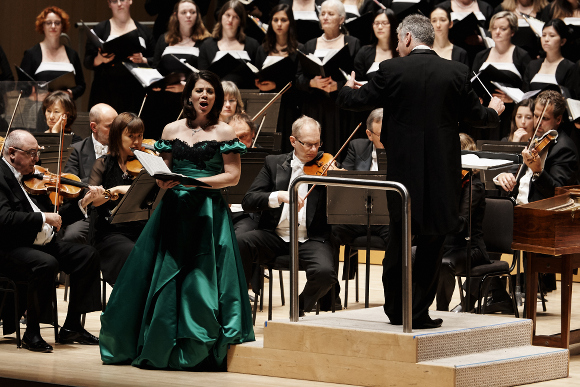
‘Tis the season to Hallelujah in Toronto and Handel’s Messiah is everywhere.  Last night was the first performance of the biggest of them all, the Toronto Symphony and the Toronto Mendelssohn Choir at Roy Thomson Hall.  Traditionally this is Toronto’s equivalent of John Barbirolli and the Huddersfield Choral Society so I was surprised to see a set up for a rather small orchestra.  In fact about thirty instrumentalists were used, playing modern instruments of course, with about 150 choristers.  It was something of a sign of things to come as conductor Grant Llewellyn took us through the piece quite briskly and rhythmically with even some ornamentation in the da capo repeats.  It’s becoming more common I think for conductors to get something approaching an HIP sound out of a modern orchestra as we’ve seen with Harry Bicket  in various opera houses.  The orchestra and chorus responded pretty well to the less staid approach with the sopranos sounding particularly spritely and incisive.

TSO Messiah_Allyson McHardy (Malcolm Cook photo) Continue reading

Dream of Gerontius

medium_stuart-skeltonEvery time I go to Roy Thomson Hall, as I did last night to see the TSO perform Elgar’s Dream of Gerontius, I have to recalibrate for the acoustic.  It’s just much quieter than the Four Season’s Centre and, indeed, many other venues.  This has the advantage that coughing is largely inaudible but also that even a large orchestra playing full bore doesn’t exactly blow one’s socks off.  So, perhaps it wasn’t a surprise that I was more struck by the meditative aspects of this score than its moments of high drama such as the chorus of demons.  I’m pretty sure this was just the acoustic because conductor Peter Oundjian was certainly going for maximum effect in those sections. Continue reading