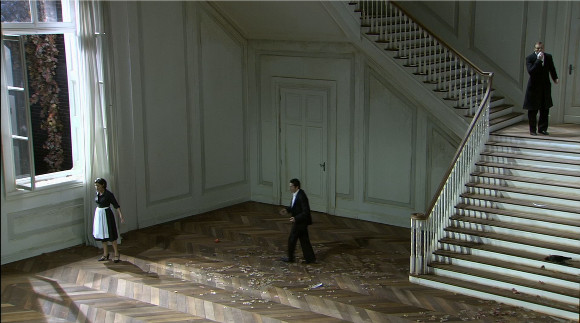
I’ve watched the Blu-ray version of the 2006 Salzburg production of Le Nozze di Figaro a few times now but sitting through it with notepad at the ready made me realise how much I hadn’t seen on the previous viewings. My notes are copious. I usually take a couple of pages or so. This time I covered four pages and it could easily have been more. You have been warned.
Mussorgsky’s Khovanshchina may be the most depressing opera ever written. It’s a catalogue of executions, murders, betrayals and mass executions that are no doubt designed to show the extreme purity of the Russian soul. I’m glad I’m not Russian. It’s also a rather beautiful score, though how much that’s due to Mussorgsky who didn’t complete and didn’t orchestrate it is, I suppose, anyone’s guess. In the version I watched; a 1989 performance from the Wiener Staatsoper, the ending is by Stravinsky and the orchestration by Shostakovich. Continue reading →
In 1969 the BBC’s new Director of Music and recording producer of genius, John Culshaw, contrived to align the heavens to permit the recording and broadcast for television of Britten’s Peter Grimes with Peter Pears in the title role and Britten conducting. What’s more it was recorded on a stage set (at The Maltings) with the orchestra in the same room as the singers who sang ‘live’. So, unusually for the time there was neither a double studio set up nor a studio audio recording that was lip synched to the stage performance. There’s a great little essay in the DVD booklet that explains how this all came to pass.
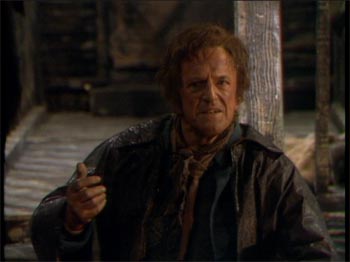
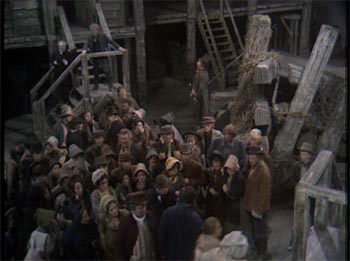
All that said, it’s a 1969 TV broadcast and I expected it to be of largely historic interest. I didn’t expect to get completely sucked in which is what happened. The design and production is very literal. The Boar is a pub. Grimes’ hut is a hut and so on. The people of the Borough are dressed in a range of working class clothes of sometime in the 19th century. They don’t look like a flock of crows on a telephone wire. Oddly, this makes their conformity all the more telling. The direction is a collaboration between Joan Cross who, we are told, directed the singers and Brian Large (who must have been about twelve at the time) who directed the cameras. As you would expect for a 1969 TV production there are lots of close ups which is fine as there was no “house view” here. The orchestral interludes are played out to either abstract patterns (which sometimes look a bit like those gel slides popular in discos of the period) and continuity shots. We don’t see the orchestra or, worse, a heavily perspiring conductor. It’s all straightforward but effective. There are some interesting interpretative nuances. For example in the storm scene in the pub I’ve never seen Grimes’ otherness so well brought out. Also, it’s absolutely starkly clear that Ellen and Balstrode have given up on Peter during Act 2 Scene 1 but he persists most compellingly in his hope until the ‘prentice falls at the end of the act. Pears’ reading of the part at this point is so hopeful that I had to go back and check that the bit where he accuses the boy of betraying him hadn’t been cut.
The performances are mostly strong. Pears’ Grimes is what it is. It’s beautifully sung and the lyrical passages like “Now the Great Bear and Pleiades” are gorgeous. It’s not totally convincing though. When he punches Ellen it comes out of nowhere. This dreamy, haunted Grimes just doesn’t have the violent side that the Borough and, ultimately Ellen, see. Heather Harper’s Ellen is gorgeous. She sounds younger and sweeter than in the later Vickers recording. Bryan Drake’s Balstrode is well sung but he’s more of the Borough and less the more broadly travelled and worldly wise character than others make of him. Both Gregory Dempsey as Bob Boles and Elizabeth Bainbridge as Auntie are more delineated than is often the case and Ann Robson gives a decidedly sinister Mrs. Sedley. Other supporting roles are perfectly adequate. Britten conducts the LSO and gives, especially, in the interludes, an even more taut and compelling reading than on the audio recording with the ROH Orchestra ten years earlier. This, for sure, is definitive.
Technically this disc is amazingly good. The 4:3 picture is a bit soft grained but amazing for 1969 TV. The sound is “enhanced Dolby mono” and while, obviously, it doesn’t produce any width or depth it’s clear and bright. (There’s also LPCM mono but its not nearly as good). There are English, French, German and Spanish subtitles.
All in all this is so much more than “just” a historical document. In every way it’s a performance worth watching.
I’ve been wondering about whether to bother with the Decker production of La Traviata when it gets its MetHD broadcast in April since I own the Blu-ray of the original Salzburg 2005 production. So, it seemed like a good time to take another look at the disc.
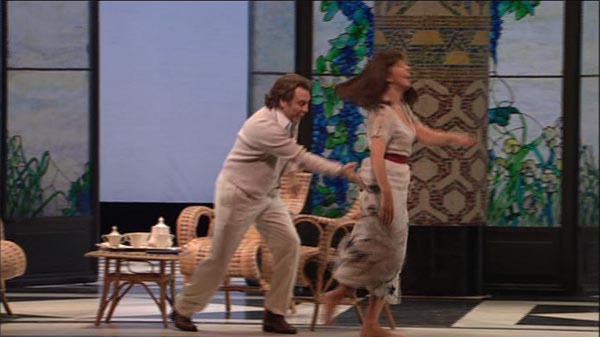
I like this production more every time I see it. The overall concept of a Violetta who knows she is dying and is pretty consciously counting off the days works really well. The set is basically a curved wall with a clock and some sofas. There’s a lot of empty space and that’s entirely deliberate and serves effectively to reinforce Violetta’s alienation. The use of the chorus is interesting too. This is no jolly band of party goers. Rather, the chorus comes across as quite feral; a pack of wild dogs in evening dress. The character of the doctor does double duty too. He haunts the set almost throughout and from the very beginning. It’s hard not to think of him as Death though I don’t think Decker ever came clean on whether it’s supposed to be that explicit. When Violetta sings of “sterile pleasure” it’s quite clear what she means.
In Act 2, the country idyll is symbolised by flowery drapes over the sofas and, crucially, the clock. It’s the only time the clock is hidden. Violetta and Alfredo romp in flowery dressing gowns and underwear. The Germont senior arrives and as Violetta’s hopes dissolve she rips the flowery drapes away revealing both the clock and herself. The countdown has begun again. Back in Paris, the chorus is more cruel than ever playing out a vicious pantomime of Violetta before becoming a crowd of leering onlookers as Alfredo stuffs money into Violetta’s dress and mouth. The entry of Germont senior parallels actions of the doctor/Death earlier in the piece. There’s no break at the end of Act 2. The doctor very slowly forces the chorus off stage taking the clock and the pantomime Violetta with them to leave the stage completely bare. The rest of the action plays out with the characters widely spaced across this vast empty space.
It’s all very well thought through and consistent. There are many, many deft directorial touches (probably far more than we see on disc – see below) and the overall effect is very powerful.
It’s pretty much a dream cast. Netrebko in 2005 was just about perfect in every way for Violetta and she throws herself into the role with abandon. She’s not at all afraid to take physical risks and she sings really well. Her voice has power and brightness and her coloratura is spot on. She can also be lyrical and affecting when needed. Her interpretation is absolutely at one with Decker’s. Her “sempre libera” is quite chilling and there is real intensity in “Addio del passata”. Rolando Villazon’s Alfredo is a very good match. Salzburg caught him, too, at his very best and he doesn’t put a foot wrong. I’d go on at more length but this really is the Netrebko show! Thomas Hampson as Germont senior is a bit more of a conumdrum. Is he sincere or is his whole persona an elaborate bourgeois facade? Hampson doesn’t really tell us though he sings with his customary refinement and intelligence. Luigi Roni as the doctor deserves a special mention too. He only has a few lines to sing but his overall presence is huge. Carlo Rizzi conducts a polished performance from the Wiener Philharmoniker.
So where’s the fly in the ointment? Surprise! It’s the video direction of Brian Large. Emptiness and space are central to this production and Large can’t bear to give us space. We do get just enough framing shots to allow us, with a bit of imagination, to figure out what the director is doing but mostly it’s relentless close ups. He produces a particularly pointless example of switching back and forth between close ups in “Che e cio?” when he seems to think he’s filming Wimbledon. It doesn’t help that the framing shots we do get are, unaccountably, taken from high stage left. So grrr (and not the word I have written on my notepad because my mother may read this).
Technically the disc is very good. The picture is 1080i HD (maybe just a hint of ghosting on low light level shots) and the sound is very vivid DTS HD Master Audio 5.1 (LPCM stereo optional). Subtitles are IT, FR, EN, ES, DE, IT and CH. The documentation is a bit more generous than usual with a track listing and a synopsis in EN, FR and DE. There’s a useful and entertaining “making of” documentary which suggests that directing Villazon and Netrebko is easier and a lot more fun than directing Hampson! (Some people are perhaps just too smart).
So after all that how do I feel about seeing the Met production? If I could see it live I’d be there in a moment. Can I bear to see it butchered by another inept video director? I don’t know. It should be a good vehicle for Natalie Dessay though.
Pretty much all of this production is available on YouTube if that’s your thing. Here’s an excerpt.
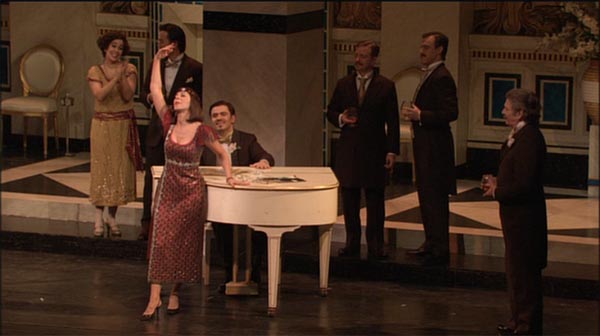
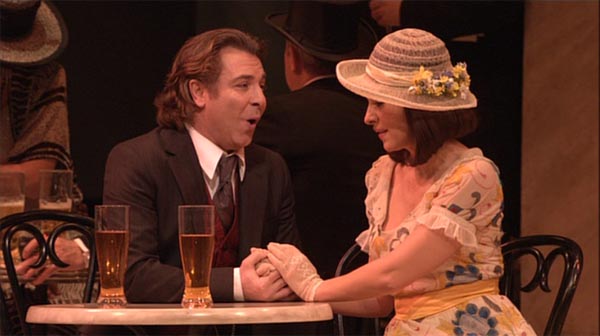
Puccini’s La Rondine has a plot that’s lightweight even by opera standards but it also has some really good tunes and plenty of opportunities for a star tenor and soprano to show off. In 2009 the Metropolitan Opera presented it as a vehicle for on again, off again couple Roberto Alagna and Angela Gheorghiu. Judging by the body language on and off stage this was definitely an “on again” phase. The production (Nicolas Joël), staging (Stephen Barlow) and design (Ezio Frigerio) don’t have a single thing in them that would cause concern to the most conservative of opera goers. The whole thing oozes old fashioned opulence. It’s the first time I’ve heard an audience applaud the sets! (Baldrick, you’ld laugh at a Shakespeare comedy). So no Regie here!
What we get is a beautifully sung and played performance. Gheorghiu sings gorgeously throughout and Alagna is not far behind. Their acting hows off some real sexual chemistry and if Gheorghiu tends to play the dive, well it’s that sort of role and that sort of production. They get well supported by Marius Brenciu, as the poet Prunier, and Lisette Oropesa, as the maid Lisette. These two basically provide the comic relief to the slightly cloying romantic main plot. Monica Yunus, Alyson Cambridge, Liz DeShong and Samuel Ramey take the other important roles and all are perfectly competent and true to character. The only aspect of the staging that doesn’t quite come off is the bar scene in Act 2. It’s all a bit too busy and there is some not very well thought through “drunk” choreography. Otherwise it’s basically a drawing room drama so not too, too hard to pull off. The orchestral playing is unsurprisingly good with the kind of music the Met orchestra excels in and Marco Armiliato conducting.
The video direction by Brian Large is OK. Given how much of the piece is two people talking, snogging or groping close ups seem a perfectly reasonable choice much of the time. The approach doesn’t work so well in Act 2 where a little more distance would have helped. Technically the DVD is an absolutely standard EMI treatment of a MetHD broadcast. The picture is very good 16:9 and the DTS 5.1 soundtrack is clear and spacious (LPCM stereo available too). English, French, German, Spanish and Italian subtitles and rather basic documentation in English with French and German PDF versions on the disk. Renée Fleming does the interval interviews which are about as revealing as usual (not at all).
All in all, it’s a lightweight piece but enjoyable and it would be hard to imagine a much better performance.
I am developing a pathological hatred of the people who do the video direction for opera DVDs. The sole exception I can think of is François Roussillon. Brian Large, Humphrey Burton, Kriss Rumanis, Gary Halvorson and the rest I could happily roast over a slow fire while poking them with a sharp stick. I do not want to see the tenor’s dental work or the soprano’s tonsils. I certainly don’t want a head shot of someone who isn’t even singing filling the whole screen. I do not watch opera on a 1950s television with a ten inch screen. Who does? FFS let us poor viewers see what is going on on the stage. It’s quite likely that the stage director does all that stuff deliberately(1) and maybe we might be able to understand the production if we could only see the bloody thing. This rant brought to you courtesy of trying to decode David Alden’s Ariodante while looking through the wrong end of the telescope.
This is what I want to see much/most of the time:
With tons going on all around and in the background this isn’t helpful:
And as for this…
Words fail me.
fn1. OK this may not be true of Zeffirelli or similar Met favourites. If the alternative is a furniture catalogue I’ll take the close ups.
I looked at the cast list for the 1999 Wiener Staatsoper Don Giovanni and almost drooled. Carlos Alvarez, Franz-Josef Selig, Ildebrando d’Arcangelo, Adrianne Pieczonka, Anna Catarina Antonacci, Michael Schade, Angelika Kirchschlager and Lorenzo Regazzo. Add to that Riccardo Muti in the pit and musically it’s going to be hard to miss. So, unsurprisingly it turns out musically excellent across the board. I particularly enjoyed Michael Schade’s Don Ottavio. His supremely stylish singing and excellent acting added up to perhaps the best interpretation I’ve seen of perhaps opera’s dullest character. One might have reservations about Pieczonka’s Donna Anna but I think it’s a matter of taste. She can sing very prettily as she shows in her final duet with Schade but when she ups the volume she has great power but significantly less beauty of tone. It really boils down to one’s personal feelings about casting a genuine dramatic soprano in the role. I guess casting a mezzo as Zerlina is a bit unusual too but Kirchschlager is very good indeed. All in all it’s as well sung a Don Giovanni as I have heard.
So, what about Roberto de Simon’s production and, supporting it, the acting? First, this production was performed at the Theater an der Wien so space on stage is tight and there’s a tendency for the singers to migrate to front centre stage for their big numbers giving a bit of a “park and bark” feeling. This is reinforced on the DVD by excessive use of close ups. If there is anything else going on we mostly don’t see it. This is a problem because there are some potentially interesting ideas in the production that don’t seem to be fully developed and that may be because the DVD viewer doesn’t see them develop. The first “big idea” is that as the piece progresses the costumes get more modern. Characters update roughly a hundred years on each appearance starting in the 16th century and going up to around 1900. The progression though is uneven and even my resident costume historian had trouble decoding some of the statements. It has to be said too that the early costumes in particular are sometimes bizarrely stylized. Don Giovanni gets visibly younger as the action progresses too. Add to that that there are two statues of the Commendatore; a 16th century one and a 19th century one. The former accepts Don Giovanni’s dinner invitation but the latter shows up. What are we to read into these elements and are they connected? To say that the characters are “timeless archetypes” seems to be a total “so what?” but I don’t have a deeper explanation. The second element is a flirtation with commedia. It’s never full on but we see glimpses of Harlequin in Leporello. In the opening scene he’s wearing what looks like a Harlequin costume that’s been desaturated in Photoshop as well as clown face. Don Giovanni’s acting too has some commedia elements. In particular there’s heavy use of the right-hand-shielding-left-side-of-the-face gesture in the opening scene with Donna Anna and it recurs in the final scene with the statue of the Commendatore. It gives Don Giovanni a sort of cheeky chappy quality at two of the most serious moments of the opera. Why? I don’t know. There are other, more or less isolated, visual references to the commedia sprinkled through the piece.
The final element of commedia is that Masetto is played as a complete clod. He’s the stock dim peasant rather than someone who recognizes Don Giovanni for what he is, the class enemy, from the get go. This is then set against an even more knowing than usual Zerlina. Certainly in “Batti, batti” she appears to be offering far more than poor old Masetto can begin to grasp. Whatever it’s all supposed to mean, the cast give it their all and are clearly acting their hearts out and at least it’s never dull.
The biggest problem with the disc though is the video direction. Once again it’s Brian “close up” Large. With such a small stage it ought to be quite easy to show us what is happening but instead we get super close up on super close up. I particularly hate it when several people are singing and the director is just showing us a headshot of one of them. It interferes with my ability to hear the rest apart from anything else. Besides I don’t have a tonsil fetish. This comes to a final utterly annoying climax in the confrontation between the Commendatore and Don Giovanni. Large keeps cutting back and forth between full screen head shots of the pair of them. Ugh!
Technically it’s OK for a 1999 DVD recording. The picture is decent 16:9 and the LPCM stereo soundtrack is OK but not stunning. There are English, French, German, Italian and Spanish subtitles. There are no extras which is no surprise as it’s all squashed onto one DVD9 disc.
All in all, definitely worth a look but if you figure out what the director is driving at please let me know!
Apparently the 2000 production of Beethoven’s Fidelio at the Met was controversial. It’s very hard to see why. Although Jürgen Flimm has moved the setting to the mid 20th century and some unspecified country that looks vaguely Germanic the storyline is followed to the letter, bar a few changes to dialogue, and there is no risk at all of any dangerous ideas surfacing. It’s actually a very good example of what the Met does when it’s on form; assemble an all star cast, stick them in an inoffensive production and let the music do its thing. Here we have an enviable cast. Leonora/Fidelio is sung by Karita Matila who looks and sounds spectacular (although maybe the fact that she’s the only “male” among the principals with no facial hair should have triggered a little cluefulness). Vocally she is most assured and never seems under any strain at all. She acts well too. Ben Heppner, as Florestan, is also vocally solid and even quite lyrical in the big trio “Euch werde Lohn in besseren Welten”. The acting though is best passed over in discrete silence. René Pape is fascinating as Rocco, the gaoler. I’m used to seeing Pape playing magisterial roles like Boris Gudonov or Sarastro. Here, the big voice is coupled with almost bumbling acting as he plays a morally weak character. It’s most interesting. A young Matthew Polenzani, one of my favourite tenors, sings Jacquino and he sings quite beautifully. Marzellini is Jennifer Welch-Babidge who I had never heard before but was sufficiently impressed to go look her up. It seems she’s busy with four kids in Utah and doesn’t spend much time at all in opera houses these days. It’s rather a pity. Falk Struckmann’s Don Pizarro is appropriately villainish and musically solid like everyone else. James Levine conducts and right from the overture launches us into a very intense, muscular reading of the score backed up by a very high standard orchestra. Musically and dramatically this is very satisfying albeit in a thoroughly conservative way.
The production was recorded for TV broadcast and it shows. The sets are already pretty claustrophobic but Brian Large’s video direction amplifies that. One gets the feeling that this is being directed for a 27 inch screen and it looks a bit lost on anything much larger. That said, the picture is more than decent and the DTS 5.1 soundtrack is top notch (Dolby 5.1 and LPCM stereo are also offered). The English subtitles are a bit odd. For some reason “Gouverneur” is translated as “Colonel” and “König” as “President”. I didn’t check the French, German, Spanish or Chinese subs for similar oddness. Bonus material is minimal but the documentation is fairly decent. All in all it’s a typical Deutsche Grammophon release of its period.
This excerpt from Act 1 (Gut, Söhnchen, gut) is pretty typical.
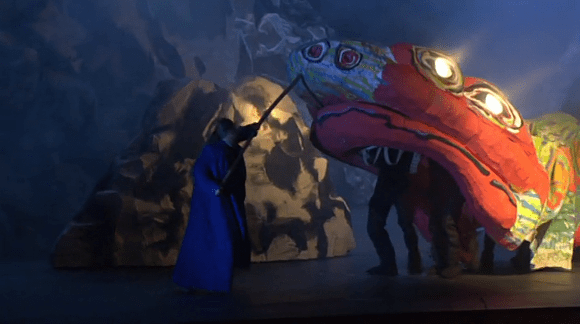
In 2006 the Salzburg Festival staged all 22 Mozart operas and Decca released them all on DVD. Die Zauberflöte appeared in a Pierre Audi production originally staged in Amsterdam.






 operaramblings