
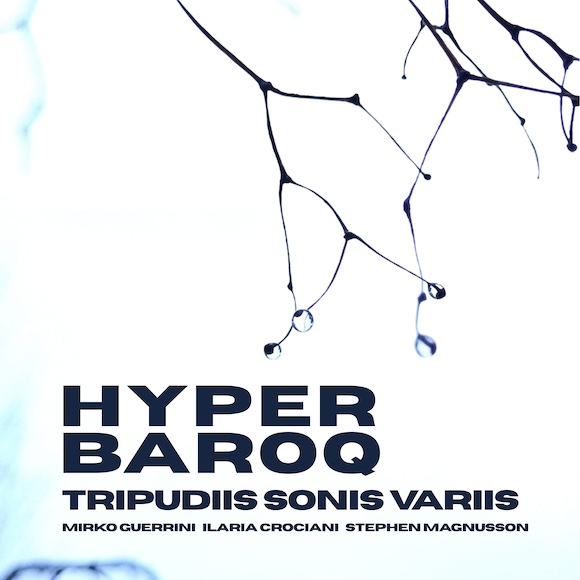
 I don’t often listen to CDs released on Australian jazz labels but I did come across tripudiis sonis variis from the Melbourne trio Hyperbaroq and was quite intrigued. It’s a set of performances of, mainly, Italian baroque music. Composers such as Monteverdi, Scarlatti and Strozzi feature but there are also a couple of earlier pieces in Latin and Galician and two English songs; one by Henry Purcell and a Robert Johnson setting of Ben Jonson.
This is not your typical HIP baroque performance. Hyperbaroq’s style is highly improvisatory and incorporates a lot of atypical instruments as well as pre-recorded electronics. The results are interesting but the dominant style seems to be a kind of cool jazz sound. This is very evident in their version of Scarlatti’s O Cessate Di Piagarmi; which features saxophone and electric guitar along with vocals. Some other tracks are rather different though. Monteverdi’s Lamento Della Ninfa gets a much more experimental feeling treatment with lots of electronics and the 13th century Galician Ay Ondas Que Eu Vim Veer makes interesting use of nature sounds and electronic effects. There’s also a weirdly boppy but rather enjoyable version of Purcell’s Music for a While. It’s pretty varied though I think I could have used more up tempo, high energy material as it mostly feels pretty relaxed.
It’s an interesting group. Vocals are provided by Ilaria Crociani with her partner Mirko Guerrini playing piano, soprano sax, chinese flute, moseño, duduk and chalumeau synth as well as being responsible for the sound art. The third member is Stephen Magnusson on various electric guitars. One gets the impression that they must have played together a lot to reach this level of cohesion.
The booklet contains both an artistic and an academic justification for the approach taken as well as full texts and translations. Personally, I’m a firm believer in experimenting, especially with something as difficult to pin down as baroque music. Attempts at historic reenactment have their place for sure but there’s also room for a freer treatment I think. So, yes, I found this to be an interesting experiment that grew on me. I definitely enjoyed it more on second listening.
The recording is clean and detailed; at least on the 48kHz/24bit version I listened to. It’s also being released as a physical CD and in MP3 and the release date is 2nd October 2026.
And now a note on the album title because everyone needs a digression about the evolution of obscure Latin words. In 1504, the physician Gaspare Torella coined the Latin phrase “tripudiis sonis variis” to describe his antidote and preventative against the plague, The booklet translates this as “a triumph of various sounds in which the soul delights”. Having little idea what “tripudium” meant I ran the phrase through Google translate and got “with various resounding ritual dances” which is a bit different from the earlier definition! So I looked up “tripudium” and discovered that in classical Latin it refers either to a ritual dance performed in honour of Mars or a successful outcome to the ritual feeding of chickens; a form of augury performed by Roman commanders before battle! I like the idea of “the various sounds of overstuffed ritual chickens”. But there’s a modern (if somewhat obscure) Italian word “tripudio” meaning “great rejoicing” or “jubilation” so I’d guess that by 1504 “tripudium” had lost its original meaning which would be, lets face it, pretty redundant.
Catalogue details: Earshif Music EAR131

