
Ferrucio Busoni’s Doktor Faust was left unfinished at the composer’s death in 1924 and completed by Philip Janarch. Further sketches for the work by the composer were fleshed out and incorporated into the score by Anthony Beaumont in 1982. That more complete version was performed at the Maggio Musicale Fiorentino in 2023 and recorded for video.
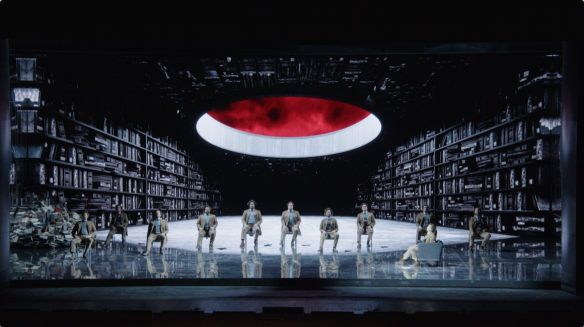
It’s a large scale, essentially late Romantic, piece. It uses a big cast and a large orchestra including organ as well as plenty of percussion and brass. It’s often loud and sometimes rather chaotic and the singers have to work pretty hard. The German libretto is by the composer and owes more to the German puppet theatre tradition of Faust than to Goethe. The soldier and his sister (not named here) so prominent in Gounod’s version are minor characters and the pivotal events of the opera centre around the marriage of the Duke and Duchess of Parma and Faust’s seduction of the latter.
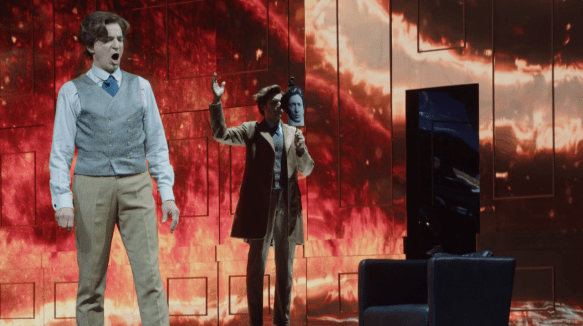
Dramatically it is a bit odd. It starts out with a spoken prologue about the Poet’s intention in creating the work. He would have preferred to do Don Giovanni but it’s hard to top Mozart so Faust it is. Then there are two more preludes in which Faust acquires a magic book from “Three Students from Cracow” and Faust and Mephistopheles work out their contract. It takes an hour to get to that point.
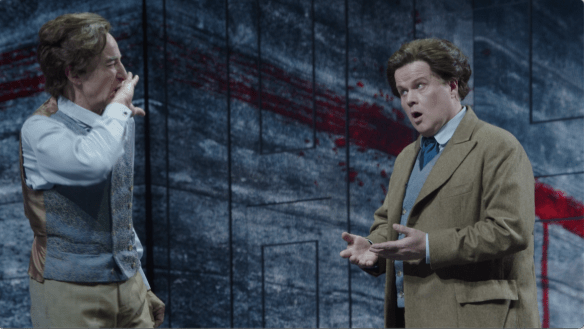
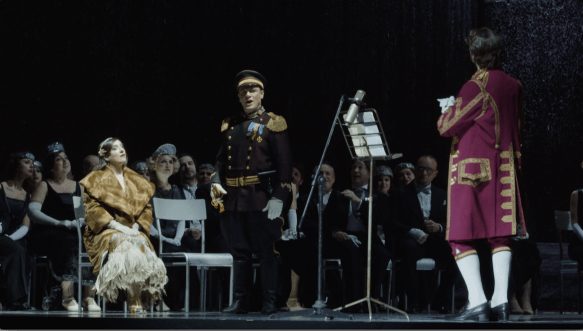
Then we get the first real action. The soldier is out to avenge his dead sister who was “ruined” by Faust. This of course misfires and the soldier is killed. Then it’s on to the Wedding at Parma. Faust provides the entertainment by conjuring up various visions of love and lust which seduce the Duchess into eloping with him. Next we are in Wittenberg where Protestant and Catholic students argue drunkenly over the eternal verities. Mephistopheles shows up with a dead baby and relates the story of Faust’s seduction of the Duchess and her recent death. He turns the baby to straw and sets fire to it. Faust sees a vision of Helen of Troy and the Three Students show up again foreshadowing Faust’s death.
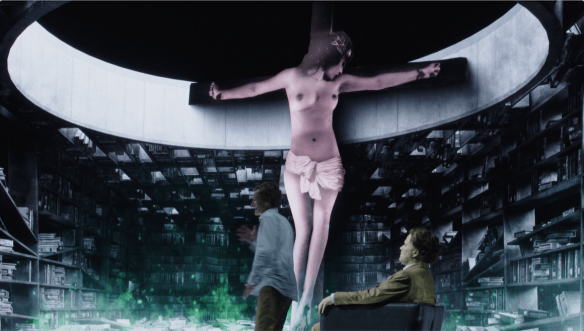
In the last scene Faust is conscious that he is near death. He sees a crucifix but it’s Helen on the cross. There is no redemption for Faust. The Duchess shows up with her baby and the Soldier carries in his dead sister. Faust is annihilated but his spirit appears to reanimate the dead child.
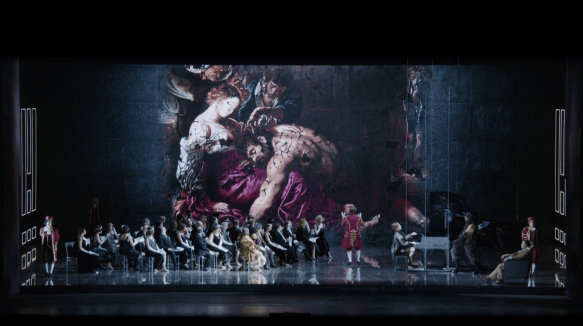
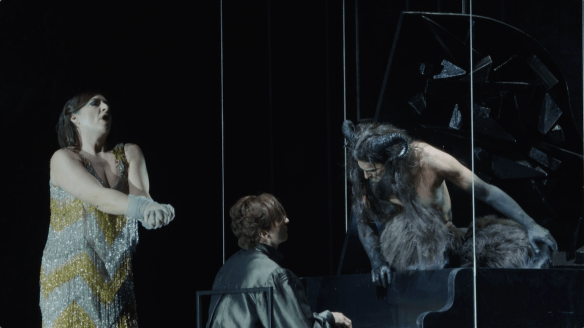
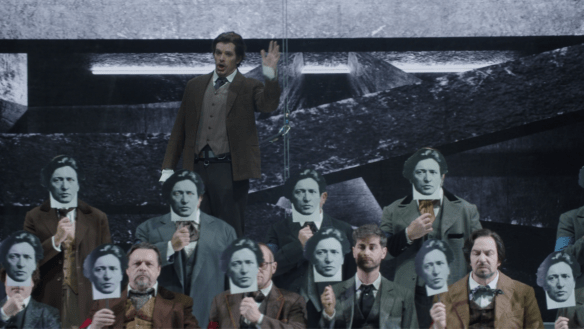
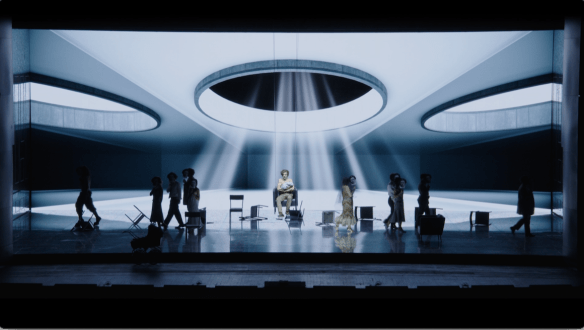
If all this wasn’t complicated enough Davide Livermore’s production takes quite a lot of liberties with the libretto. Mephistopheles, for instance, is supposed to appear in a wide range of guises but here he is in the same costume throughout. Much of the clutter at the wedding called for in the libretto is simply omitted. Instead we get a rather sinister satyr who seems to represent Faust’s libido; at least when he is enthusiastically shagging the Duchess, though at other times he’s fondling Faust or other characters. In the final scene, where Faust is supposed to be singing to the baby he’s actually singing to his shirt and various other elements of the final denouement are changed. There’s also extensive use of “Busoni masks” by all kinds of characters but especially the chorus. It’s rather overegging the obvious; Busoni is Faust or v.v. Overall though it’s pretty coherent and the only reason I realised how many changes were made was by reading the synopsis in the booklet which, as is so often the case, describes the opera as written, not as performed.
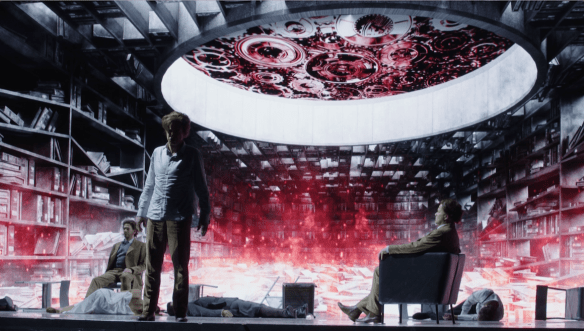
The best bit about the production is the use of video projections by D-Wok. These are gorgeous and spectacular and take the place of scenery pretty mush altogether. They are also very effective. The visions conjured up by Faust are impressive but the psychological commentary provided by a world that has portals and space and fantastic flame effects is even more compelling. All in all, it’s much more abstract than the 2008 Zürich recording but perhaps more coherent and probably more fun to watch and it uses the Beaumont additions so it’s more complete.
The singing and acing is rather good too. Dietrich Henschel is brilliant as Faust. He sings well and really conveys the sense of Faust as a deeply puzzling character who knows much but ften refuses to credit it. Daniel Brenna is also vocally quite spectacular on occasions but again it’s really his encapsulation of a Mephistopheles who is sardonic and evil but who, ultimately, is just doing a job he’s done millions of times before. There’s also an excellent performance from Olga Bezsmertna as the Duchess. She has two big arias which she handles very well and she has some awkward acting scenes to pull off. Wilhelm Schwinghammer doubles up as Wagner (not the composer) and the Master of Ceremonies while Joseph Dahdah does a similar double act as the Duke and the Soldier. Both are very solid.
The orchestra and chorus are both good and there’s a very impressive organ. Cornelius Meister goes for the full on Romantic sound and maybe overtaxes his singers on occasions but they cope. It’s all helped by really good sound in both the stereo and surround tracks. They are just hat little bit better than most Blu-ray releases. This is probably tricky to film but Matteo Ricchetti does a very good job and he’s backed up by an excellent picture on Blu-ray. Documentation includes the aforementioned synopsis and some background material as well as a track listing. Subtitle options are Italian, English, French, German, Japanese and Korean.
This disc is very different in many ways than the Zürich recording. Zürich I think was aiming for a “definitive” recording of a work the people involved believed was an underrated masterpiece. This new one seems more concerned with being good theatre. It’s worth seeing both if you can.
Catalogue information: Dynamic Blu-ray DYN 57998


A small correction: this DVD also uses the Jarnach completion, not Antony Beaumont’s. It’s a shame they didn’t – it would have been nice to have had filmed versions of both…