
Rameau’s Platée is a rather cruel satire on appearance and perception. Jupiter woos the unattractive swamp nymph Platée in order to prove to Juno how ridiculous her jealousy is. Platée is led to think that she is so beautiful that Jupiter will marry her only to be mocked and deflated when the crowd turns on her.

Robert Carsen decides to use the narcissistic setting of Paris Fashion Week as his vehicle for exploring the central themes of the opera. Jupiter is conceived as Karl Lagerfeld (complete with floofy and very mellow Persian cat), Juno is Coco Chanel. The settings include the mirrored showroom at Chanel and Coco Chanel’s hotel suite. Throughout, mirrors and reflective surfaces are used to reinforce the narcissism. The production premiered in Paris in 2014 with Lagerfeld in the audience and providing feedback! The recording though was made in December 2020 at the Theater an der Wien. Whether Lagerfeld watched from a more Olympian perch is a matter for surmise!
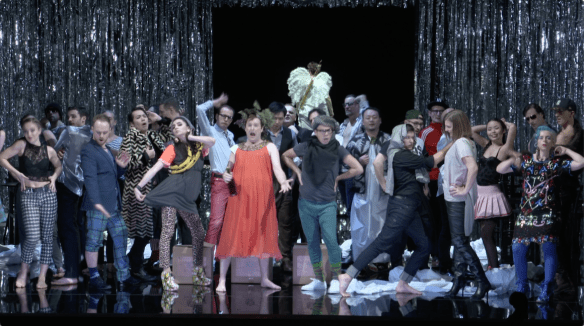
Rameau described the work as a “ballet bouffon” and, as one would expect, dance plays a very important role. As he has done in previous baroque productions, Carsen uses a choreography who can provide high energy modern choreography. In this case it’s Nicolas Paul. He gives his group of ten dancers some very difficult choreography including an orgy and a backward cakewalk which they accomplish with aplomb.

This production is also another partnership between Carsen and William Christie and his Les Arts Florissants. There are few conductors who understand the required style as well as he does and he has a band that can deliver for him. He also tends to pick singers with a good grasp of the style and of singing in French and that’s certainly the case here. Many of them are also required to interact with the dancers so they need to be good movers too.

Two performers exemplify this. Marcel Beekman as Platée is splendid. He’s a true haut contre with an excellence sense of baroque style. He does some beautiful singing but blends it well with the ridiculous “Quoi, quoi” froggy noises. He manages to move like a woman of a certain age too. He’s ridiculous but quite credibly ridiculous. Jeanine De Bique as La Folie is amazing. She sings beautifully while fully integrating into some serious choreography. She is a fantastic dancer. Throw in a busy beaver Cyril Auvity as Mercury, a booming and very convincingly Olympian Jupiter from Edwin Crossley-Mercer and a brief, but funny, hissy fit from Emilie Renard as Juno and it’s looking pretty good. The rest of the cast are excellent, as are the very busy Arnold Schoenberg Chor.

Video direction by Davide Mancini is admirable. This is a very hard production to film with lots of dark scenes and the plethora of reflecting surfaces but it ends up looking pretty good. The Blu-ray picture and sound are first class. To round things out there’s half an hour of rather good interviews with members of the creative team plus Marcel Beekman.

To sum up, this is another pretty successful example of Robert Carsen’s approach to the baroque; a contemporary setting, high energy choreography and the true baroque sensibility of William Christie. If you enjoyed Carsen’s Les Boréades or Semele you’ll probably have fun with this.

Catalogue number: Unitel Blu-ray 804804
This review first appeared in the Winter 2021 edition of Opera Canada.
 operaramblings