
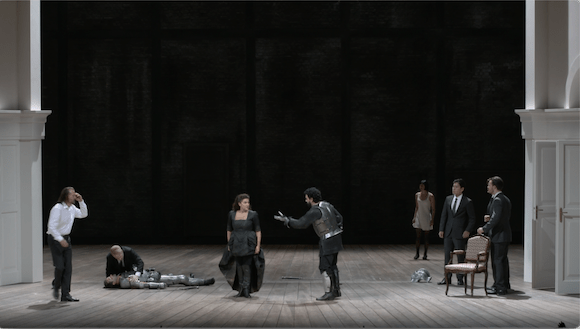
Christof Loy’s production of Handel’s Ariodante premiered at the Salzburg Whitsun Festival in 2017 and was reprised later in the year at the Haus für Mozart where it was filmed. It’s notable for marking Cecilia Bartoli’s first appearance in a breeches role. Loy uses this, and the gender ambiguity that abounds in the source material, in a most interesting way. He’s also very fluid about period; modern and 18th century costumes plus 15th century armour are mixed with gay abandon. Using very spare monochrome sets, often backed by 18th century style genre paintings, he creates a very open space within which the details of the production play out.
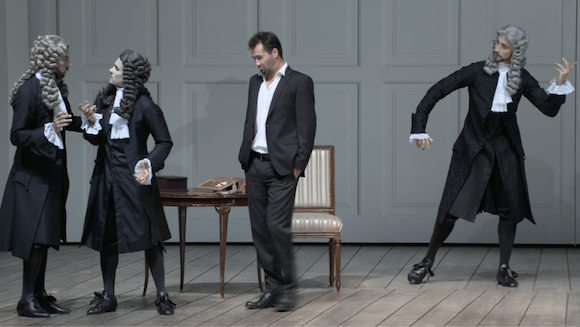
Act 1 is quite conventional, at least until the last scene. The principal characters are mostly dressed in suit and tie or equivalent though Bartoli wears tunic, boots and breeches plus straggly hair and a full beard. She looks more masculine than I would have thought it possible to make her look. She shows early on that she is going to dominate the show with a “Con l’ali di costanza” in which she gets convincingly drunker by the bar while maintaining absolute precision in her coloratura. There’s a lot of movement with a small group of male dancers on stage all the time interacting with the principals who all seem to be excellent movers. Nathan Berg, as the King of Scotland, shows impressive low notes and solid control and is especially interesting in “Voli colla sua tromba” where he interacts with on-stage valveless horns. The ballet at the end of the act gives us the first hint of gender ambiguity. Some of the dancers appear in women’s clothes. The choreography is 18th century (after a fashion) and the overall effect is Opera Atelier meets Les Trocks. It’s very funny.
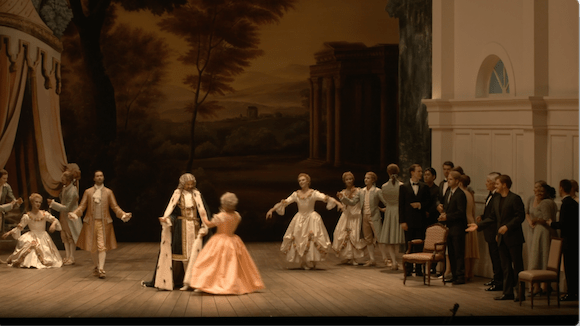
Act 2 is inevitably much darker and the gender bending continues. While singing an absolutely gorgeous “Scherza infida” (the ornamentation in the repeat is to die for) Ariodante puts on Ginevra’s discarded dress. It’s in this act too that Kathryn Lewek, as Ginevra, starts to really have an impact. She sings a lovely “Il mio crudel martoro” which suits her voice much better than the flashier numbers in the first act. There’s also excellent interaction between Sandrine Piau as Dalinda and Christophe Dumaux as Polinesso. Both are good actors and very stylish singers but while their relationship is portrayed as pretty creepy it’s not as creepy as some I’ve seen. It’s here too that Rolando Villazon’s Lurcanio comes into play. It’s a bluff interpretation of the role and the voice is darker than it once was. The ballet that concludes the act is much darker than in the first act with some quite scary demons tossing Ginevra all over the place.
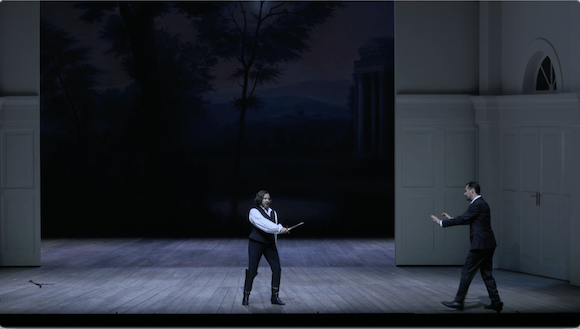
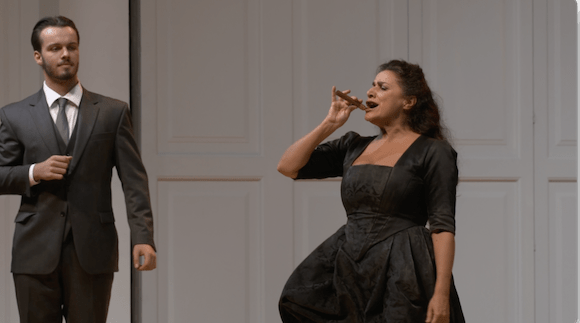
Act 3 opens with a reading from Ariosto about Orlando’s ambiguous gender. Then Ariodante appears, still bearded and wearing Ginevra’s dress, but carrying a two handed sword for his rescue of Dalinda. The scenes between Ginevra and her father are very well done and genuinely touching. Lewek sings “Io ti bacio” very slowly and beautifully with terrific control. For the denouement, Ariodante has lost his beard and masculine makeup. He/she is the totally feminine Bartoli we all know and love. To prove it she sings “Doppo notte” with pinpoint accuracy despite having a cigar clamped between her teeth much of the time! The act concludes with very ill looking dancers; male and “female” collapsing into heaps successively. Make of that what you will.

The pit band is the excellent period ensemble Les Musiciens du Prince-Monaco with Gianluca Capuano conducting from the keyboard. It’s a proper period sound with a mix of suavity and abrasiveness that works beautifully. Handel is so much better this way! Capuano’s tempi are interesting too. They are often extreme at both ends but he has a cast that can make that work. Tiziano Mancini’s video direction is judicious and backed up by excellent audio and video quality to produce a very watchable film.

There’s a real sense in which this is the Bartoli show, and she is utterly brilliant. Loy’s production rather emphasizes this so it would be easy to downplay the contributions of the other singers and the band but one mustn’t. They are very good indeed across the board. Overall, this is a terrific disc.
Catalogue number: Unitel Blu-ray 802504
This review first appeared in the Fall 2021 edition of Opera .Canada
 operaramblings
Pingback: Going for Baroque | operaramblings