
Duo Oriana consists of soprano Sinéad White and lutenist Jonathan Stuchbery. They gave a lunchtime concert in the RBA on Tuesday. Unsurprisingly most of their repertoire consists of lute songs from the 16th and 17th (and even 18th) century but they have recently branched out with the Toronto Book of Ayres which sets verse by contemporary Toronto poets. We got to hear that for the first time on Tuesday.
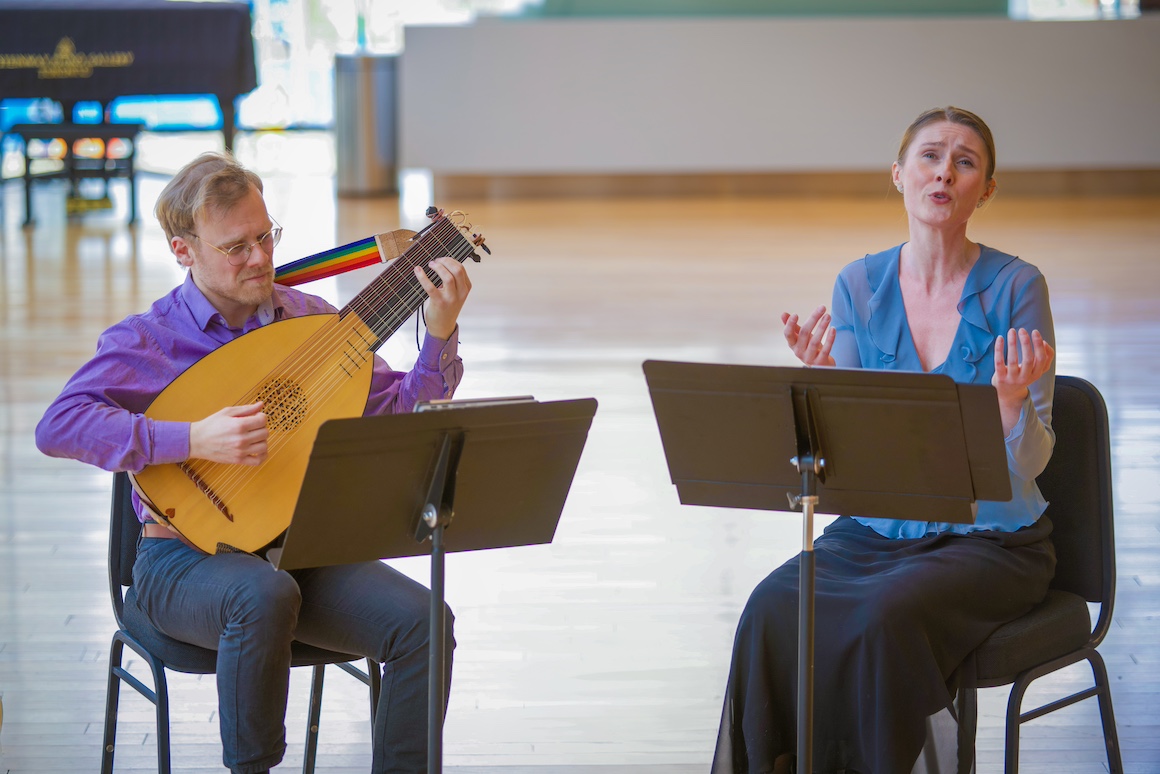
They began though with English songs from around 1600. Two rather beautiful and gentle songs; Robert Johnson’s “Have you but seen a white lily grow” and John Danyel’s “Why canst thou not as others do?” were followed by two plaintive but not entirely serious “love songs”; Robert Jones’ “My complaining is but faining”, and Thomas Morley’s “Who is it that this dark knight”: Duo Oriana really have this style mastered. Sinéad sang clearly with minimum vibrato and restrained emotion and Jonathan accompanied sympathetically. Queen Elizabeth would have approved.

The first part of the Toronto Book of Ayres sets poetry by Martin Gomes. “O Daughter” and “O Mother” deal with a fraught relationship from both points of view. What intrigued me was that writing a “lute song” had inspired Martin to use a 16th century inflected language palette. It wasn’t an imitation or a parody of the period but he did dip into the vocabulary to good effect. It was interesting; of today and yet not of today.
 Moving on a generation or two we heard William Lawes’ “Whiles I this standing lake” followed by a switch from lute to theorbo and Henry Purcell’s “Evening Hymn” with a prelude by (maybe) Bartolotti. This is one of the most beautiful of English songs and it got a lovely, restrained, elegant treatment from both musicians.
And so to the Toronto Book of Ayres part II. This sets two poems by Mellissa Davidson about the lost rivers and creeks of Toronto as an allegory for remembering. In some ways they sound like “singer songwriter” pieces which I suppose is not inappropriate. Are not the guitar toting minstrels of our own day the lineal descendants of young musicians who accompanied themselves on the lute so long ago?
And so to Scotland and on another century for James Oswald’s “The Parting Kiss”; a gentle farewell song from a man who would become Chamber Composer to George III. And finally, Henry Lawes “The Angler’s Song” which articulates the long held English view that the answer to trouble and care is to say “bugger it!” and go fishing. There’s a reason why Walton’s Compleat Angler is one of the best selling books of all time in English!
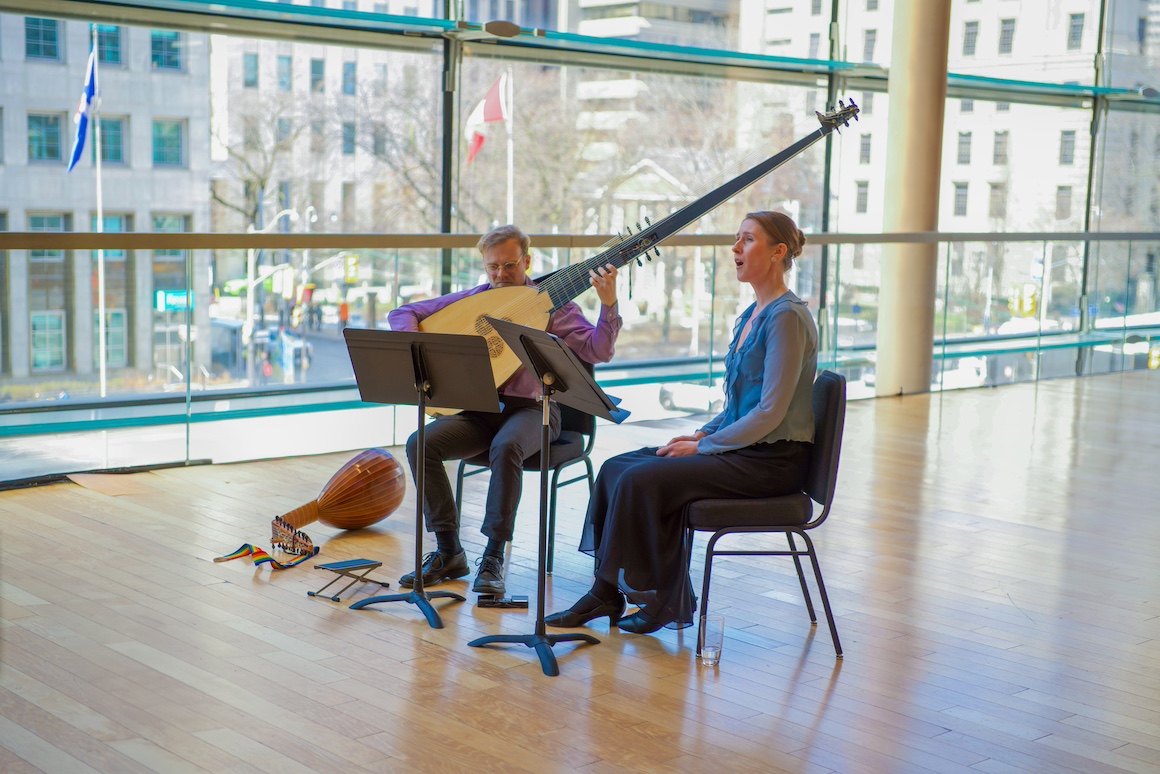
So, rather a lovely concert in a gentle, even genteel, way. Go see these two if you get a chance!
Photo credits: Karen E. Reeves
 operaramblings