
Most new Canadian operas get an initial run (if they are lucky) and then disappear. Luna Pearl Woolf and Royce Vavrek’s Jacqueline is unusual in that following it’s premiere at Tapestry Opera in Toronto in 2020 it also played in San Francisco in 2024 and is now back in Toronto for a revival at Tapestry; once again directed by Michael Mori. There’s even, we are told, a fourth run at a yet to be disclosed company in the works. In some ways it’s not such a surprise. In these cash strapped times the appeal of a very good full length opera that only requires two soloists; no orchestra, no chorus, ought to be obvious!

So, what of the opera, which opened at the Betty Oliphant Theatre on Thursday evening? It hasn’t changed much since the first run and my reaction on rereading my review of the premiere that appeared in Opera Canada Summer 2020 edition was “what on earth new am I going to find to say?”. There are a few new observations but mainly I’m going to quote a lot…
So what’s it about?
English cellist Jacqueline du Pré burst onto the music scene in the 1960s. In 1965, at the age of 20 she made a recording of the Elgar concerto which is still the standard against which all others are judged. In 1967, in the aftermath of the Six Days War she married Daniel Barenboim, then at the height of his fame as a pianist, in Jerusalem and converted to Judaism, becoming part of a New York “jet set” of intellectuals, musicians and artists. In 1968 du Pré started to experience numbness and fatigue in her fingers. Initially it was misdiagnosed as a psychiatric problem but four years later it was confirmed as multiple sclerosis. She was forced to give up performing and died in 1987 at the age of 42.
How does it work as an opera?
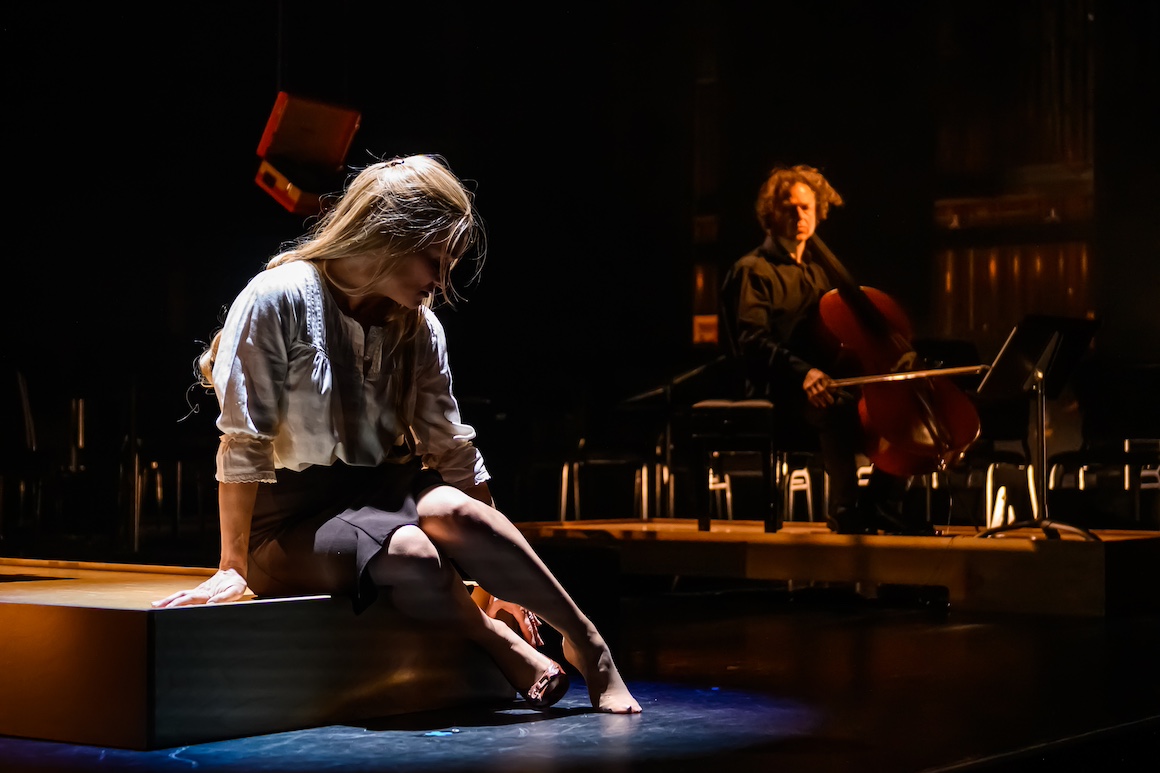
[by] focus[sing] on the relationship between Jacqueline and her cello; “mon ami”. They form the two characters in the drama. Jacqueline is sung by soprano Marnie Breckenridge with Matt Haimowitz providing most of the accompaniment on cello; though occasionally prerecorded music is also blended back in to good effect.
The pre-recorded elements seemed more prominent last night than five years ago. It could just be my memory but maybe that bit has been enhanced.
The libretto goes well beyond simple narrative. There’s a real sense of time and place in the choice of words and while, obviously, we are dealing with a very sad story it’s often very funny. Vavrek’s ability to conjure up a particular kind of England in the 60s and 70s is uncanny.
Actually it’s more than just Vavrek’s choice of words that evokes time and place. Breckenridge’s diction; accent, tone and timing, is impeccable (all the more impressive as she’s singing). She sounds just like some of the girls I went to university with.
And the music?
… [it] moves between the sound world most associated with du Pré; Brahms, Elgar etc, and something more atonal and astringent. We really hear a conversation between the cello; most human of instruments, and the singer, made more compelling by Breckenridge, on occasion, adopting a cello like glissando between notes.
I did find that, being more familiar with the piece this time around that I was listening more to the music and not spending as much energy in keeping track of the plot. It’s a very good score.
And the staging?
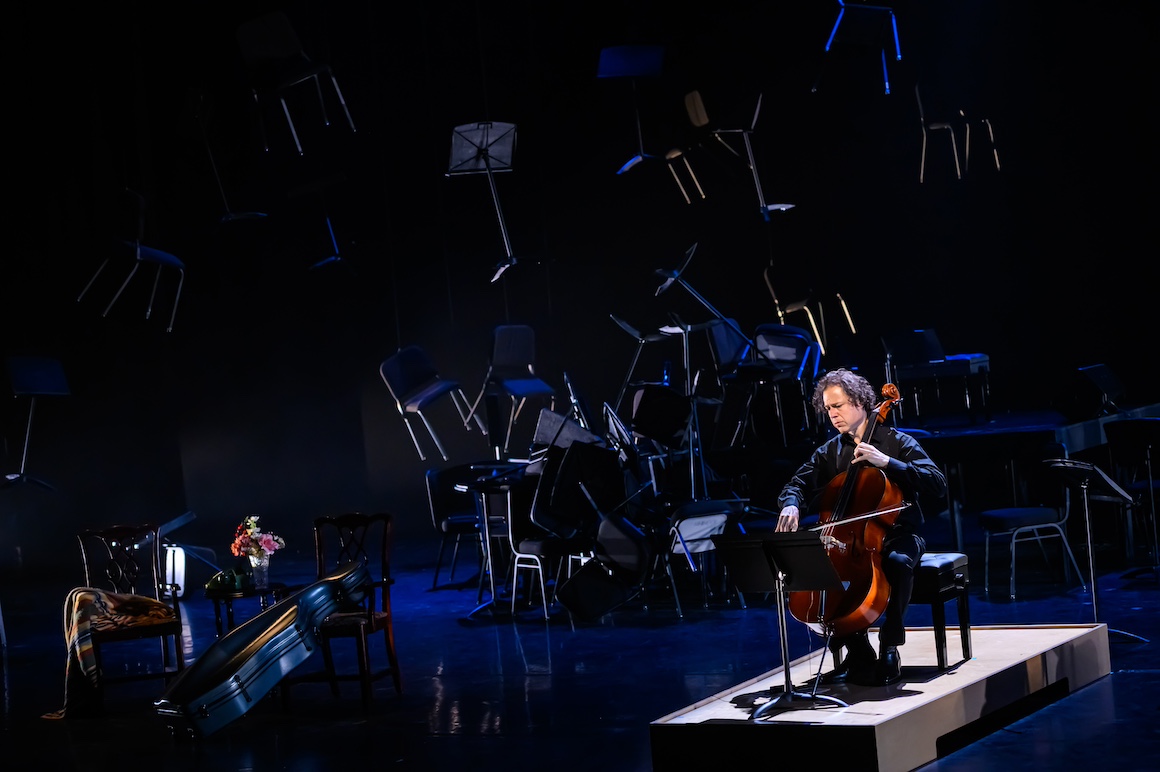
…designs, direction and staging are stark. The stage of the Betty Oliphant Theatre is ringed by chairs and music stands leaving two spotlighted chairs for the performers. Occasionally props; an LP, a record player, descend from the fly loft. Otherwise Michael Mori’s direction is all about physical movement and the relationship between woman and cello.
One thing I did notice more this time was the chairs and music stands. They start out in an orderly fashion and become more chaotic as Jacqueline’s illness progresses. It’s a rather clever touch.
And the performances?
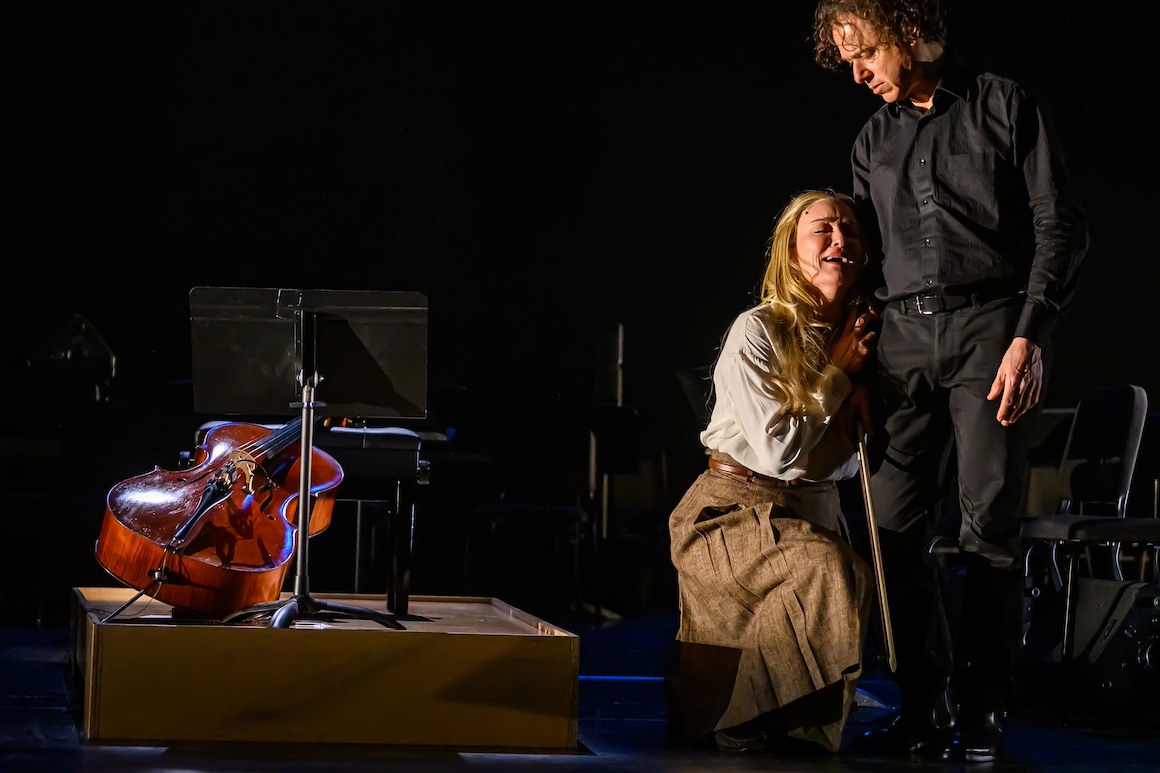
Much of the success of the piece as drama comes from the sheer intensity of the performances. Breckenridge sustains her persona brilliantly over about an hour and a half (plus an interval) which is quite a marathon for one singer. She also copes with music that covers a wide tonal and emotional range with apparent comfort. It’s not just the singing either. She throws herself exuberantly around the stage as young Jacqueline, slowly being reduced to an agonised crawl as the disease progresses. Haimowitz is equally intense and very skilled. He has a lot of playing to do too. It is perhaps even more intense at the points where they interact directly which really do convey the idea of a person whose primary emotional relationship is with her instrument.
That last point seems even more compelling this time around. There are times when the physical relationship is clearly sexual. Given the milieu parallels with teenage girls and horses come to mind.
So there it is. It’s a fine piece very well directed and performed and it’s playing in the very pleasant Betty Oliphant Theatre. There are two more performances on the 22nd and 23rd. If you can’t make that it’s also available on CD with the same performers; Pentatone PTC5187341 (review in the Summer 2024 print edition of Opera Canada).
Photos are from the 2020 run at Tapestry by Dahlia Katz.
 operaramblings
Enjoy your work. Massive commitment!
To quote Ann Manov, unfortunately I find most new opera is:
“box-checking census-opera; but ultimately, these currents are more cynical attempts to avoid criticism than criticism themselves.”
Thanks for the compliment!
As to new opera I think there are lots of forces in play. In the US there’s enormous pressure to be “accessible” and preferably to tick as many DEI boxes as possible. The same pressures are not as acute outside the US and maybe in some parts of Europe it’s rather the opposite. Creators are under pressure to impress a small, essentially self selected, commentariat who care little for what anyone else thinks. Despite this some really good operas get created.
It’s also worth remembering that most “new” operas have always been awful and quickly forgotten. No-one wants to go see Donizetti’s “Emilia di Liverpool”!
Pingback: Jacqueline | Reviews - Tapestry Opera
Pingback: The reviews are in for Tapestry Opera’s “Jacqueline” remount! | OXINGALE MUSIC
Pingback: The reviews are in for Tapestry Opera’s “Jacqueline” remount! – Luna Pearl Woolf