
The Enchantress (sometimes translated as The Sorceress) is a rather infrequently performed 1887 opera by Tchaikovsky. It got a production in Frankfurt in 2022 with an interesting cast. Asmik Grigorian plays the title character; Kuma or Nastasya, and Iain MacNeil, late of this parish, is Prince Nikita. It’s the first time I’ve come across him since he moved to Germany.
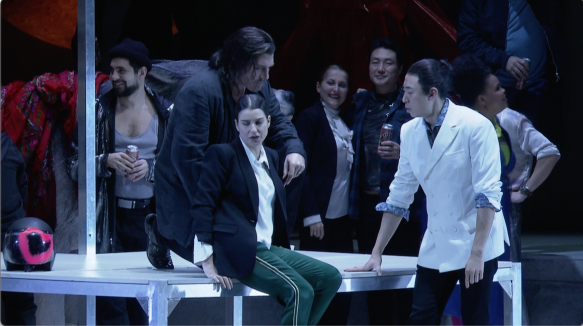
The director is Vasily Berkhatov and he’s chosen to take the original 15th century story; which Tchaikovsky intended as a commentary on the defects of Tsarist Russia, and translate it to the present where it works very well as a commentary on contemporary Russian autocracy. He also works with the more fantastical elements of the story very effectively.
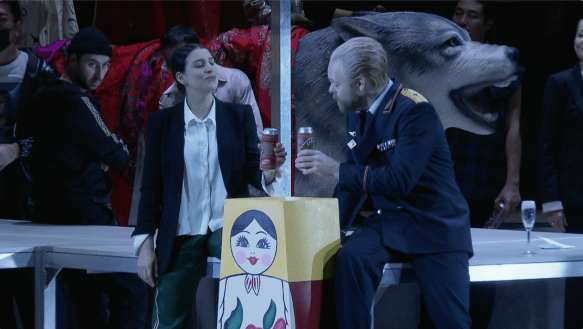
The story is easy to summarize. Kuma is a widow running a bar or inn largely frequented by artsy types somewhere near Nizhny Novgorod. This Bohemian-ness has attracted the attention of the authoritarian and unpleasant local bishop Mamïrov who claims that Kuma is a witch and her establishment a den of vice that should be closed down. He shows up with the Prince on a sort of inspection which doesn’t go according to plan. The Prince becomes infatuated with Kuma and humiliates Mamïrov.

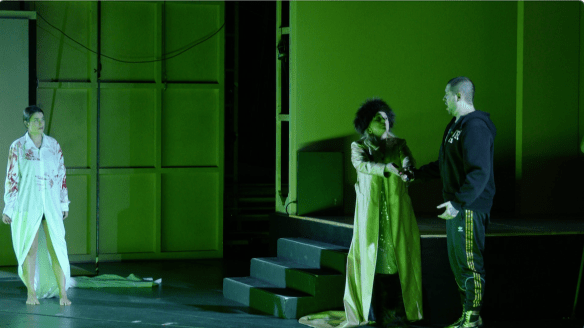
Back in the city Mamïrov convinces the conventionally pious Princess that her husband is having an affair with Kuma. When her son, Yuri, learns of this he swears to kill Kuma. He shows up at Numa’s place just after she has rather forcefully repelled his father’s advances klargely because she’s actually besotted with Yuri. She convinces hin that she is not having an affair with the Prince and Yuri promptly falls in love with her. They plan to run off together. That takes us up to the end of Act 3 in a pretty conventional, more or less realistic, manner. Then it goes all Russian folk tale. We seem to be in some sort of enchanted forest. The Princess meets a sorcerer (here played by the same person as Mamïrov) and obtains poison from him to “kill the witch”. Kuma shows up by boat for her tryst with Yuri but meets the Princess instead; who does poison her and then boasts to Yuri about it. Yuri curses her. The Prince shows up aiming to take Numa for himself but when he realises she has been murdered he kills Yuri and the Princess then goes mad and (in this version at least) may or may not kill himself too.

The staging is really very clever. It seems like a revolving stage is in play (though as so often it’s hard to tell on video). One area represents Numa’s bar and it’s full of artsy types drinking. There are dancers too; men in skirts and wolf’s heads. It contrasts with the palace which is represented by a rather bourgeois sitting room with an icon cabinet. The princess and her maid/confidante do yoga. The young Prince Yuri is a gym bunny and boxer and he’s also rather obviously a mummy’s boy and not too bright. These two basic sets do for the first three acts but at the end of Act 3 Numa goes through a door from her place to some alternate reality where menacing projections are playing. When she tries to go back through the same door it seems to lead to the palace but all of this now is weirdly lit with background projections to emphasis the shift from realism to something else. And it’s energetic and colourful and fun to watch.

All this is backed up by some excellent performances. Asmik Grigorian as Numa tends to hold centre stage whenever she’s on. She’s super sympathetic and, of course, she’s a fabulous singer. Her first big aria “If you look down the steep mountain” is a gorgeous display of carefully controlled and very idiomatic singing. Iain MacNeil is also very good. His two principal interactions with Grigorian; when they meet in Act 1 and in Act 3 where she rejects his advances (“pity isn’t love”) are very well done and he’s very convincing in the finale. He doesn’t really get a big aria but he sings very well in duets with Kuma and the Princess.

Alexander Mikhailov is Prince Yuri and he’s a proper Russian tenor. He produces impressive, ringing high notes and does a very decent job of working with the slightly pathetic character he’s given. The Princess is the reliable Claudia Mahnke. Her portrayal of the conventionally religious side of her character is convincing and there’s real venom in her “revenge” persona. She has a pleasing mature mezzo and sings some very good duets with both of the princes. Frederic Jost doubles as Mamïrov and the sorcerer Kudma. He’s suitably nasty and a proper bass. There’s a whole raft of minor characters and they are all pretty good. The dancers are excellent.

The Frankfurt Opera Chorus shows that it can act and sing very well. It sounds particularly lovely in the very Russian final chorus “If evil were sowed in the woods”. The orchestral writing is about one would expect from Tchaikovsky and the orchestra sounds appropriately romantic and Russian though, mercifully, the brass isn’t too Russian. Conductor Valentin Uryupin seems to both get the score and have a good understanding with the director and he keeps everything together in what is sometimes a busy, even chaotic, staging as well as getting a pretty lush sound out of his players.
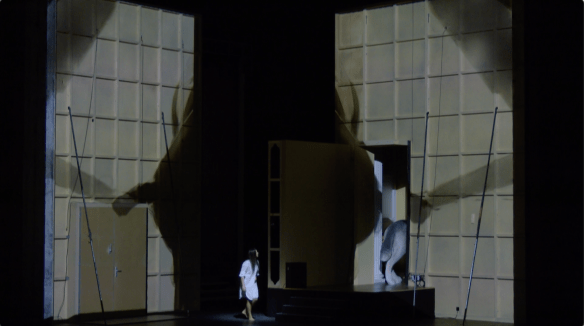
Götz Filenius directs for video. It’s not an altogether easy show to film. The first act is very busy and there are low light levels and some quite weird lighting in Acts 3 and 4. I think it comes off pretty well though. It’s perfectly possible to follow the plot and see how the stage director is interpreting it. On Blu-ray it’s predictably good in the sound (DTS-HD-MA and PCM stereo) and video quality departments.

There are no extras on the disk but there is a very good interview with the director in the booklet. It sheds a good deal of light on his choices for this production. There’s also a synopsis and track listing. Subtitle options are English, German, French, Spanish, Japanese and Korean.
It’s quite timely to have a Russian opera about the suppression of dissenting voices and this is a good one in a very effective production and performance. I did wonder why it’s not done more often but I suspect the answer is fourteen named solo parts!

Catalogue information: Naxos Blu-ray NBD 0180V
 operaramblings