
I’m probably not the only person who knows Delibes Lakmé only by the famous duet “Viens, Malika”, nor did I realise it actually comes about ten minutes into the first act. So, I was curious to explore the recent (2022) recording from the Opéra Comique where the work premiered in 1882.
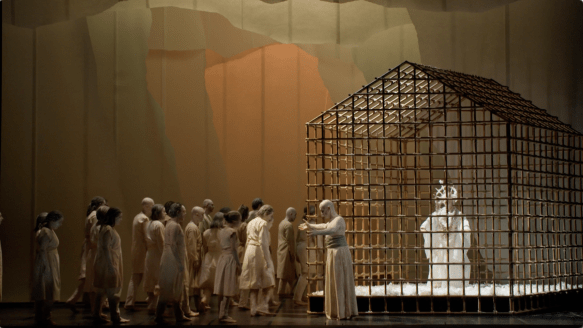
It’s rather an odd piece. In some ways it feels like two different operas spliced together. There’s the central love story of the Hindu “priestess” Lakmé and the British officer Gérald and the revenge her father Nilakantha wants to exact for various slights by the British. But there’s also an operettaish send up of the British in India, feeding the rampant Anglophobia of 1880’s Paris. The music for the central story is post-Wagnerian, almost going on Débussy, while other bits are a bit Offenbachish. The mix of recitative and spoken dialogue reinforces this slightly weird feeling.
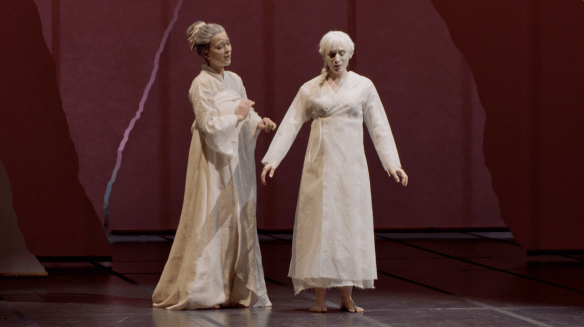
The story is straightforward enough. Nijkalantha is angry that is temple has been destroyed by the British and is engaged in some sort of revolt. He has a beautiful daughter Lakmé who is considered almost a goddess by the devout. A British party consisting of two officers, their girlfriends and the girlfriends’ governess accidentally break into the garden where Lakmé lives. Gérald hangs around to sketch some jewelry he has seen but is surprised by Lakmé’s return. They fall in love. Nikalantha arranges to have Gérald stabbed but Lakmé’s sidekick spirits him away to the forest where Lakmé cures him with her knowledge of medicinal flowers. Géralds’s comrade discovers him and persuades him that honour requires he rejoin the regiment as they go off to fight the rebels. Lakmé marries Gérald in a Hindu ceremony then kills herself with a poisonous flower to set him free.

To be fair there’s some pretty decent music along the way. Besides the Malika/Lakmé duet (which feels weirdly different in context) there’s a really good love duet at the end of Act 1. Lakmé gets a big coloratura aria (“Air des clochettes”) in Act 2 and Gérald gets a proper tenor show off aria (“Lakmé, c’est toi”). The orchestral writing is quite lush and evocative too.
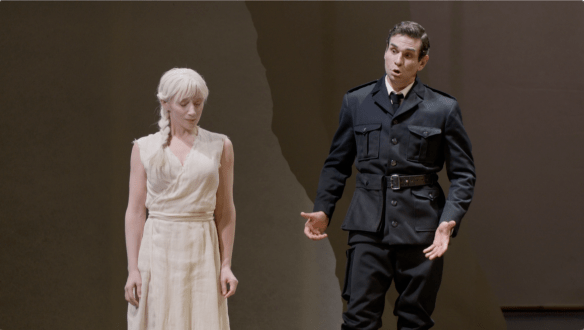
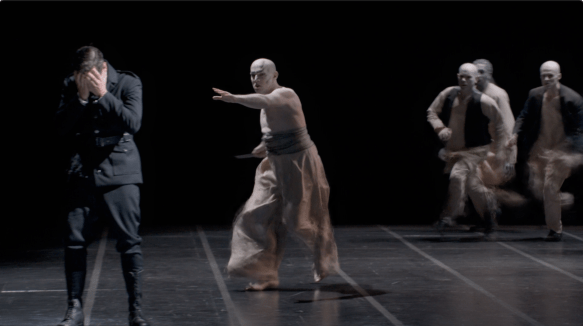
The Opéra Comique production is by Laurent Pelly and it’s typical of his work. Most of the scenes are more or less monochrome; creamy/yellowish for the Indians, grey/black for the Brits. There are stylized flats. the operettaish scenes feature a lot of synchronised movement. It’s not especially insightful but it works well enough.
The Opéra Comique assembled a very strong francophone cast for this production. In many ways the first half is held together by Stéphane Degout as Nikalantha. It’s the classic 19th century pissed off priest role and he’s very solid. Sabine Devieilhe, as Lakmé and Canadian tenor Frédéric Antoun as Gérald come into their own in the second half of the opera. She’s absolutely solid with excellent coloratura and he does some proper romantic tenoring. The supporting cast is uniformly excellent too.
The pit band is Pygmalion from Bordeaux. They are a period instrument ensemble who do everything from Monteverdi to Brahms but, to be honest, I’m not really sure what that means in the context of a piece from the 1880s. That said, they sound fine and Raphaël Pichon gets a fine, lush, sound from them. Pygmalion also supply the chorus, who do just fine, too.

There’s nothing at all demanding from a filming point of view and François Roussillon does a nice job backed up by first class Blu-ray video and audio (PCM stereo and DTS-HD-MA). The booklet has a synopsis, essay and track listing and subtitle options are French, English, German, Korean and Japanese. This is currently the only video recoding of Lakmé in the catalogue.
Catalogue number: Naxos Blu-ray NBD0177V
 operaramblings