
No, not a pandemic piss-up at No.10 but a newly released recording of Mussorgsky’s Boris Godunov recorded at Covent Garden in 2016. Funnily enough I remember Bryn Terfel, who plays the Tsar, alluding to learning the role during his Koerner Hall recital in April of that year.
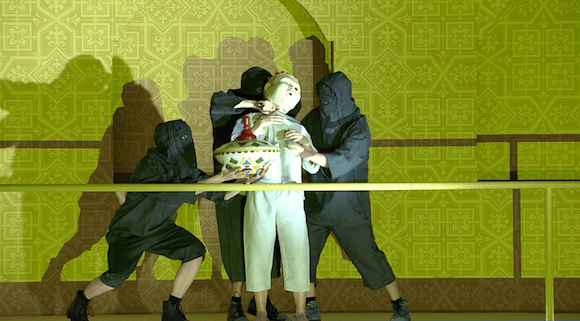
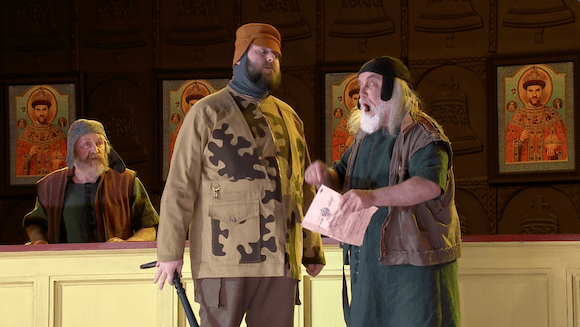
This is the original version in seven scenes so no Polish act and no really meaty female role at all. It’s also quite a straightforward Richard Jones production set in some, rather unspecific, Russian past with glitzy clericals, ikons and grubby peasants aplenty. And, for me, that’s a bit of a problem because it’s all a bit straightforward and dull. (The fault of the libretto rather than Jones). The one directorial intervention is that the dead Tsarevich, the memory of whose murder haunts, Boris gets dramatically killed again about six times over the course of the piece.

The set is a two level one with an upper gallery used mainly for court scenes, ceremony and murdering the Tsarevich. The lower level does multiple duty as the square outside the Kremlin, the inn on the Lithuanian border, monastery, palace etc. Each of the seven scenes is given a distinct look in this lower space. It’s all competent and workmanlike but it doesn’t pose awkward questions the way Bieito’s 2013 Munich production does. Nor is it as spectacular as Tarkovsky’s older version.

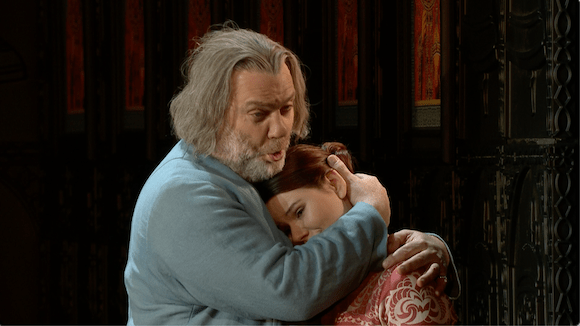
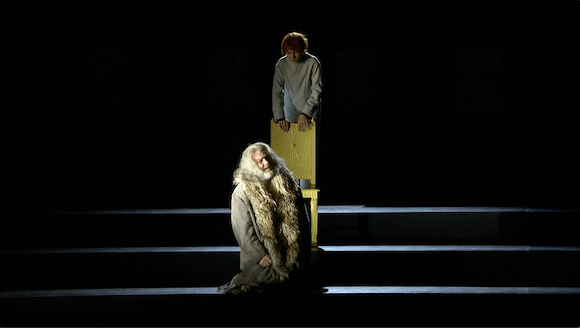
All that said, it’s musically very good. In many ways Mussorgsky’s music makes up for the dull libretto and it gets good value here. Bryn stars of course. He’s strong throughout but really quite touching in the scene with his children and his death scene. If anything he’s a bit too nice for a c.1600 CE tsar who got the job by murdering his predecessor! There’s a lot more good singing from David Butt Philip who deploys a pleasing youthful tenor as the false Dmitry. John Graham-Hall’s more mature tenor is well suited to the scheming Shuisky. Of course one can’t do Boris without some proper basses and there are excellent cameos from John Tomlinson as Varlaam and Ain Anger as Pimen. The supporting cast are all more than adequate and the chorus plays it part well. Antonio Pappano conducts and, as you might expect, goes for a full blooded, dramatic sound most of the time. Bottom line it’s more successful musically than dramatically.
Jonathan Haswell’s video direction is pleasingly unobtrusive and is backed up by the usual Blu-ray sound and video package. There’s an extra on the disk; a quite insightful rehearsal conversation between Pappano and Terfel. It’s especially welcome as the booklet is vestigial with a brief synopsis and what i suppose could be called a “track listing” but there’s only one cue point per scene. Subtitle options are English, French, German, Korean and Japanese.
There’s absolutely nothing wrong with this recording but, in the last analysis, I find the equally well sung Munich recording more insightful and rewarding. If you have a strong preference for more traditional productions you may well prefer this one.
Catalogue number: Opus Arte Blu-ray OABD7314D
 operaramblings