
Wednesday night’s main event in Toronto Summer Music was Teiya Kasahara’s The Butterfly Project performed at Walter Hall. Teiya’s introduction was most interesting. For them, the project is about exploring their Japanese-ness. As the child of a Japanese father and a German mother growing up in Vancouver that’s inevitably a complex thing. When it gets combined with opera and, specifically, Puccini’s “Japanese” travesty Madama Butterfly it gets really complicated. So The Butterfly Project raises some really interesting questions; for Teiya ones related to being a to-some-extent-Japanese performer of works like MB, for me ones related to why this opera fascinates people like Teiya when, frankly, I’d be happy to bin it.
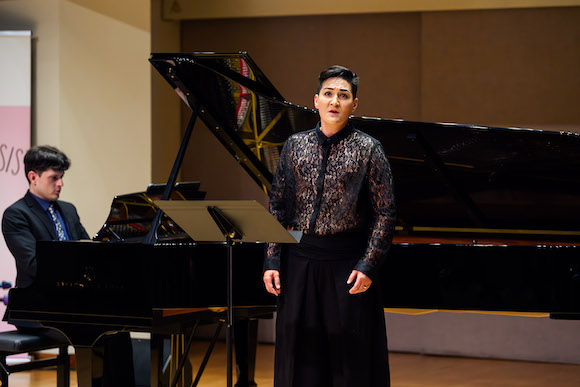
But before we got a chance to ponder those insoluble questions Teiya tossed us a curve ball (a suitable metaphor perhaps for Western influence on Japanese culture). The first half of the programme, before we got to The Butterfly Project, consisted of chamber music and art song by Japanese composers writing in the Western classical tradition around 1900. There was music for piano and violin by Rentarō Taki, Kunihiko Hashimoto and Kōichi Kishi and songs by Kōsaku Yamada. Much of this, Hashimoto’s “Azami no hana” for example, was well crafted music that wasn’t obviously Japanese. Others, songs in Japanese or chamber pieces that used Japanese folk tunes, pentatonic scales and rhythms one thinks of as essentially Japanese, had me wondering whether they were a homage to roots or an attempt to meet the expectations of a Western audience 100 years ago listening to music by a Japanese composer (or both or neither). In any event it was interesting music well performed by Dabin Zoey Yang on violin with Xi Huang on piano with Teiya accompanied by Gregory Smith performing the songs.

The Butterfly Project itself is an intriguing work. It’s dense and complex and mixes up excerpts from Puccini’s opera; sometimes in Italian, sometimes in Japanese with other Japanese songs in a variety of styles ranging from folk melodies to electronica. Some of it is sung by Teiya at the piano, some of it is samples from recordings. There’s a major component of the sound world contributed by Andrea Wong on electric violin. It’s loud, non-linear and disorienting. I think I was expecting something more linear, quirky and cabaret-like like The Queen in Me. It wasn’t like that at all. Did it address Teiya’s question of “How Japanese is enough”? Yes it did. Did it answer it? No it didn’t. I think it moved forward a conversation about the key questions and probably created a basis for another iteration but it definitely feels “provisional”. And that’s perfectly OK. I don’t think the question of how we address/deal with cultural appropriation (distortion? mangling?) in opera is going away anytime soon.
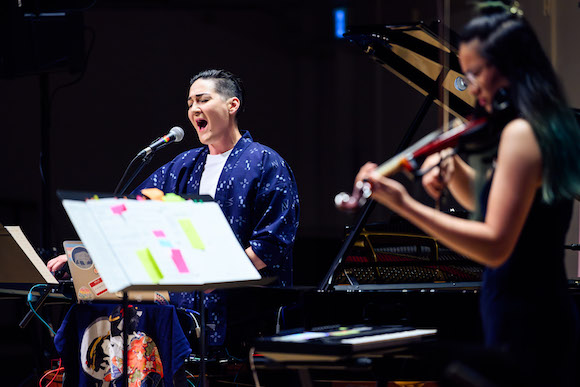
Photo credit: Lucky Tang
 operaramblings
3rd sentence, pls correct the pronoun. Thanks for your reviews!
Done. Thanks for the spot. Still struggling a bit with this pronoun thing!