

Miriam Khalil
Last night was the first night of a four night run for Against the Grain Theatre‘s production of Britten’s The Turn of the Screw. These are the folks who did La Bohème at the Tranzac and The Seven Deadly Sins in an art gallery. Last night’s space was only marginally less unconventional. We were in some upstairs space at the Helen Gardiner Phelan Playhouse reached via the back entrance and lots of stairs. It was a sort of loft set up so that the performance space was a narrow strip bounded at each end by a door and at the sides by three banked rows of seats. There was seating for maybe eighty people so it was intimate, even claustrophobic. Add to the space a few simple props, lights and a fog machine and you have the raw materials for Joel Ivany’s production.
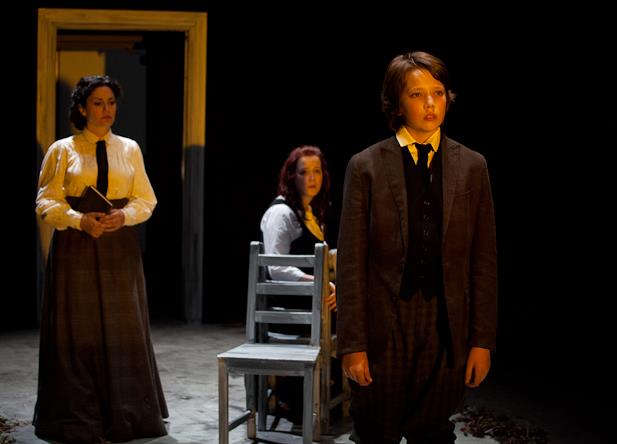
L-R Miriam Khalil, Johane Ansell, Sebastian Gayowsky
The Turn of the Screw is a potentially very rewarding piece but difficult to pull off. The opera stage isn’t the easiest medium to generate ambiguity about what is real and what in the imagination, the roles of the children are difficult to cast, none of it’s an easy sing and the score, if not driven forward with great attention to rhythmic detail, can seem flat and lifeless. All of these problems were overcome last night to create a show that was never dull and was, at times, actually quite disturbing.
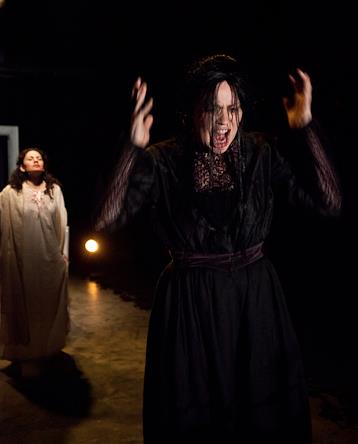
Miriam Khalil (L), Betty Allison (R)
The intimacy of the space pretty much forced a decision to have very corporeal ghosts and both Michael Barrett’s Quint and Betty Allison’s Miss Jessel had as much of the vampire as the ghost about them. It worked. Miss Jessel’s first entrance was a bit Hammer Horror like as she dragged herself across the floor but it set the scene very well. The scene at the beginning of Act 2 where the pair argue over the children was played out around the children asleep in bed with Quint and Miss Jessel almost pawing them in their desire. Really creepy! The same can be said for the great confrontations between the Governess, the children and the ghosts. There was also a very clever touch near the end that really messed with the audience’s perception of what Mrs. Grose can and can’t see. You’ll have to go see for yourself though as I don’t want to spoil it!
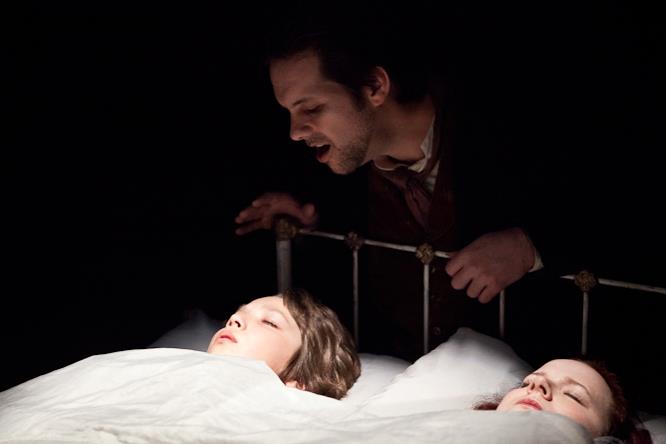
L to R: Sebastian Grabowsky, Michael Barrett, Johane Ansell
The singing and acting were excellent. The ghosts sang as well as they acted. The tricky problem of casting the children was overcome with treble Sebastian Gayowsky excellent as Miles. He can sing and act well beyond his years. Johane Ansell managed the even more difficult feat of looking like a young girl while, not quite, sounding like one. She was good throughout but really injected some venom into the confrontation with the Governess in Act 2. Miriam Khalil was a carefully characterised Governess. She managed all the nuances of the role; the optimism, the creeping fear, the resolution and the self doubt. It was a huge advantage here to be in such a small space because she was used small gestures and facial expressions, that might easily have been missed in a larger house, to great effect. She has the right voice for the part too; mostly lyrical and expressive but capable of pulling out the stops where needed. The cast was rounded out by Megan Latham as the undramatic housekeeper Mrs. Grose. It’s a bit of an ungrateful role, being mainly a foil for the Governess, but she managed it without becoming impossible bumptious or squally.
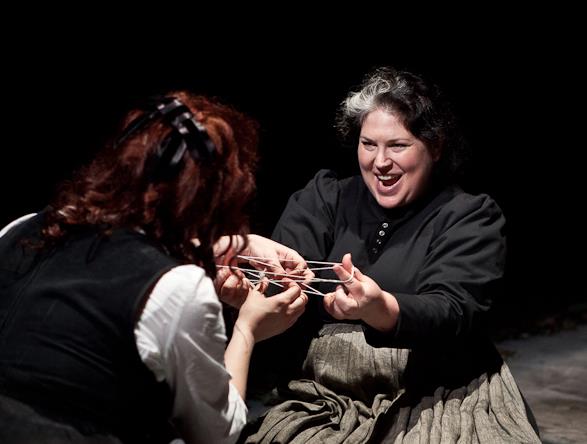
Joane Ansell (L), Megan Latham (R)
Perhaps the most controversial aspect of the production was the decision to go with piano accompaniment. Space and cost dictated it and I perfectly understand that it was piano accompaniment or no production. That said, the orchestral interludes play a major role in The Turn of the Screw and there are few operas with more evocative orchestration. Even the astonishing Topher Morzewski couldn’t make a piano sound like Britten’s orchestra. However, he did inject lots of energy and drive and the piece never flagged or got lifeless. The use of piano coupled with the acoustic of the small space did mean that, musically, some of the big ensemble moments didn’t get to “bloom” the way they would in a more operatic acoustic but if that was, to an extent, a musical loss it helped heighten the sense of claustrophobia. Swings and roundabouts.
Bottom line, Against the Grain have created another remarkable theatrical experience with a budget that I would estimate as roughly 1/3000th of a Lepage Ring cycle. I’m told there are still tickets available for tonight, Saturday and Sunday.
Photo credits: Darryl Block
 operaramblings
Thanks for the evocative review. Love the system of economic measurement, too… has potential to be widely applied, possibly with a long German word for its units. 🙂