
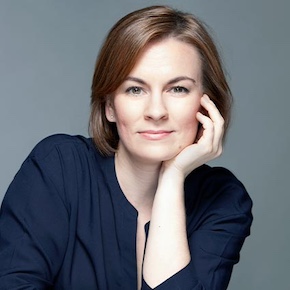
 On Wednesday I sat down with Daniela Candillari at the COC’s office for a chat about her approach to opera, conducting and so on. Daniela is in Toronto to conduct the upcoming revival of Rossini’s The Barber of Seville at the COC. It’s her first Barber and something of a change of pace for someone who has conducted mainly contemporary opera including world premieres at Opera Philadelphia (for example, Jeanine Tessori’s Grounded and Rene Orth’s 10 Days in a Madhouse) and Opera Theatre of St. Louis where she is Music Director (Ricky Ian Gordon’s This House, among others).
We started with Barber. I wanted to know more about the opportunities and constraints of conducting a production that had already had two runs at the COC with, what’s more, the same Bartolo; Renato Girolami, each time. Her perspective is that, irrespective of the production, the music has unifying ideas and natural tempi that need to be respected. There’s some flexibility of course and more in some places than others. She used Bartolo’s aria as an example of where one could take a piece in different directions without doing violence to the score. It was pretty clear that she was going to do Barber her way without too much consideration of how it been performed here before. Which makes sense to me.
So we turned to conductor/director partnerships and how you need the coming together of minds (as long as the music comes first!) to achieve the magic. Daniela threw in that, in her view, it actually took more. The ensemble had to be fully on board with both the staging and musical ideas for it to really happen. I should have known that having experienced some “interesting” rehearsal conversations but I guess I had pushed it to the back of my mind. We talked about which directors she particularly liked. Two of her picks; Robert Carsen (with whom she has not worked) and Amy Lane (who she has worked with) are both familiar to Toronto audiences and I share her respect for those two and how they can bring new insights to works without totally “reinventing” them. More to my surprise she brought up Zeffirelli. I guess I get the attraction even though, personally, I never want to see another Zeff production. Controlling a spectacle like the Zeffirelli Turandot would be be pretty exciting I guess.
We also talked a lot, unsurprisingly, about contemporary opera. Now Daniela grew up in Serbia and Slovenia, has degrees from universities in the USA and Austria and now works mainly in the USA so she’s well positioned to reflect on the differences in contemporary opera composition on both sides of the Atlantic; a subject of considerable interest to me. It’s not just a case of funding models demanding “accessibility” in the more commercially sensitive markets. The clear musical divide goes deeper than that though she pointed out that it’s not as binary or as clear cut as one might think. Generalising, opera scores, especially in the US, tend to pack in the words to tell a long story in a manageable length opera whichcan lead to dull, movie score like music. Europeans tend to go for more abstract themes and more modern musical language and perhaps cleave closer to an operatic tradition that doesn’t demand a great, new story if the emotion is in the music. Think Il Trovatore or La Bohème. There are exceptions of course. John Adams, Philip Glass and increasingly, Missy Mazzoli travel east well enough and George Benjamin and Thomas Adès get performances over here. Maybe because, au fond, they all follow the old philosophy albeit in very different ways. Daniela pointed out though that there are complexities. Benjamin Britten, for example, doesn’t get much traction in the German speaking countries; perhaps because there’s no link to the Second Vienna School. There was a lot more in this conversation than we had time to unpack.
We also touched on baroque opera and the different demands and opportunities it presents. It can, if one is unlucky, be very boring but if singers (and instrumentalists) fully embrace the freedom the relatively non-prescriptive baroque scores afford it can be magic and also very modern sounding. It’s worth noting that one of Daniela’s masters degrees is in Jazz Studies! So we talked about Julius Caesar and L’incoronazione di Poppea; both of which she has conducted and just how powerful those works can be and how they afford a freedom to the audience , as well as the performers, to find their own sound world.
And so finally to some fun. What’s on Daniela’s conducting wish list? It’s a fascinating list. The first things to come up were Dialogues of the Carmelites and Rosenkavalier but then came a group of three that I wouldn’t have grouped but which do make sense as a collective; Tales of Hoffmann, Love for Three Oranges and Hansel and Gretel. All of these have an element of magic realism, even absurdity, though I suppose it comes out in different ways. In any event, it fits with our earlier conversation about not wanting opera to be a kind of “documentary”. I suppose Adès’ The Exterminating Angel fits in there too but I guess Don Carlo fits better in the “guilty pleasure” category. In any event, an interesting list. I’d take any of them in Toronto!
It was a fascinating hour and now I’m agog to see what she does with The Barber of Sevilleem> which opens at the COC on February 5th.
 operaramblings