
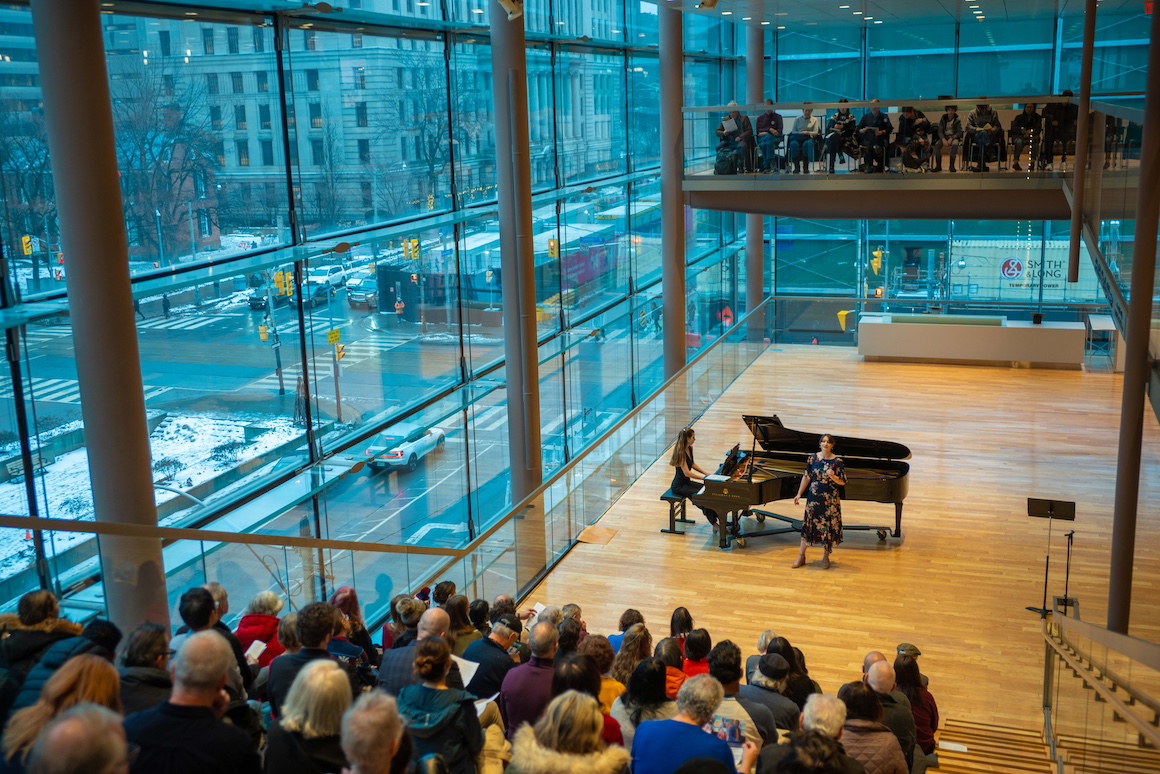
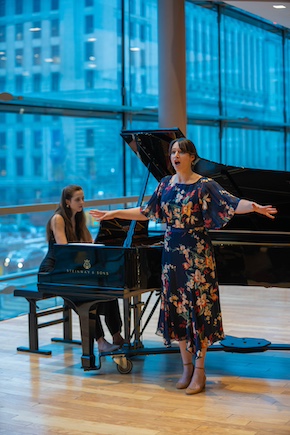
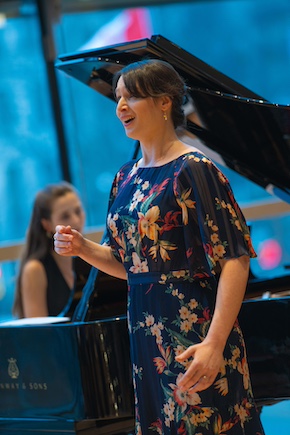
Tuesday’s lunchtime recital in the RBA, the first of 2026, was given by Israeli mezzo-soprano Michal Aloni and pianist Alona Milner. All the music, most of it Hebrew language art song, was by composers who either emigrated to Palestine/Israel or who were born there. In their excellent introductions Michal and Alona enumerated three waves or generations of composers:
- Those who were trained in Europe in the early 20th century who left Germany (or parts adjacent) for obvious reasons after 1933 such as David Zehavi and Paul Ben-Haim.
- Those who emigrated later; often as children, whose musical formation was in the new state like Yehezkel Braun.
- Those who were born and/or educated in Israel somewhat later represented here by Stella Lerner and Aharon Harlap.
What I found really interesting was that the three groups were more similar than different and almost all the music seemed to represent a conscious attempt to “be Israeli”. So lots of late Romanticism infused with elements of various Jewish folk traditions; reminiscent in some ways of late 19th/early 20th century attempts to do the same in parts of Europe.
 One might have expected someone like Ben-Haim who moved to Palestine in the 1930s in the middle of a successful musical career to have shown more signs of growing up in the world of Schoenberg and Stravinsky but I didn’t hear it. Even more perhaps one might expect composers active in the 50s, 60s and 70s to have flirted with the sort of experimentation that was so dominant in those decades. If they did, it wasn’t represented here.
The one piece that bucked the trend to some extent was Yehezkel Braun’s three movement Piano Sonata. The first movement here showed some distinct Bartok and Stravinsky influences and, to my ear, the opening bars seemed to owe something to Shostakovich. The two later movements though reflected on Jewish mysticism and dance. But for the most part one sense that for these composers, to be truly national implied also accessibility.
 That said, there were some fun songs like Ben-Haim’s onomatopoeic Four Children’s Songs, quite a few that applied a sense of yearning to either scriptural texts or the land itself; such as David Zehavi’s Eli, Eli: A Walk to Caesarea, Alexander Boskovich’s Hinach Yafa with text from The Song of Songs and Marc Lavry’s Shir Ahava riffing off the story of Ruth and Boaz.
Most of the material was fairly upbeat but there was one dramatic exception; Aharon Harlap’s God’s Step Daughter which sets text by Yaakov Barzilai about the separation of a mother and daughter during a Transport. Besides a brutally dramatic text, the music here is both darker and harmonically more complex than any of the other songs.
The performances by Michal and Alona were nuanced and really rather good but the point, I think, especially in the context of the upcoming Holocaust Remembrance Day, was to showcase the, largely unknown outside Israel, corpus of modern Israeli music, especially song in Hebrew. That the concert did very well indeed.
Photo credit: Karen E. Reeves
 operaramblings