
On Wednesday evening I went back to the Four Seasons Centre for another look at the COC’s production of Berg’s Wozzeck. I was really impressed with the show on opening night (my review on bachtrack.com) and was interested to see whether a second look would give some insights into a production that is visually fascinating almost to the point of overload.
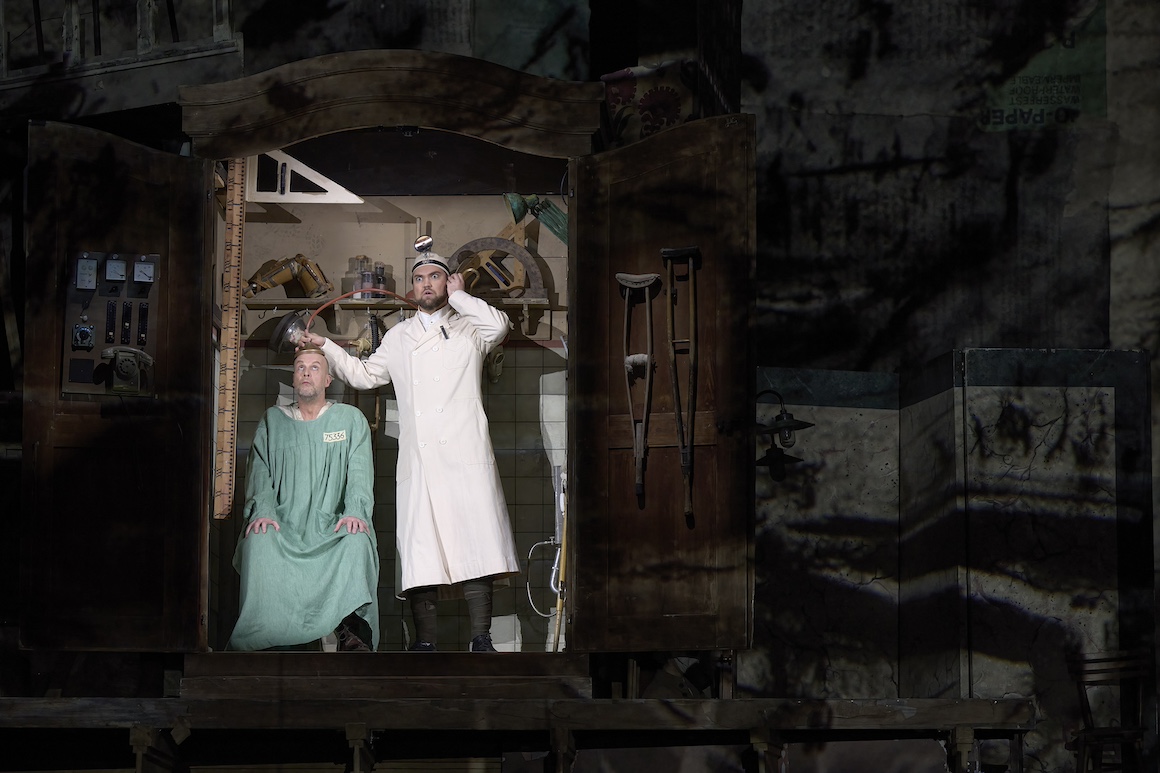
Michael Kupfer-Radecky as Wozzeck and Anthony Robin Schneider as the Doctor
I was sitting a little further back and slightly more centrally which opened up my view of the stage a bit. What dawned on me as I watched was how the production has worked both with and against the structure of the libretto. As written, Wozzeck consists of a series of fifteen scenes separated by orchestral interludes during which, in a super traditional production, the curtain comes down. Obviously Kentridge’s production doesn’t do that. It’s a unit set and the curtain is completely absent (funny how the “composer’s original intention” crowd don’t fuss about that the way they do if a sword is turned into a carbine in, say, Verdi). So the action is continuous, aided by the use of actors and projections. But… the structure of the fifteen scenes is preserved in a very subtle way. Projections reshape the space to be whatever is required; a town damaged by shell fire or bombs, a barracks etc. It’s subtle and allusive but it’s there. The heavy visual pyrotechnics are mostly reserved for the orchestral interludes.
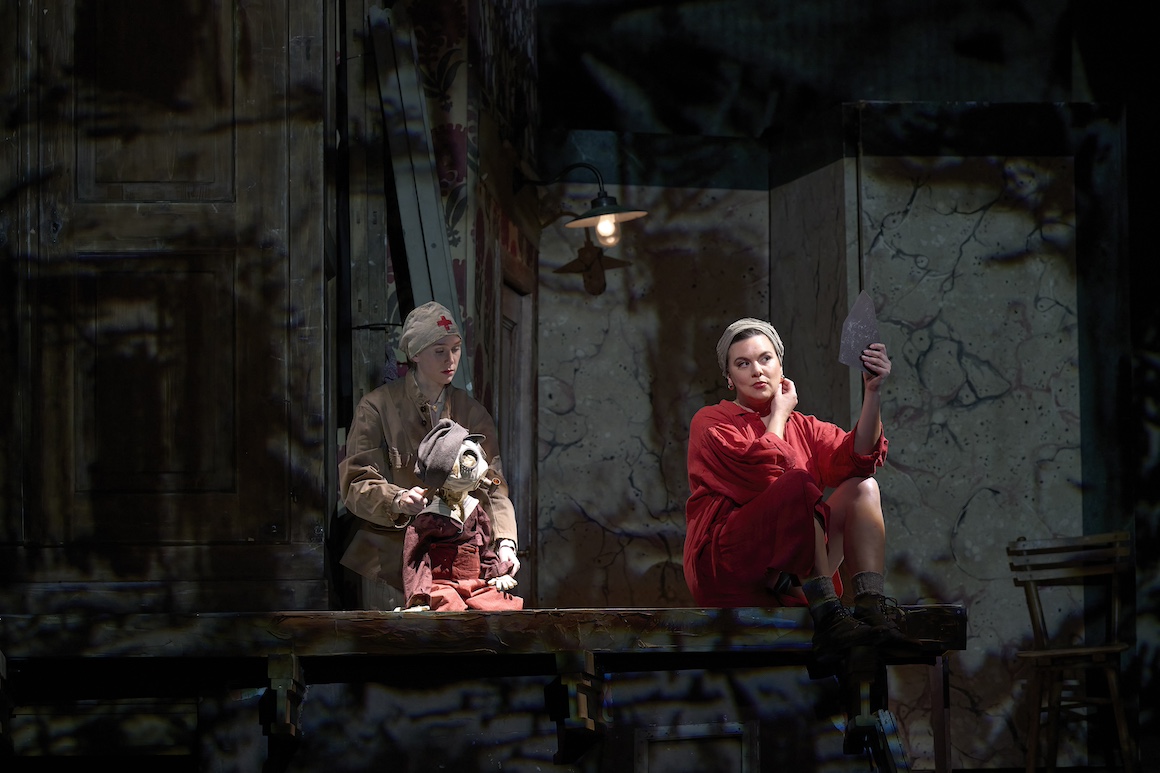
Brooklyn Marshall and Ambur Braid as Marie
A couple of aspects of the iconography had bothered me first time around. The projections and animations are heavy on WW1 imagery but it’s pretty clear that the work is set before the war so I think we are seeing a sort of foreshadowing of events that will lead to the collapse of the rigidly hierarchical world of the opera. Another thing that a number of people have commented on is the use of a puppet for Marie’s son. Here the problem, as much as anything, is the libretto. We have a child who can ride a hobby horse and go out and play in. the sunshine. Yet we are told that Marie and Wozzeck have known each other less than three years. Kentridge has gone with portraying the child as a two year old. Most productions make the child much older and use a child actor. I could make a case for either.
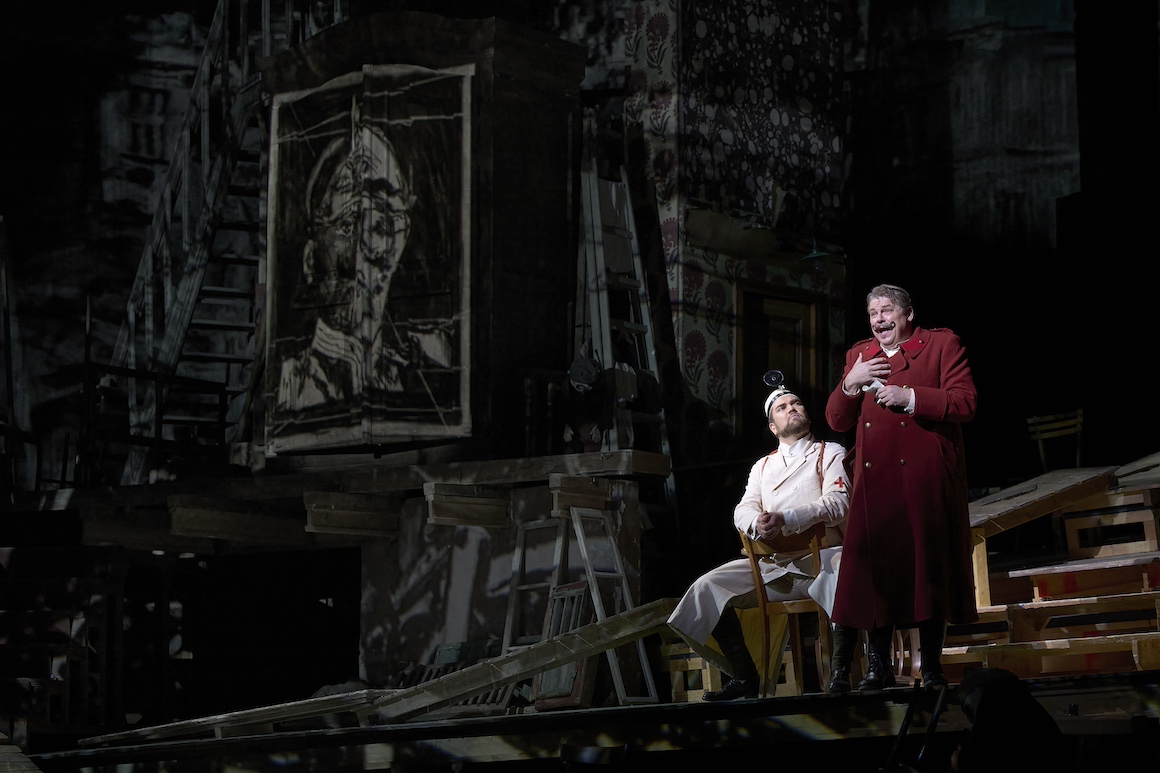
Anthony Robin Schneider as the Doctor and Michael Schade as the Captain
Ad those projections and animations… There’s so much going on that one would have to see the show many times to fully deconstruct the imagery. Perhaps the most disturbing ones are dissolving images of child, or child-like, soldiers but the gas masks and facial disfigurement run that a close second. The repeated short clips from what look silent movies are also rather unsettling!
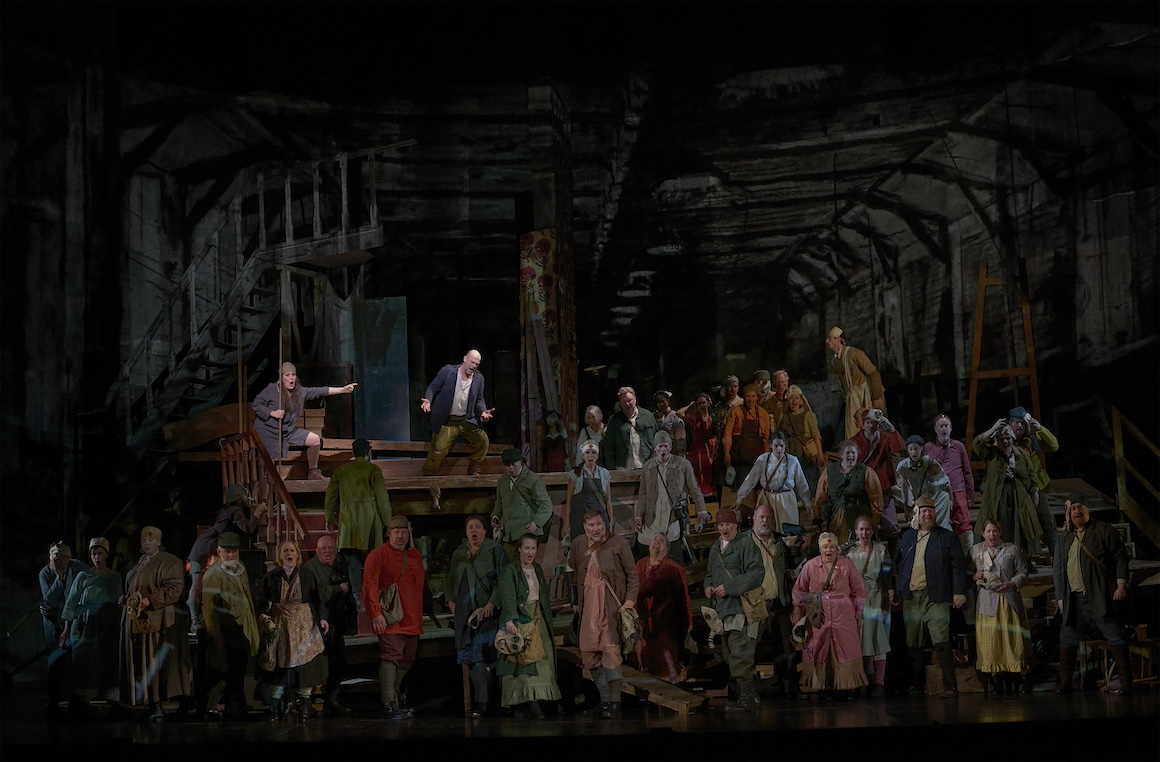
Krisztina Szabó as Margret and Michael Kupfer-Radecky as Wozzeck
How did the performances stack up against opening night? I’d say they were as good, if not better. I think there’s sometimes a degree of tension at openings that is somewhat inhibiting. On Wednesday everybody seemed to have settled in and none more so than Michael Kupfer-Radecky in the title role. I thought he sang with more confidence and attack on Wednesday taking a very fine performance up an extra notch. Overall, it’s a fabulous performance really. It’s an almost all Canadian cast and shows no weaknesses and the COC orchestra and chorus are world class.
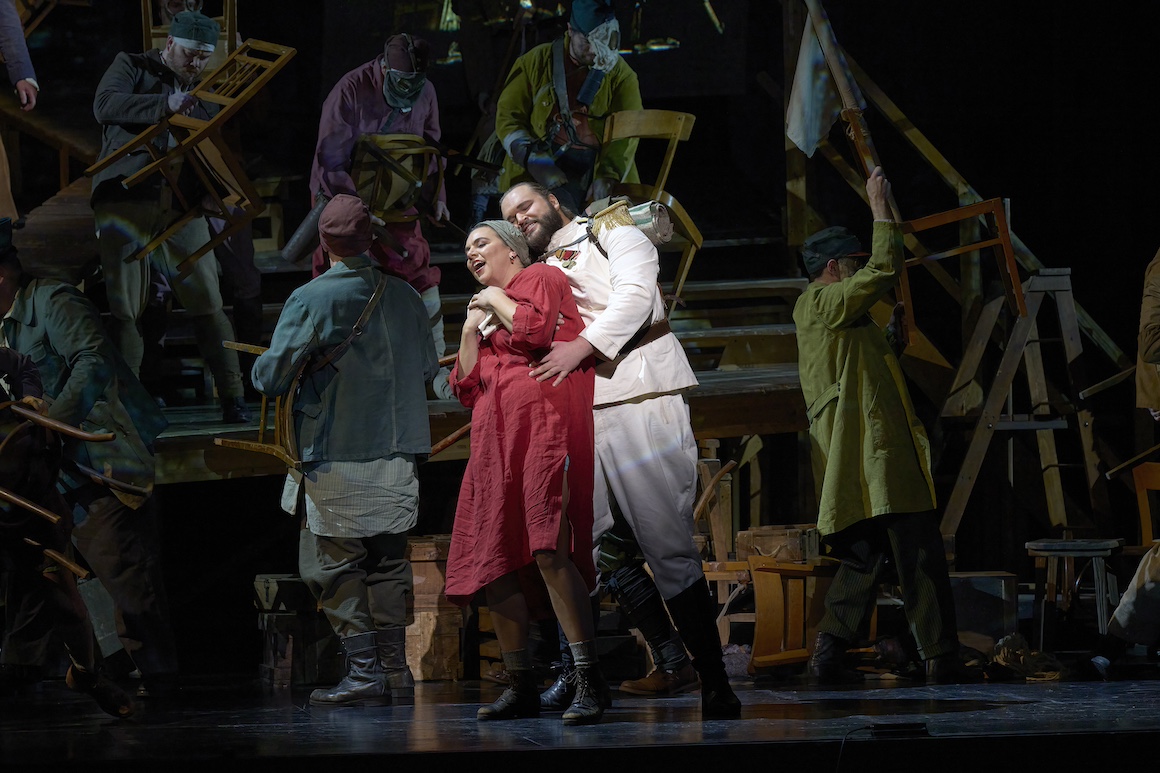
Ambur Braid as Marie and Matthew Cairns as the Drum-Major
The audience reaction was a bit different from opening night too. Contrary to my expectations the place was reasonably full (I’d been hearing doom and gloom about ticket sales) and I’d hazard a guess that, unlike opening night, most people were there because they wanted to experience this Wozzeck rather than dress up for an opera opening. Certainly the reaction at curtain call was much more enthusiastic. There’s a marketing issue in there that I don’t know how to address in the context of a short, rigid, performance run. “Word of mouth” and reviews take time to percolate, especially when the major print media take a week or more to get a review out.
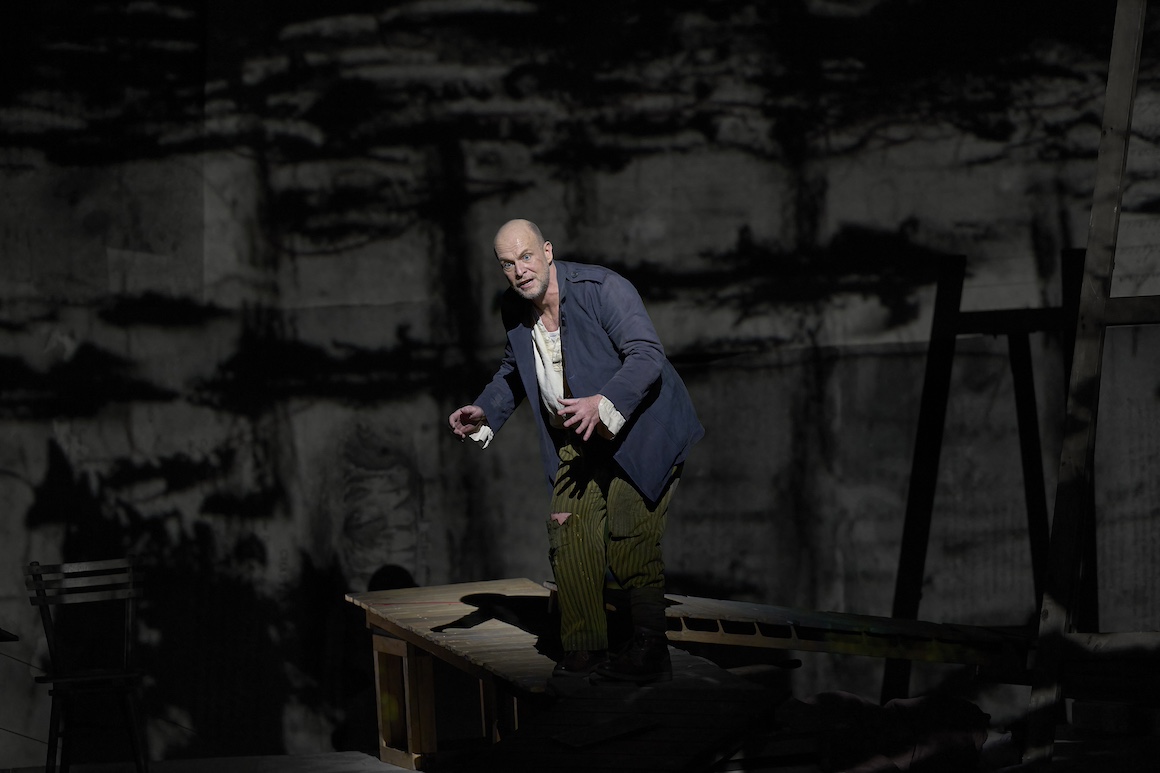
Michael Kupfer-Radecky as Wozzeck
There’s just one more chance to catch this show. Friday evening.
Photo credit: Michael Cooper
 operaramblings