
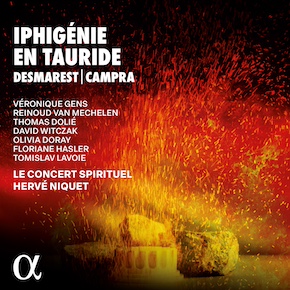
 Euripides’ Iphigenia at Tauris formed the basis for an opera almost a century before the more famous one by Gluck. Henri Desmarets; one of the more notable successors to Lully at Versailles/Paris began work on an Iphigenia opera to a libretto by Joseph-François Duché de Vancy in the 1690s but work was interrupted by Desmarets being exiled from France for marrying a minor without her father’s permission. Eventually the Académie Royale de la Musique entrusted the task of completing the opera to André Campra who teamed up with Antoine Danchet as librettist. The end result was a tragédie lyrique in five acts and a prologue that premiered in 1704 to some success. An even more successful revival in 1711 led to multiple productions across France and abroad before it was effectively replaced by the Gluck work in 1779.
It’s the same basic plot as Gluck. Diana has whisked Iphigenia away fro Aulis to serve as her priestess in Scythian Tauris. A bunch of Greeks are captured by the Scythians under their king Thoas and are to be sacrified to Diana. They include Orestes and his sidekick Pylades, unbeknownst to Iphigenia. Stuff happens then Diana shows up and facilitates the escape of the greeks thus ending the practice of human sacrifice. This version has some interesting features. It’s somewhat longer than the later opera at about 135 minutes and it includes Elektra as a character; in fact in a love triangle with Pylades and Thoas which helps make Thoas a bit less of the cardboard cutout villain he is in the Gluck.
There’s also a fun scene where Thoas summons up Ocean and a bunch of watery nymphs which gives an opportunity for interesting sound effects! Also, unusually, the prologue is actually a prologue to the story rather than sucking up to the relevant Louis which is usually how these things were done. Campra did an excellent job of maintaining Desmarets’ style. If the work of the two composers were not labelled as such in the printed score I’m sure we’d have endless arguments about who composed what! The end result is a fairly compact piece with loads of dance music and marches, as well as the usual airs and recitatives. It’s musically as interesting as anything else I’ve heard from the French baroque.
It’s now been recorded by Hervé Niquet and Le Concert Spirituel with a cast of (mainly) French baroque specialists led by Véronique Gens as Iphigénie. It’s very well done. As tends to be the case nowadays Niquet doesn’t let things drag and there are some very brisk tempi. There’s an excellent example of this in Act 3 where the music for the Water Nymphs’ dance and the subsequent storm music are taken very fast indeed. There’s some fine singing. Gens is excellent, especially in her touching scenes with Oreste, but she also blends nicely with the slightly lighter soprano of Jehanne Amzal as Isménide and the darker toned Olivia Doray as Électre. Unusually for the period Diane is written as a contralto role and sung here rather well by Floriane Hasler.
The men are good too with some contrast between Thomas Dolié’s bass-baritone Oreste and Reinoud van Mechelen’s rather beautiful haut-contre as Pylade. Bass David Witczak is Thoas and he really gets to be a lot more subtle than in the Gluck opera. He is particularly interesting as he vacillates about whether to sacrifice the Greeks or reprieve them based on his love for Électre. It’s as though Euripides (and the librettists) are unwilling to make him other than “barbarian”; therefore savage, but can’t resist making something quite human out of his dilemma. The various supporting roles are divided up between Tomislav Lavoie, Antonin Rondepierre and Marine Lafdal-Franc. The chorus has quite a lot to do here and it does it well and, of course, the orchestra is one of the principal exponents of the French baroque.
The recording was made in January 2024 at Auditorium du Conservatoire Jean-Baptiste Lully de Puteaux. I listened to 44.1kHz/16bit digital and it’s perfectly OK but not spectacular. There is also a 96kHz/24bit version which may be more exciting! Also a two physical CD set and MP3. The booklet has text and English translation plus useful historical and musicological information.
Catalogue information: Alpha Records ALPHA 1106
 operaramblings
Thank you, sir, for alerting me to the existence of this recording and – in fact – this opera. I have Gluck’s “Iphigenie en Tauride” on CD but have somehow never warmed to it. After reading your review of the Desmarest/Campra I checked it out on YouTube and found myself really enjoying it. Half-way through, I decided to go ahead and purchase it from iTunes – and finished listening that way. Very good to the end. Looked up Desmarest on line and found out about another opera I’d never encountered, “Circe” from 1696. Even better, there are two recently recorded versions of it, both well reviewed. Back at YouTube I listened to the Herve Niquet/Concert Spirituel version. Very good. Then the Boston Early Music recording. That one just blew me away. A wonderful discovery. Now I have to start saving my pennies to acquire a copy of my own. Once again your keen observations have opened my eyes and ears to music I know I’ll keep enjoying from now on.