
Thursday evening’s concert by the Vancouver Chamber Choir at Christ Church Deer Park was the culmination of Soundstreams’ RBC Bridges Emerging Composers program. It’s an annual week long workshop that brings six young composers together with an experienced mentor and a professional resident ensemble with the resulting works being performed at the end of the week. So the core of Thursday’s programme was the six works so created bookended by three works by the mentor; British composer Tarik O’Regan and three works chosen to give the concert a balanced opening.

The first set consisted of Riikka Talvitie’s setting of Kuun kirje (Moon Letter) which I think is in Finnish. It’s a densely layered piece about moonlight on a porch appearing to be a letter. There’s lots of repetition and lots of notes on each word so the final effect is of an impressionistic sound world rather than anything narrative. T. Patrick Carrabré’s Histoire des Métis: The Freedom Songs sets English texts by Jean Teillet about Métis culture and history. We heard three of the songs from the cycle. The settings are straightforwardly tonal with all the focus on the text and a wistful quality. Finally we heard Alex Freeman’s multi-layered and textured, somewhat bittersweet Northern April.
And so to the six world premieres; three either side of the break. They were super varied. Josema Garcia Hormigo’s Tres Cantes Flamenos sets three rather gloomy Andalusian texts about bad omens, sorrow and tears. It has a chant like quality but combined with a lot of layering and some extended vocal technique to create a far from simple overall effect. Mari Alice Conrad’s Table Manners takes texts from various etiquette manuals but primarily, I think, Jean de Meun’s 13th century The Etiquette and Service of the Table. The texts all deal with the proper comportment of women in formal dining situations. The setting is superficially straightforward but with some surprising effects and (less surprising) lots of layering of texture. Closing out the first half was maybe my favourite piece of the evening; Mees Vervuurt’s A Fall. The text is all about falling and inspired by a quote from Nietszche. For this piece the choir reorganised into a semi circle around the front of the audience with a couple of singers facing the “wrong” way. This allowed for a kind of antiphonal quality between the extreme left and right wings wrapped around some unusual sound patterns in the centre. I found it very evocative of the topic and just fun to listen to.
So, three more new works after the break. First up was Rebecca Haas’ KI Kishkishin (Do You Remember?). The text is in Michif and was described by Rebecca as part of a process of recapturing her Métis roots and “decolonising her musical practice”. In some ways it seeks to recapture the simplicity of the first songs and of the relationship of heartbeat to drumming. It celebrates all aspects of Creation; animals, trees, rocks, the land, as our relations. Quite moving really. Next was Oskar Österling’s Moarsi Fávrrot (The Wind’s Will). This explores how a Sami song got incorporated into a poem by Longfellow and quotes both but mostly it’s about the wind or, perhaps better, becoming the wind. And it does kind of do that with an almost instrumental quality to the singing. And so to Katherine Petkovski’s Bawaajigan. This basically tonal piece sets a poem by Colleen Coco Collins which contrasts motion with stillness and simplicity with depth.
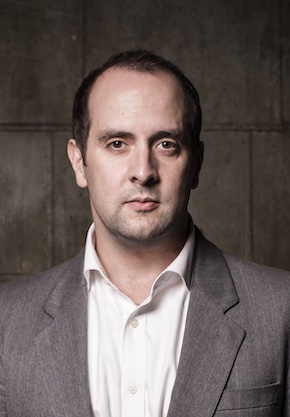
Tarik O’Regan. Photo by Peter Greig
And to conclude three pieces by Tarik O’Regan. Turn is an interesting piece. It deals with impermanence and while it’s basically fairly straightforward there’s a somewhat disconcerting fluttery quality to the music that really does get that across. I listen to the stillness of you sets a text by D.H. Lawrence. It’s a deceptively simple, slow and lyrical piece but it is redolent of “stillness”. Finally, the piece I was most intrigued to hear; The Spring. This tells a story from the Tales of the Elders of Ireland. Two ancient warriors; survivors of the destruction of the Fian, keep interrupting Saint Patrick’s evangelism with tales of the old days. What should he do? His guardian angels counsel him to record the old stories as “the hearing of them will provide entertainment for the lords and commons of later times”. Cultural memory is not to be erased in the pursuit of theological purity (so take that Taliban). Musically, it tells the story over a series of droning or chirping effects but with, I think, a proper focus on text.
So, such a varied concert that showed just how many different musical effects a handful of unaccompanied voices can produce and so many ways that composers can exploit that. Of course, none of this would be possible without a ridiculously skilful choir and the Vancouver Chamber Choir and their musical director Kari Turunen are most certainly that.
 operaramblings