
Productions on the lake stage at Bregenz are usually spectacular but rarely stray very far from the traditional/canonical. The production of Weber’s Der Freischütz, directed by Philipp Stölzl and recorded in 2023 is quite radical though. I think there are three main elements to this quite ambitious reworking. One is to give Samiel a much enhanced role. Here he is both MC and puppetmaster; controlling the action, including playing with time, and addressing the audience directly. The second element is to emphasize that this is taking place in the aftermath of the Thirty Year War and, to add to the misery of that, the village has suffered severe flooding. This sets up a duality between Agathe as the one who still, despite everything, trusts in God and Ännchen who believes God has forsaken them. This tension serves to make the two girls perhaps the most important figures, after Samiel, in the piece.
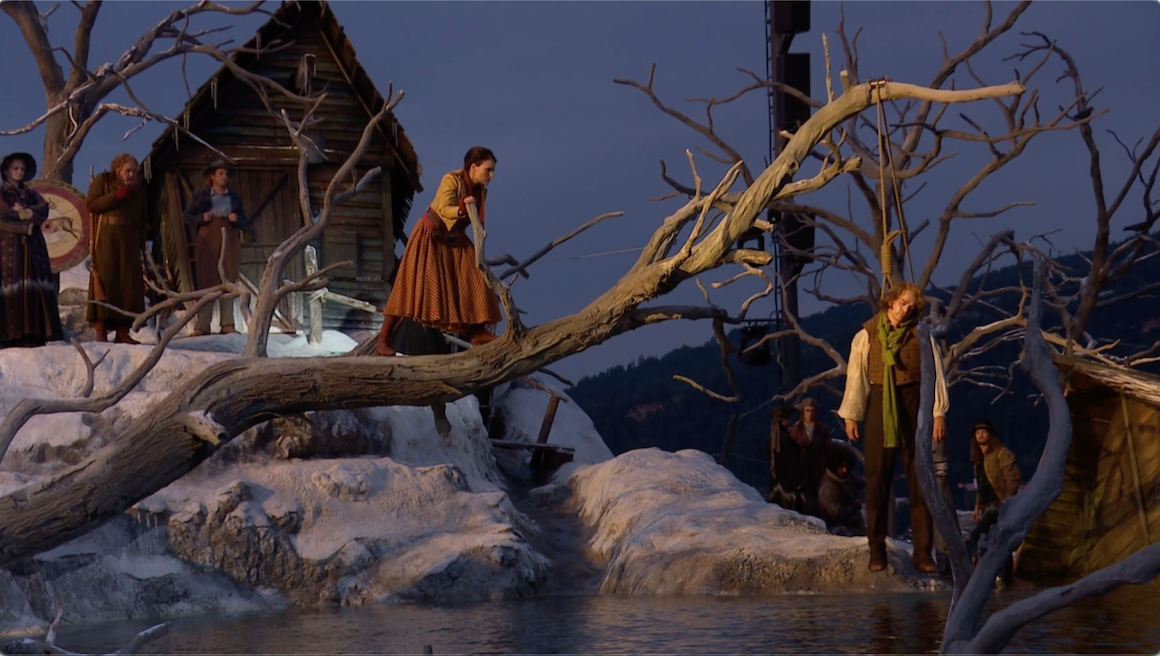
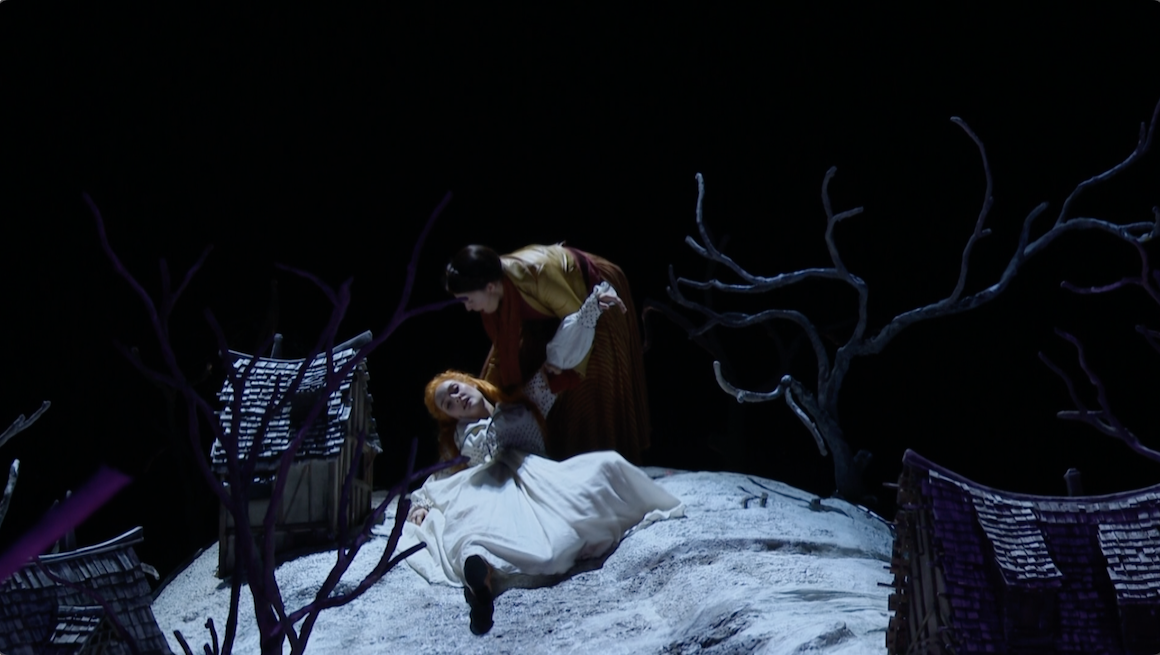
We first get the sense of what’s coming in a prologue in which Agathe, prominent bullet wound on her breast, is being carried to her grave. The villagers hang Max from a tree and the priest reveals himself as Samiel. Informing us that if we start here there’s no play to see, he turns the village clock back and the overture starts.

It’s obvious from the start that Max doesn’t know one end of a musket from the other and has no chance of passing the shooting test. There’s lots of clowning around about who will actually get to marry Agathe but Act 1 is fairly straightforward. Things start to liven up in Act 2. Everyone is very drunk and Samiel orchestrates a very glittery watery ballet as the girls wait for Max to appear. Agathe sings a really lovely “Leise, leise, fromme Weise”.
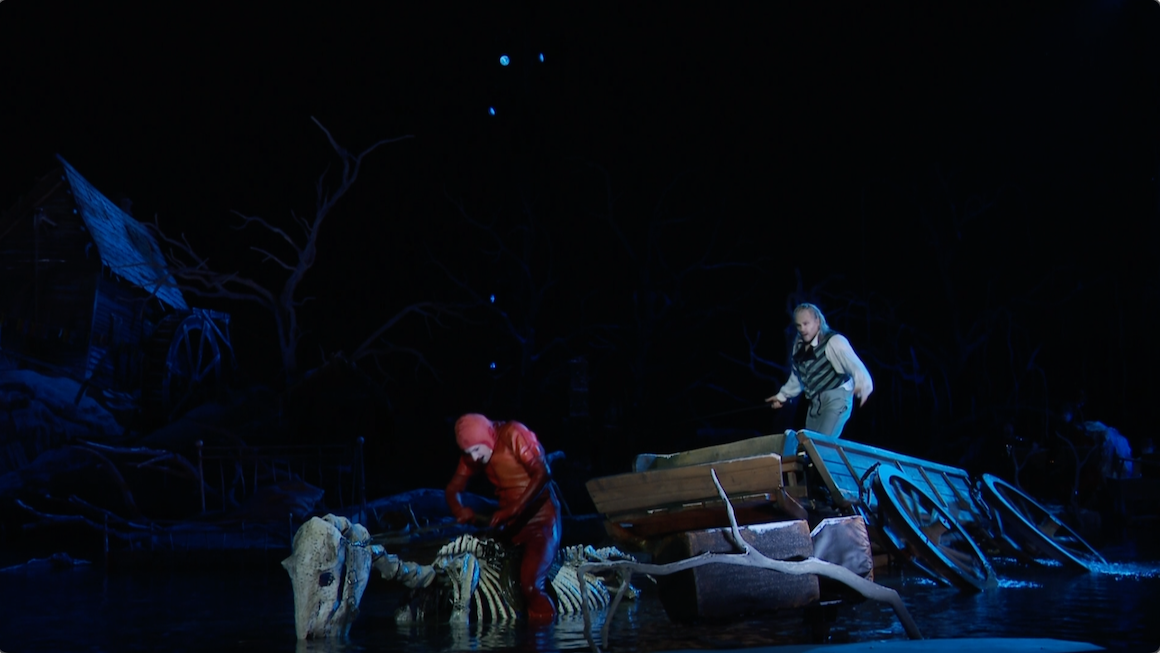
Max shows up but he’s made his deal with Kaspar and must head for the Wolf’s Glen. This is spectacular with a swamp full of ghosts, a fire-breathing dragon, the ghost of Max’s mother in her coffin and a spectral Agathe. The Wild Hunt appears as a cartload of skeletons drawn by a skeletal horse ridden by Samiel. I think there’s more than a bit of the old German folkloric idea that during the horrors of the Thirty Years War the boundary between Hell and earth became permeable. Kaspar casts the magic bullets knee deep in water in a circle of fire. It’s all quite spectacular but very dark. It works OK on Blu-ray but I wouldn’t chance DVD.

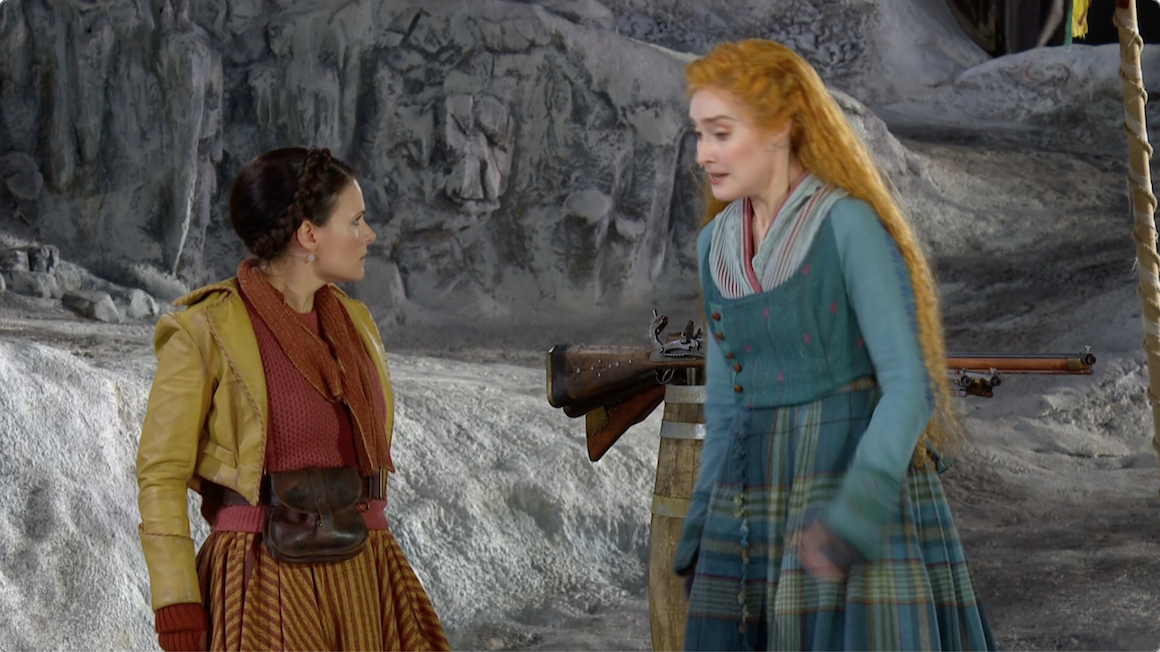
Act 3 begins with dialogue between the two girls. Ännchen wants Agathe to flee the village with her on the grounds that God, if he exists, has forsaken it. Agathe reaffirms her faith; “Und ob die Wolke sie verhülle” but reveals to Ännchen that she is pregnant so must marry Max before it shows.
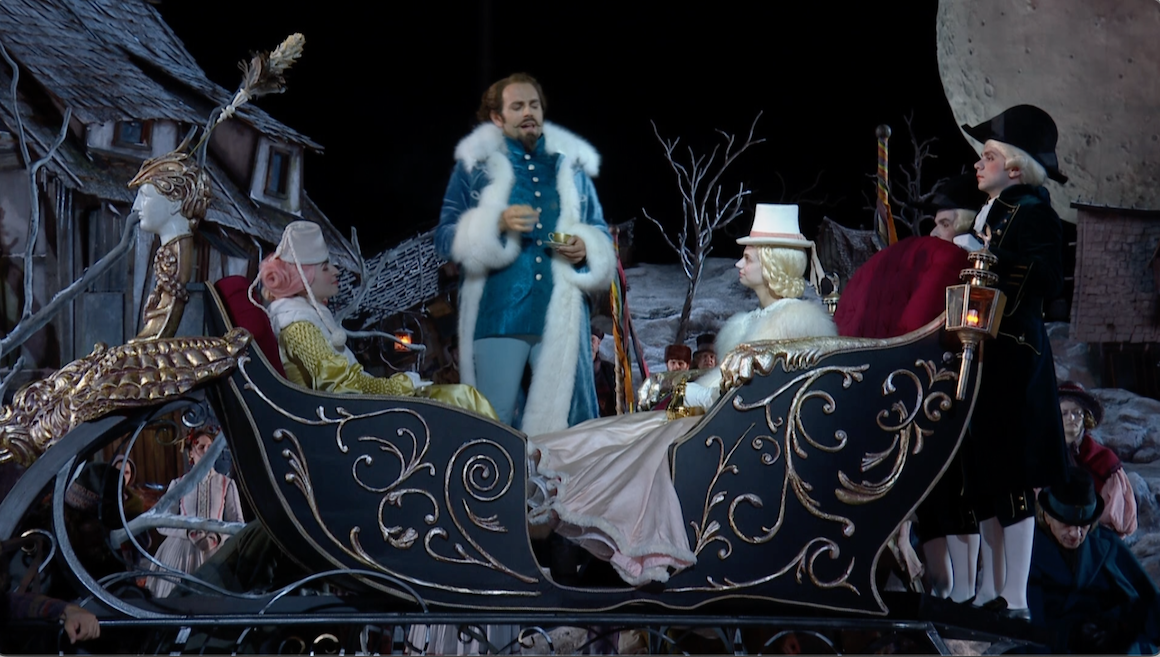
Max returns having shot six deer in one night courtesy of the magic bullets and is in high spirits. Ottokar shows up and sets Max an impossible target. Max begs the magic seventh bullet from Kaspar but that one belongs to Samiel and when Max tries to shoot the target bird he hits Agathe and kills her. The villagers are horrified and we reprise the prologue hanging of Max.

But Samiel intervenes. He addresses the audience directly with a tongue in cheek speech about drama and art. Perhaps all this realism is too much for husbands who have been dragged reluctantly to the opera and were hoping for some entertainment? Well lucky them because he has an alternative happy/kitschy ending. The traditional final scene follows with the death of Kaspar and Max’s banishment; reprieved by the intervention of the Holy Hermit. A year from now Max may marry Agathe (and in the meantime…). All rejoice until the hermit is revealed as Samiel, who, literally, has the last laugh.

The reworking is very clever. It gets around the excessive sentimentality of the original and, while often being very funny, much more effectively evokes the horrors of the Thirty Years War than the original. Of course it’s much easier to do this with spoken dialogue than recits as Tobias Kratzer also showed in his Covent Garden Fidelio.

Musically it’s really good. Mauro Peter as Max, who has a fine, quite powerful lyric tenor, and Nikola Hillebrand as Agathe, who has a lovely, rich soprano are the standouts. Both make the most of their big arias. Katharina Ruckgaber as Ännchen makes a really important contribution too. She’s a most effective foil to Hillebrand, vocally and dramatically. The supporting roles are well done with some especially fine singing from Liviu Holender as Ottokar and Andreas Wolf as the Hermit. Then, of course, there’s Moritz von Treuenfels as Samiel. He’s wicked and really holds this thing together with terrific acting. Bearing in mind that half the time the cast is at least partially in the water it’s all pretty good going.

The orchestra is the Wiener Symphoniker and they sound great, as does the Prague Philharmonic Choir. Enrique Mazzola somehow manages to pull it all together despite the huge logistical problems. I think a nod is also due to the many swimming dancers and stunt people who make a big contribution.
Henning Kasten directs for video. This is a brute to film. The lake stage is always tough but this doesn’t have the obvious vertical features of the old stage (see below). It’s all fairly flat and rather dark so if we get a few shots that don’t seem to convey a lot of information that’s probably a sensible attempt to simulate the live audience experience. Despite all the complexities the sound (PCM and DTS-HD-MA) is really good with a real spatial dimension to it. The picture too is good enough if, occasionally, only just. Subtitle options are German, English, Japanese and Korean. The booklet has a synopsis and an essay as well as track listing but the bonus feature is probably more informative.
The bonus feature is interesting. Besides some thoughts on the production it chronicles the complete rebuilding of the lake stage and its infrastructure. After Madama Butterfly closed in 2022 everything was ripped out and replaced. Not just the stage area but six stories worth of concrete underwater with all the dressing rooms, washrooms, canteen etc. As well as the sound (80 speakers!) and lighting infrastructure. Plus, of course, building the new set. This was done in nine months or so. I invite my Ontario readers to speculate on how many years (decades?) it would have taken Metrolinx.

Bottom line, this is a unique take on Der Freischütz. The musical values are high. It’s as spectacular as a Bregenz lake production should be. And to my mind it’s an intelligent and thought provoking take on an opera that, played straight, can seem very dated and kitschy.

Catalogue information: Unitel Blu-ray 768404
 operaramblings