
I attended the third and final performance of Aportia Chryptych: A Black Opera for Portia White by HAUI x Sean Hayes at the Canadian Opera Company Theatre on Sunday afternoon. It’s a very ambitious piece which has some really excellent ideas and scenes but perhaps bites off a bit more than it can chew.
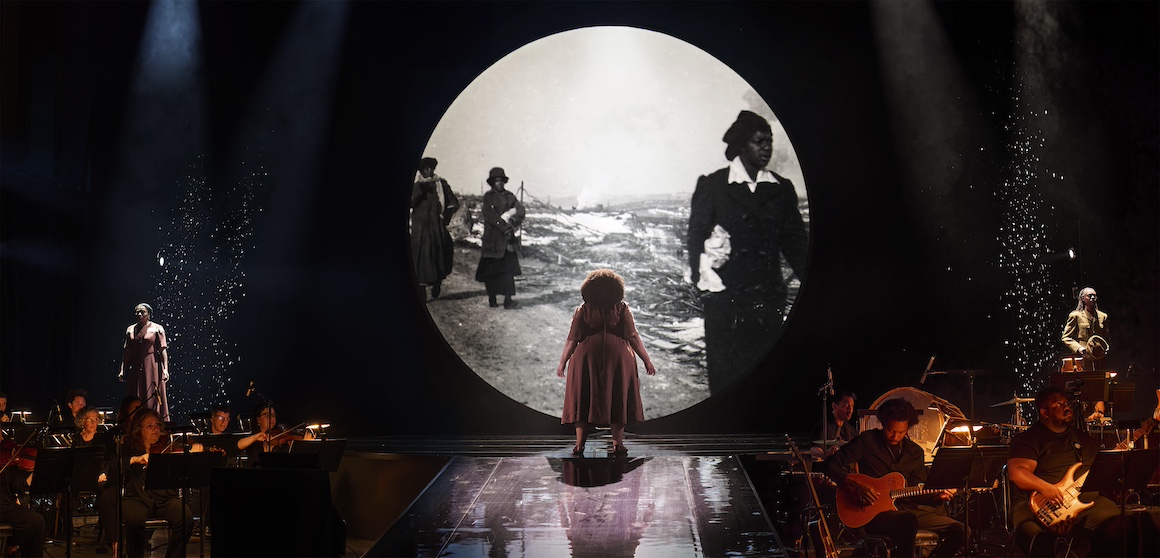 It’s not an opera in the conventional sense. It’s a loosely linked series of vignettes drawn from the life (and imagined afterlife) of Nova Scotian born contralto Portia White. (I will come back and amplify that comment but first I want to talk about some other aspects of the piece.). Musically it;’s not conventionally operatic either. It uses a lot of spoken dialogue and several different styles of singing; “classical”. soul, gospel etc. The singers are miked and pre-recorded sounds; e.g. Portia’s own voice, are mixed in. There’s a conventional chamber orchestra plus electric guitars, drum kit and some other stuff. It actually works really well and creates a more compelling sound world than anything else I’ve heard in the generally pretty horrible acoustic of the COC Theatre. Kudos here to sound designer Wayne Hawthorne as well as the composer.
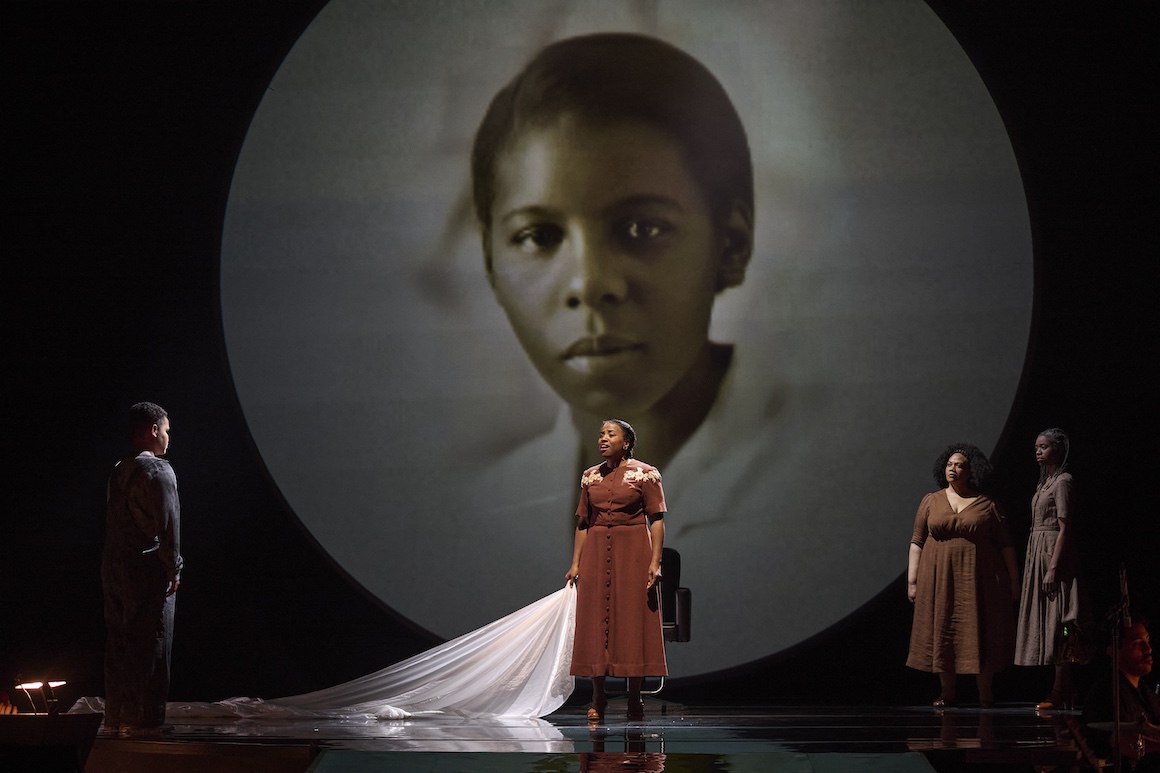
The music itself is a mixed bag. I wasn’t entirely sure whether Sean Mayes’ aim was to write something that stood on it’s own or something that was more of a “soundtrack” for the scenes. It’s certainly more effective as the latter when, for example, evoking a CBC dance band in the 1920s/30s. There’s also a lot of music niot written by Mayes mixed in; opera arias, gospel songs etc, though rarely “straight”. There’s usually something in the arrangement to invoke a slightly different mood. All in all, I thought the score served the project pretty well but anyone expecting a “modern opera score” along the lines of, say, George Benjamin or Hans Andriessen, will need to recalibrate.

Visually it’s stunning. Costuming (Diséiye Thompson), for the most part is effective and sometimes playfully hilarious. The lighting (Bonnie Beecher) and projections (Laura Warren) are better than effective. Overall the use of the space and the visuals are top notch. And, praise be, there are surtitles. It’s the first time I’ve seen them used in this space where they are most definitely needed!
So how well does it work dramatically? I think it’s a bit hit and miss. It’s largely made up of a series of vignettes featuring Portia White but it goes off on some odd tangents too. It uses these vignettes to comment on various aspects of Black history/experience in Canada and the USA; some of which go way beyond Portia’s story. We meet Rosa Parks and Marian Anderson and Queen Elizabeth II, among others, and MLK gets a mention. Portia’s father’s experience in WW1 is discussed but not the fact that he was a commissioned officer (there’s a projected photo of him in officers’ service dress with captain’s badges) which I found ninteresting as I had no idea there were Black officers in the Canadian army in WW1. We shift from society concerts in Toronto, to wartime shipyard work in Vancouver to racism in post war New York to a royal command performance in PEI. There are even passing references to the Stonewall riots and the war in Rwanda. Portia’s son; given up for adoption, gets a look in. Some of these scenes are individually very effective (though it’s not always obvious who is playing who!) but I’m not convinced they hang together well. Neema Bickersteth is credited as dramaturg but she is also (see below) a cast member. I do wonder whether a sympathetic but less involved dramaturg might have tightened things up a bit.
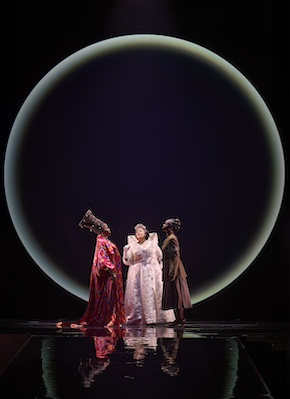 The performances though are excellent. There are two contrasting classical voices in the very dramatic Adrienne Danrich and the more lyrical Neema Bickersteth plus the jazz/soul/gospel sound of SATE. There’s even a cameo for boy soprano Henos Girma. All four sing and act extremely well. They are required to sing in a variety of styles and switch rapidly from character to character which they do with aplomb. The orchestra too is excellent with some especially notable not-at-all-operatic playing from the brass.
All in all this is a pretty good show though it’s stretching the term to describe it as an “opera”. It succeeds in “resurrecting” Portia White as an important figure in the history of Canadian music and raises a lot of trenchant issues about race then and now. I do feel though that it rambles a bit and that there’s an even better show buried in there trying to get out.
Photo credit: Michael Cooper
 operaramblings
As an audience member deeply moved by Aportia Chryptych, I find this review both intriguing and, in some respects, limited in its perspective. While the work is described as ambitious and visually stunning, the critique underplays its innovative reimagining of operatic norms and its profound engagement with Black history. The statement that it’s “not an opera in the conventional sense” raises a key question: by whose standard? Portia White herself defied convention, and this production embodies that spirit by fusing classical traditions with gospel, jazz, and contemporary influences. The use of surtitles, pre-recorded elements, and eclectic instrumentation reflects a deliberate effort to make the opera accessible and relevant, particularly in spaces where traditional opera can feel alienating or exclusionary. The vignettes are rightly noted as a mosaic of Portia White’s life and legacy, extending into broader narratives of Black history. Yet dismissing these as “odd tangents” misses the point: Portia White’s story cannot be disentangled from the systemic forces and cultural touchstones that shaped her time. From her father’s service in WWI to nods at figures like Rosa Parks and MLK, the opera situates White’s struggles and triumphs within a larger tapestry of resistance, resilience, and creativity. The review also reflects a self-acknowledged gap in understanding Black history, such as the mention of Black officers in WWI. This underscores a broader issue: how can one fully critique a work so steeped in Black cultural narratives without a foundational grasp of its historical and social contexts? The opera’s complexity—and its refusal to fit neatly into traditional categories—should be seen not as a flaw but as a testament to its richness and depth. If anything, Aportia Chryptych challenges us to rethink what opera can be and who it is for. As Black artists continue to redefine artistic spaces, it’s vital for critics to engage with these works not only on their own terms but also with an openness to learning and growing. The production succeeded in its mission: resurrecting Portia White’s legacy while inviting audiences into a vibrant, multifaceted world that defies convention. Ultimately, Aportia Chryptych reminds us that art should not only be evaluated by its adherence to tradition but also by its power to inspire, disrupt, and expand our understanding of what is possible.
You make some very good points and, of course, opininions about whether a piece “works” or not will differ. I did want to engage with a couple of points though.
>>The statement that it’s “not an opera in the conventional sense” raises a key question: by whose standard?
I think it can be taken as read as that the standard here is the mythical “typical opera goer”. Why? Because that’s my audience for the most part. So what I’m saying is not that AC is bad or flawed in some way but that one needs to engage with it in a different way than with, say, The Magic Flute.
As to “imperfect understanding”. It’s a fair point but it rather ignores the reality of reviewing. One rarely has perfect understanding of the context of a piece and with new work one is usually reviewing under time pressure and based on one viewing. Not ideal perhaps but most of the audience doesn’t have that perfect understanding either. That to me raises a very difficult question of to what extent the creators should (or at least would be wise to) take that into account. It’s fine to challenge. I would be the last person to say otherwise but if one pushes the boundaries of an artform, especially in the context of a production mounted by an organisation like the COC, one must expect to be misunderstood at least some of the time.
Thank you for your thoughtful reply and for engaging with my points. I’d like to respond once more, specifically to the idea of “by whose standard?” You mention the mythical “typical opera goer,” and I think it’s important to unpack what that often implies—namely, white, privileged audiences accustomed to traditional repertoire and conventional storytelling. In many ways, Aportia Chryptych challenges not just operatic norms but also the cultural expectations that have historically shaped them.
What HAUI™ was able to achieve, especially within an institution like the COC, was nothing short of subversive. By centering Black history, blending classical traditions with gospel and jazz, and presenting a work that refuses to fit neatly into predefined categories, this production expands what opera can be and, importantly, who it is for. This is not just innovative—it’s essential. Embracing new forms like this is what the artform needs to remain vibrant and relevant, especially as audiences evolve and diversify. As one of the few Black audience members who attends this artform, I feel that the work speaks directly to an underserved demographic, which is vital for the future of opera.
I also understand the constraints of reviewing, especially with new work. However, the risks this team took with this piece are precisely what make it so compelling, even if it challenges critics and audiences to step outside their comfort zones. For me, that challenge isn’t a flaw but a strength—a reminder that opera can still provoke, disrupt, and inspire.
Thank you again for the dialogue. It’s this kind of exchange that highlights the evolving potential of the artform and the critical role we all play in shaping its future.
>>You mention the mythical “typical opera goer,” and I think it’s important to unpack what that often implies—namely, white, privileged audiences accustomed to traditional repertoire and conventional storytelling
Yes. But opera companies like the COC tend to cater (pander?) to this idea of the audience so the expectations of people who don’t fit it particularly well are also shaped by that stereotype. That’s not a good thing but I think it’s reality.
>>For me, that challenge isn’t a flaw but a strength—a reminder that opera can still provoke, disrupt, and inspire.
Amen to that!