
Le siège de Corinthe is a 1826 reworking, for Opéra de Paris, of Rossini’s earlier Maometto II so besides, of course, being in French it is restructured as a three act tragédie lyrique with a substantial ballet in Act 2. The plot is straightforward enough. It’s the mid fifteenth century. Mahomet II is besieging Corinth but unknown to him the king, Cléomène’s, daughter Palmyra is the girl he fell in love with during an incognito trip to Athens. Cléone has promised Palmyra to his top warrior Néoclès. After Corinth falls Mahomet promises clemency to the Greeks as long as Palmyra marries him. She agrees and is cursed as a traitor by her father. The marriage doesn’t happen for various reasons and Palmyra flees to the camp of the once again revolting Greeks. When they are defeated for a second time she commits suicide rather than submitting to Mahomet.

The opera is very much mixed up with Western ideas of the then contemporary Greek revolt against the Ottomans, especially as portrayed in the West by Lord Byron and particularly his poem The Siege of Corinth of 1816. The idea that the Greeks in the early 19th century were, or saw themselves as, the literal and spiritual descendants of the men who fought at Marathon and Thermopylae is, of course, nonsense but it fitted nicely with 19th century ideas of Western culture and its debt to Greece and Rome. As someone educated at an English Public School in the 1970s I can relate to that easily enough!
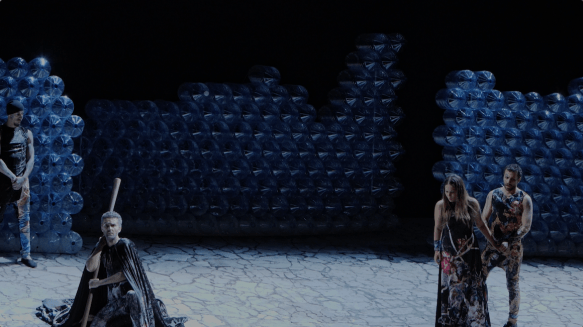
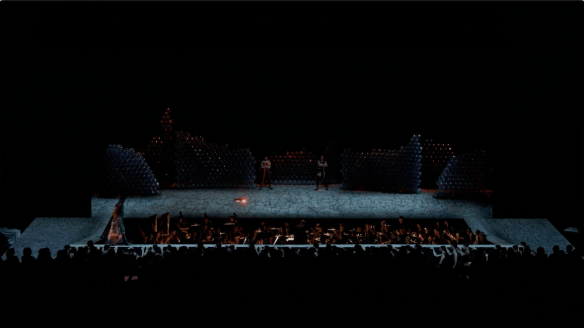
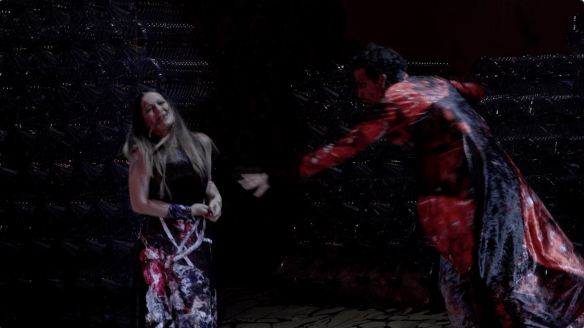
The production at the Rossini Opera Festival at Pesaro in 2017 was staged by Carlus Padrissa of La Fura del Baus in the Vitrifigo Arena which is an indoor sports stadium that holds over 10,000 when used for opera and which has a huge stage area. For reasons I can’t explain the set is built almost entirely out of those big plastic bottles that fit on water coolers. Much use is also made of them as water containers; to pour water into holes or over characters as required. Much of the time the stage area is very dark and it’s huge and wraps around the orchestra with much action in front of the pit. Some pretty cool projections do brighten things up though.
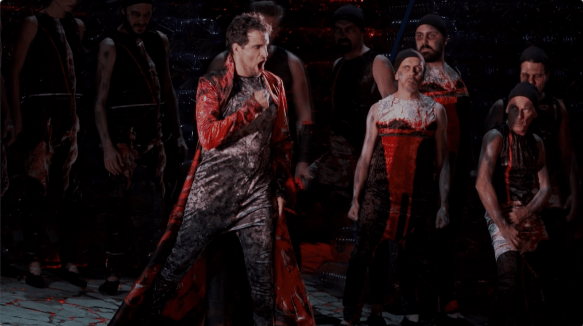
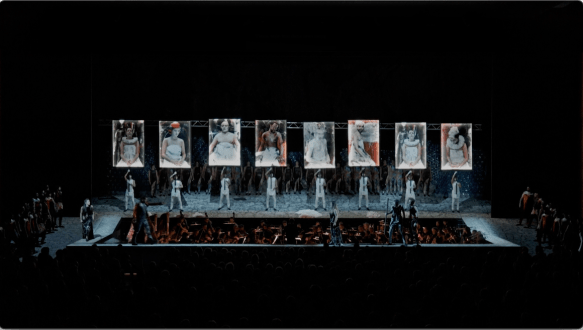
During the overture and at various later points Byron’s poem (in Italian) is projected (presumably where the surtitles are when someone is singing). There’s some business with banners which start off with slogans but change to portraits; of whom I do not know. The ballet is a missed opportunity. There’s sixteen minutes of ballet music that deserve more than some Byron text, some moping about and a weird fight about (inevitably) a water bottle. In the last act a big pile of something appears. What it is or what it represents I don’t know! Other than that it’s actually pretty straightforward. The visuals may be a bit odd (though spectacular at times) but the story telling is entirely as written.
Musically this is a great advert for later, serious Rossini. Anyone who thinks the man could only write fluffy comedies should see this (or Guillaume Tell). It’s another reminder of what might have been if Rossini hadn’t retired so prematurely. The Pesaro cast is excellent and does it full justice. Mahomet is Luca Pisaroni who is probably unrivalled in the field of genuine coloratura basses. Here he combines his trademark blend of power and agility with a really quite grim portrait of his character. Soprano Nino Machaidze as Palmyra is equally excellent. This is one of those roles (like Matilde in Guillaume Tell or some of the slightly later Paris rep) that require a soprano who has pinpoint coloratura and considerable dramatic power. She absolutely has that and adds some interesting dark colours that one imagines Rossini would find most agreeable. They also sound fabulous together in their big Act 2 duet.
Cléomène (John Irvin) and Néoclès (Sergey Romanovsky) are typical of Rossini’s Paris tenor roles. Again real dramatic heft is called for as well as serious high notes. Both gentlemen sound truly heroic. There’s a rather good cameo and some more proper bass singing from Carlo Cigni as the priest Hiéros and a charming though brief appearance by the excellent mezzo-soprano Cecilia Molinari as Ismène. The chorus is huge and is supplied by the Coro del Teatro Ventidio Basso. They sing very well and I think the ones who appear upside down in holes on the stage deserve some kind of award. The orchestra; the Orchestra Sinfonica Nazionale della RAI, is also very good as is conductor Roberto Abbado. He co-ordinates a show that could easily get quite chaotic very well and produces some really exciting moments especially in the big ensembles like the Act 2 finale.
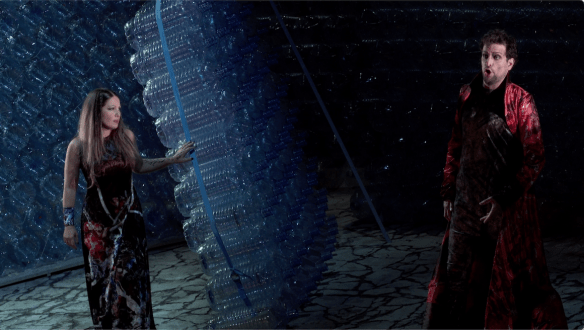
This must have been a nightmare to film and I think Paolo Filippo Berti does a decent job. I strongly suspect he’s boosting the light levels in the closeups because some of the long shots are really murky. They really push the boundaries of video on Blu-ray. The PCM stereo and DTS-HD-MA sound tracks are fine though. The documentation is pretty basic; track listing, very brief synopsis and a very short introduction are all we get. Subtitle options are Italian, English, French, German, Korean and Japanese.
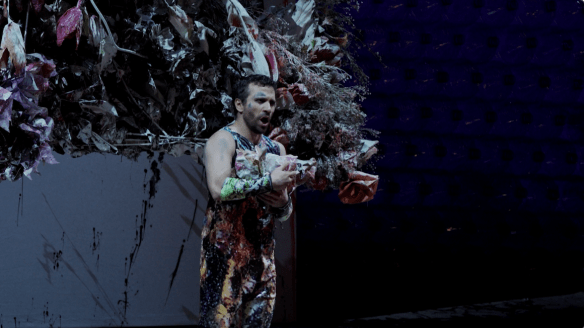
This is the only video recording of this work and even if the staging doesn’t come over perfectly on video it’s still interesting and musically it’s very fine.
Catalogue information: C Major Blu-ray 765904
 operaramblings