
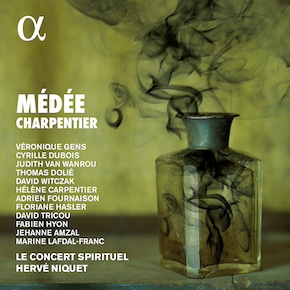
 Cherubini’s Médée of 1797 is undergoing something of a revival at the moment albeit in an Italian version. But there’s an earlier and less known version of the same story with a libretto by (as opposed to based on) Corneille. It’s Charpentier’s Médée of 1693. It’s a tragédie lyrique with all the expected elements; an allegorical prologue in praise of Louis XIV, a classical subject, five acts, gods, spirits and demons and lots of spectacular theatrical effects. The Lully formula in fact.
It’s recently been given what might be called the “Bru Zane treatment” though in fact most of the scholarship and reconstruction hails from the Centre Musique Baroque de Versailles. The result is similar; a performing edition and a recording as close to what might have been heard in 1693 as possible. It’s on the Alpha label so it doesn’t get the fancy Bru Zane packaging but there’s a perfectly respectable booklet with useful information, a synopsis and text and translation.
The opera itself deals with Medea’s time in Corinth. Corinth is threatened by war and Creon, the king, has enlisted the help of Jason and Orontes; both of whom think they are going to marry Creon’s daughter Creusa. Jason is Creon’s choice and to facilitate the match he sentences Medea to exile. Medea is not pleased and threatens Creon that if Creusa doesn’t marry Orontes chaos will follow. There’s no deal and it does. Medea sends Creon mad. In his madness he kills Orontes then himself. Medea presents Creusa with a poisoned robe so that Jason can watch her die horribly; which she does. To further spite Jason, Medea kills their kids then rides off on a dragon leaving Corinth in flames. Along the way there are spells, demons, spirits and what not. It does start a bit slow, not helped by the usual slightly nauseating prologue, but it gets tenser, more dramatic and more spectacular as the opera proper progresses.
Musically it’s very much of its time. There’s a lot of accompanied recitative with a few duets and airs for relief plus a lot of ballet music. It’s an interesting libretto. Corneille uses a wide range of verse forms and some pretty involved rhyming schemes. It’s definitely not three hours of Alexandrines.
The band and chorus are Le Concert Spirituel. There’s a continuo section of viola da gamba, bass violin, theorbo and harpsichord and a fairly large string section plus oboes, flutes, bassoon, trumpet and percussion. The chorus is twenty five strong. Hervé Niquet conducts and generally takes things pretty fast which seems to be the current thinking about pretty much all French works before, roughly, the 1830s. I think it makes sense musically and dramatically.
There’s a first class line up of francophone soloists with a lot of baroque training and expertise. Véronique Gens sings Medea and she can vary her weight of delivery nicely as the drama demands. She’s very stylish and just a tad weightier than the other sopranos without sounding at all out of period. This allows for some contrast, especially with Judith Van Wanroij’s light, bright Creusa. Jason is sung by tenor Cyrille Dubois who has the proper haut contre style which, to my ear, never sounds as heroic as one might like for some of the characters cast that way. The Orontes of David Witczak and the Creon of Thomas Dolié sound much more heroic in a sinewy, masculine sort of baritone. The rest of the cast, playing a dizzying assortment of gods, shepherds, servants, guards, spirits, demons, captives and so on are all stylish and well up to the job.
The recording was made in 2023 at Cité de la Musique et de la Danse de Soissons and it’s extremely clear and well balanced. I suspect that more could have been done in the way of sound effects but clearly they decided not to. The three CD package will be released on January 12th 2024 in physical CD, MP3 and FLAC; CD quality and 96kHz/24 bit. I listened to CD quality digital.
This release is both scholarly and musically enjoyable. I do think though that a staged production would be a lot more fun. There’s lots to work with for sure.
Catalogue information: Alpha Records ALPHA1020
 operaramblings