
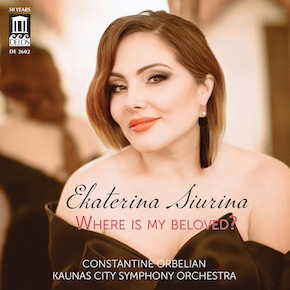
 I first came across Russian soprano Ekaterina Siurina as Zerlina in the 2008 video recording of Mozart’s Don Giovanni from Salzburg. She had had plenty of success already in coloratura roles such as Gilda and Adina and was, I thought, the best Zerlina I had come across. Fast forward to 2015 and she sang a very fine Violetta at the Four Seasons Centre opposite her husband Charles Castronovo. A few years on and it’s not terribly surprising that she’s starting to venture into slightly heavier lyric-dramatic territory. This is reflected in her recent album Where is My Beloved? recorded in 2022 with the Kaunas Symphony Orchestra conducted by Constantin Orbelian.
The album starts off with a very nice account of “The Song to the Moon” from Rusalka followed by four arias from Puccini operas. By this point it’s pretty clear what we are getting. The voice is bigger and more dramatic than formerly with a bit of steel in the upper register. She is still a terrific vocal actress as her versions of “Un bel di” and “Tu? Tu? Piccolo dio” from Madama Butterfly demonstrate. She can also float a mean high pianissimo as shown by “Senza Mamma” which has a ravishing finish. She also shows she has excellent Italian diction.
I think though I still prefer her in slightly earlier Italian repertory. She sings a nice, lyrical “Io son l’umile ancella” from Adriana Lecouvreur where she shows interesting colours in the middle register and a sweeter top in “L’attra notte in fondo al mare” from Boito’s Mefistofele. This track also demonstrates that she’s still got very decent coloratura. There’s more of the same in Amelia’s “Come in quest’ora bruna” from Simon Boccanegra.
The final two tracks are in her native Russian. There’s a straightforwardly enjoyable account of “Iolanta’s Arioso” from the Tchaikovsky opera before a rather interesting version of “Tatiana’s Letter Scene” from Eugene Onegin. Here she manages to lighten up her voice to sound convincingly younger as well as doing some excellent vocal acting.
Orchestral accompaniment is idiomatic enough although there are a few weird cuts in the orchestral sections which seems odd on a disc that lasts but 52 minutes. The recording made at the Kaunas Philharmonic is clean and naturally balanced. The booklet gives full texts and English translations as well as enough narrative to put each aria in context.
The record is available as a physical CD, MP3 and CD quality and 96kHz/24 bit FLAC. I listened to the hi-res version.
Catalogue number: Delos DE3602
 operaramblings