
So here goes with a video recording of one of those 19th century Paris operas that nowadays, if they get done at all, tend to get done in an inferior Italian version. We are talking Donizetti’s 1840 opera La favorite written for l’Opéra de Paris. The recording is of a production given at the Teatro Donizetti in Bergamo in 2022 and it’s clear that both director and conductor have gone to some lengths to get as close to the spirit of the work as possible. I think by and large they succeed.
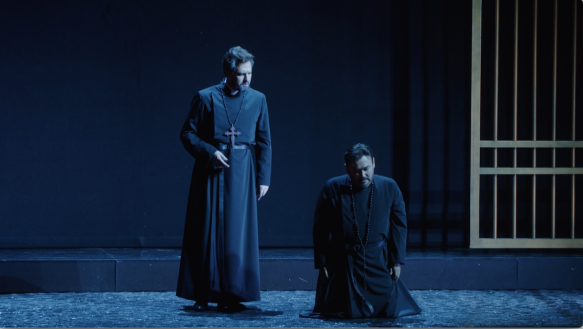
It’s a very interesting, if flawed, work. Musically it’s more ambitious than most Donizetti, especially in the orchestral writing and it provides the sort of show case arias that were obligatory for the excellent singers available in Paris at this time. The problem is the plot. (OK so which Donizettii opera is that not a problem?)

Ostensibly we are in 14th century Spain. Alphonse (the historical Alfonso XI of Castile) has a mistress Leonor (the real Leonora de Guzman). Fernad is about to take his vows at the monastery of St. James in Compostela but has fallen in love with Leonor. He leaves the monastery to pursue her. They meet on a sort of pleasure island where he realises that she is a great lady well beyond the ambitions of an unknown. So he goes off and defeats the Moors. Meanwhile the pope and his sidekick, the abbot of St. James Balthazar are threatening Alpnse with anathema if he doesn’t discard Leonor.
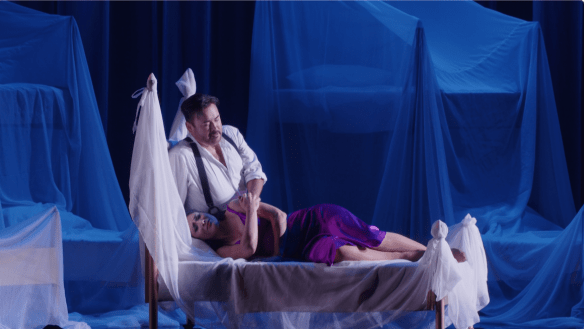
At this point he discovers that leonor is secretly in love with Fernand so when the hero shows up he offers him anything he wants as a reward and he, unaware (unlike the entire population of the Iberian peninsula) that she iis Alphonse’s mistress asks for Leonor’s hand. The king, gleefully twirling his moustaches agrees as this will revenge him on the two lovers (because Fernand will de “disgraced” by marrying “soiled gods”) and he’ll get the pope and Balthazar off his back.

Leonor tries to tell Fernand what she really is by sending a message via her lady in waiting but she is arrested. So the marriage goes ahead with Leonor thinking Fernand knows and has forgiven her and him entirely ignorant of the circumstances. When he finds out he has a hissy fit and denounces the king, renounces his titles and honours and heads back to St. James. Just after he has made his final vows Leonor shows up disguised as a young novice. They recognise each other and are reconciled. Fernand wants to break his vows and run off with Leonor but she prevents this by conveniently dying in his arms.

So here’s the problem. The moral calculus here doesn’t make sense in 14th century Spain or at almost any other time other, perhaps, than the mid 19th century and then only in the minds of the bourgeois and, maybe, Queen Victoria. Kings had mistresses and nobody fussed about it and a used one, if she was still young, pretty and of a good family was not to be despised as a bride (I initially typed “bribe” which was surely Freudian) especially if she came with a dowry of royal good will. Even in the 19th century the idea that the maitresse en titre would be shunned by the court is absurd. It still is. After all one doesn’t have to look very far for an example of a king marrying his mistress. FWIW being open about royal mistresses is what caused the Italian version, La favorita, to be censored to the point of incomprehensibility. But that’s the opera so we just have to go with it.
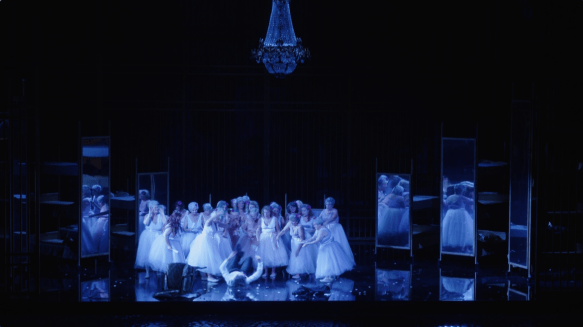
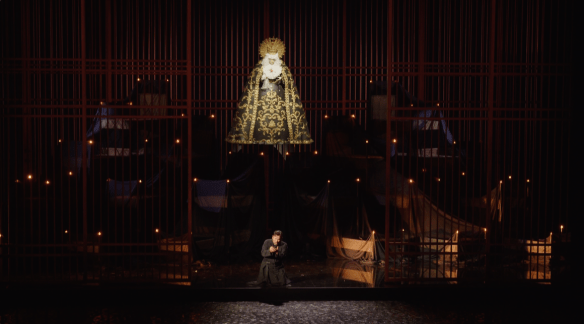
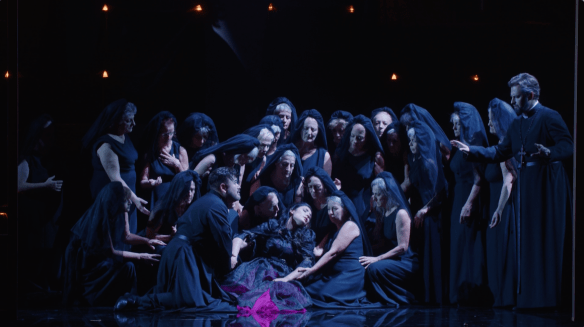
In this production (directed by Valentina Carrasco) the setting is clearly not 14th century Spain. It could be most any time between the 1840s and now. It doesn’t really solve the problem but in other ways it’s quite a clever and thoughtful approach. The one major “intervention” comes in the obligatory Act 2 ballet. Instead of being the en pointe divertissement that 1840 paris would have expected it’s made to move the action forward. Philosophically it’s a bit like the approach taken in the Royal Opera House’s Guillaume Tell. Here the dancers are replaced by extras; ladies of a certain age from the town, who inhabit what is apparently a retirement home for discarded royal mistresses. They stage a kind of pageant into which Leonor is eventually drawn. It finishes with them being driven away by the scornful court. These ladies will ppear several times again as a sort of commentary on the stage action. It works rather well.
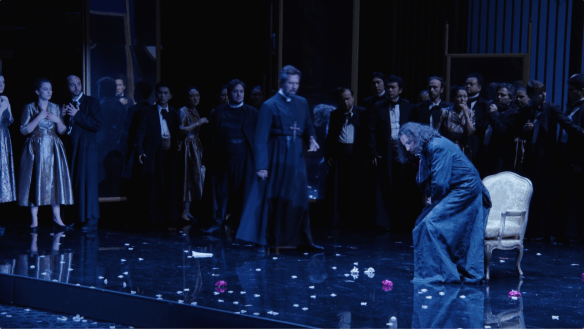
Another interesting thing about the production is the way Alphonse, played by Florian Sempey, is portrayed. It’s as if the king is playing the part of the king; which, I suppose, is largely what kings do but it’s quite striking here. Otherwise it’s fairly straightforward and carried by some really strong singing and decent acting. The lovers are played by Annalisa Stroppa and Javier Camarena. Both are pretty much ideal. Leonor is one of those parts spanning soprano and mezzo that back in the day was sung by the likes of Colbran, Malibran and, in Paris, Falcon. It requires power, precision and beauty of tome though this sn’t a coloratura fest like some such roles. Stroppa doesn’t disappoint. She’s vocally compelling, nails the big numbers and is a terrific actress. Sher’s also quite the looker. Camarena has the proper mid 19th century tenor with plenty of oomph and super high notes. When these two duet it’s very impressive. Sempey is a more than capable baritone and throw in Evgeny Stavinsky as a properly sepulchral bass as Balthazar and it’s all win.
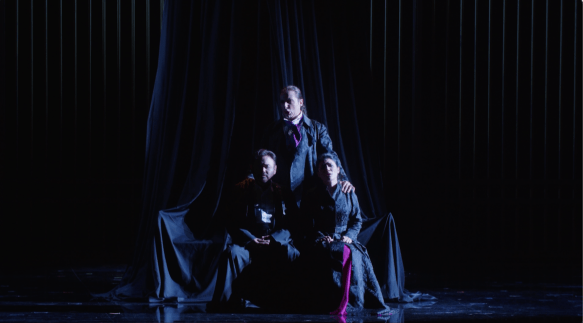
It’s a big chorus Paris again) so the combined forces of the Teatro Donizetti and Coro dell’Accademia Teatro alla Scala are used. They sing and act really well. The latter by no means always a feature of Italian houses. Conductor Riccardo Frizza seems totally into the style and gets excellent work from everyone and a more opulent sound than one might expect in Donizetti from the house orchestra.

Video direction, by Matteo Ricchetti, is judicious despite having to cope with some pretty dark stage pictures in Acts 3 and 4. The technical quality is pretty standard Blu-ray. There ae no extras but the booklet, besides synopsis and track listing, has a useful interview with the director and conductor. Subtitle options are Italian, French, English, German, Korean and Japanese.
I was really happy o discover La favorite through the medium of this recording. The French rep from the first half of the 19th century is largely either neglected or presented in inferior Italian reworkings. It’s good to see another Paris opera of this period presented properly and done so well.
Catalogue number: Dynamic Blu-Ray DYN-57992
 operaramblings