
Domenico Cimarosa’s 1794 Commedia per musica; Le astuzie femminili, is extremely silly. It’s like an early Rossini farsa but a full two acts running almost three hours. There’s a girl called Bellina, who bears a more than passing resemblance to Rossini’s Rosina. She has been left a fortune by her father contingent on her marrying a dude from Naples called Don Giampaolo Lasagna. But she is in love with the penniless Filandro. Worse, her guardian, the notary Don Romualdo also wants to marry her despite having promised to marry his housekeeper Leonora. There’s also Ersilla, a friend of Bellina, who doesn’t seem to be in love with anybody.
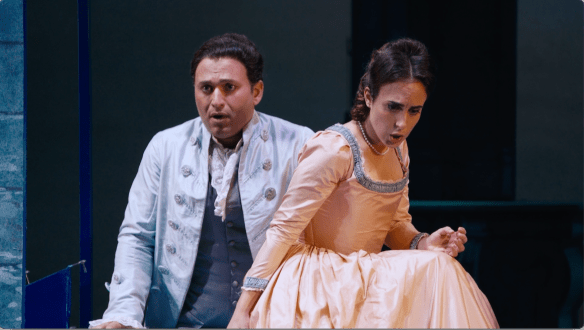
Various silly things happen culminating in Bellina and Filandro showing up separately disguised as hussars claiming that their hussar partner has been having an affair with Filandro and Bellina respectively; who the relevant “hussar” holds prisoner. By promising to release Filandro and Bellina they get the rest of the gang to go along with their wedding before revealing who they really are. Add to the general silliness that the hussars speak (sing) in a bizarre mixture of Italian, cod german and gobbledegook and you get the idea just how silly it is.
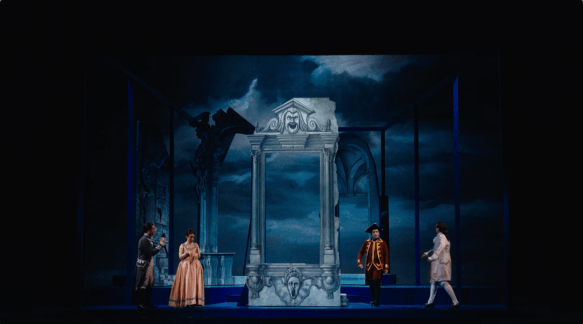
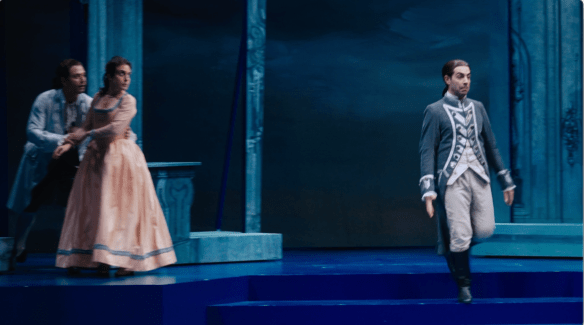
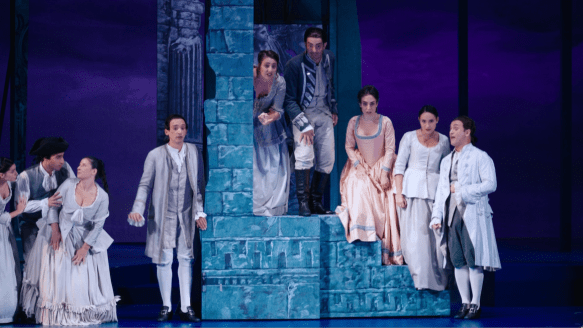
It was performed and recorded in the Teatro Flavio Vespasiano in Riete in 2022 as part of the Reate Festival, in a production directed by Cesare Scarton. Mercifully, given the complexities of the comings and goings, he goes for a simple 18th century costumed approach with essentially classical backdrops and props. He throws in a couple each of male and female extras but there’s no chorus so keeping the characters straight is pretty straightforward. The music itself is about what you might expect; somewhere between not terribly inspired Mozart and early Rossini but it’s pleasant enough.
The singing is pretty good. Bellina (Eleonora Bellucci) and Ersilla (Martina Licari) have pleasant, appropriately weighted lyric sopranos. Leonora (Angela Schisano) has a more mature mezzo, going on contralto, sound that makes a pleasant contrast. Filandro (Valentino Buzza) sounds like a proper Rossini tenor with just a hint of goatiness at the upper end. Don Giampaolo (Rocco Cavalluzzi) is a dark toned bass with a splendidly sardonic manner. Don Romualdo (Matteo Loi) is a rather pleasant, even toned, baritone. They all throw themselves into the acting part and the ensembles and it’s really quite fun.
The pit band is the Theresia Orchestra. It’s a youth orchestra dedicated to playing the music of the Classical period in a historically informed way on period instruments. They are really very good. Alessandro De Marchi conducts and keeps everything moving together with the ensembles being kept crisp and lively.
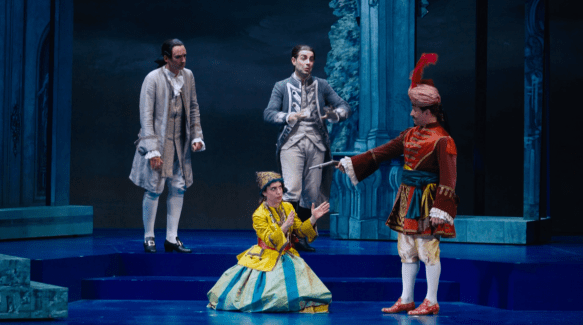
The stage is quite small so it doesn’t set many problems for video director Maxim Derevianko. Technical values are pretty standard Blu-ray. The picture is fine, despite some dark scenes. The surround (DTS-HD-MA) and stereo soundtracks are fine. The booklet contains an essay, a synopsis and a track listing. Subtitle options are Italian, English, French, German, Japanese and Korean. And, as far as I can tell this is the only recording in any format of this work in its original form, though there’s at least one CD of one of the 19th century “revisions”.
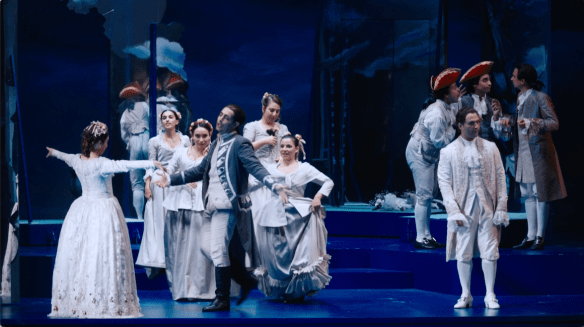
Catalogue number: Dynamic Blu-ray DYN-57989
 operaramblings